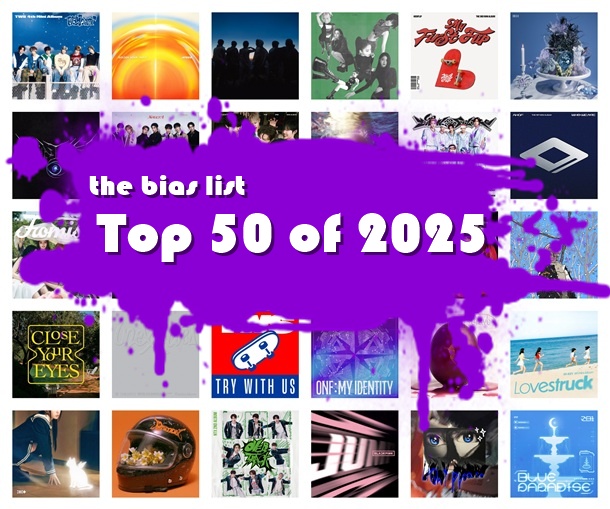
Tomorrow, The Bias List‘s comprehensive end-of-year countdowns will officially kick off with the first ten songs on my Top 50 countdown. Over the course of the next few weeks, you’ll get round-ups from every angle of K-pop: rookies, artists, b-sides, etc. I’ll also continue my tradition of recapping the industry’s year-end music festivals. In other words, things will be busy around here so make sure to check back daily!
This has been a dramatic year for K-pop, and not always in a good way. I have no hard evidence for this, but it feels like the K-pop bubble has burst — at least for Western audiences. I’ve noticed a big dip in online interaction/commentary from Western fans in almost every corner of the internet. More and more, it feels like fandoms and interest have become siloed to specific artists. In other words, people closely follow the few acts they’re interested in and aren’t necessarily looking for more outside of that bubble. Big acts grew even bigger but overall interest in the K-pop industry seems to have softened. Again, this is purely observational from my perspective, but I’ve followed online K-pop chatter for over a decade now and something has definitely changed this year.
Of course, things were still hopping over at The Bias List. For title tracks alone, I published 515 reviews from last December to the end of this November. That’s not counting “buried treasures,” J-pop releases and all the other posts I write. I became interested in seeing how these 515 reviews broke down by certain categories, which ends up being a pretty accurate representation of the K-pop industry’s output since I write about almost every small-to-major release each year. Here’s what I found from my 515 song reviews:
Boy Group – 214 reviews
Girl Group – 133 reviews
Soloist (male) – 82 reviews
Soloist (female) – 67 reviews
Duo (male) – 10 reviews
Duo (female) – 3 reviews
Mixed/Co-ed Act – 6 reviews
This wasn’t too surprising. Boy group releases eclipsed girl groups, as did male soloists when compared to female soloists. Make of this what you will, but in general it seems that male acts tend to be a safer investment for companies. With that said, girl groups and female soloists continued to chart better digitally and generally received more interest from readers of this blog. As usual, my “Top 50” list is about 75% male, 25% female, which is a little off the overall ratio of releases. I’ve long preferred the sound coming from boy group music, and that has shifted even more so in the past few years as certain trends have crystallized. Funny enough, this ratio is reversed when it comes to global pop.
The year’s musical trends were a mixed bag. I’ve enjoyed how bright and energetic the material has been from most fifth-gen boy groups, and in general it felt like the tempo amped up a bit this year. I’ve also liked seeing newer groups debut and stick with their own signature sound. This has been one of the benefits of K-pop fandom silos. Oftentimes, artists are catering directly to their fan base rather than to as many potential listeners as possible. If “beigepop” was my most derided trend last year, 2025 delivered way too many songs I’d describe as “talking over a dance beat.” When I say this, I don’t mean rap. I literally mean idols speaking catchphrases in monotone on top of club-ready production. A few of these songs worked for me, but the majority felt like huge missed opportunities for engaging melody.
As I always warn this time of year, my countdowns are different from the ones you’ll see coming from bigger publications. I’m not trying to find consensus or represent the year as a whole. I don’t take popularity or chart placement into account. In other words, there will be no K-pop Demon Hunters here (a project whose widespread adoration continues to baffle me). This is simply a list of my top 50 favorite title tracks of the year. The same applies to my other countdowns. Because of this, you may not agree with my choices but you can be certain they’re coming from an honest place.
And for those of you who enjoy stats, this year-end prelude is my 850th post of the year, which is up thirty from this time last year. That’s a whopping 287,000 words. No wonder I’m tired!
Eligibility criteria for my Top 50 Singles list hasn’t changed since last year, but for those who are new to the blog, here are the rules.
Eligibility criteria:
A song must have been released as a title, follow-up or promoted track between December 1, 2024 and November 30, 2025.
A song must be paired with a full music video or big-budget performance video (the lines get more blurred each year and I give myself some leeway here).
English-language singles are eligible. Japanese singles by K-pop artists will be part of the J-pop countdown.
Before kicking off the countdowns tomorrow, here are the ten songs that didn’t quite make the Top 50.