A Strategically Sculptural Addition For A Grand 1890s Bronte Home
Architecture
Inspired by the sandstone outcrops and cliffs of Bronte, Downie North have added a sculptural rear addition to revitalise this 1890s terrace. Custom designed American oak table and dining chairs by Joel Elliot Furniture.
Bowral Chillingham White bricks evoke the sandstone outcrops and cliffs of Bronte.
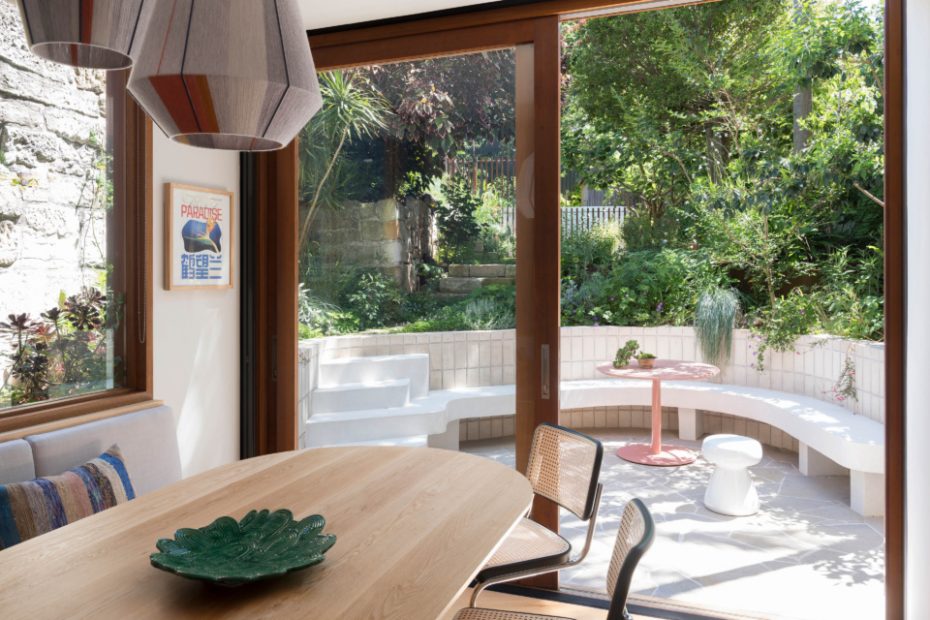
Downie North’s first manoeuvre was carving out a sunken north-facing courtyard, providing a protected and sunny exterior ‘room’ in line with the new kitchen and dining area to come. Gervasoni ceramic outdoor stool from Anibou.
The new dining area, looking out to the courtyard. Custom designed American oak table and dining chairs by Joel Elliot Furniture. Armchair by Anibou. Ceramics and small artworks from DEA Store and Curatorial + Co.
The bright kitchen overlooks the dining area. Ceramics and small artworks from DEA Store and Curatorial + Co.
The island bench references the sculptural curves of the wider building. Ceramics and small artworks from DEA Store and Curatorial + Co..
Archways inject curves into the interiors. Ceramics and small artworks from DEA Store and Curatorial + Co.
The living area. PK-22 wicker lounge chairs by Poul Kjærholm. Ceramics and small artworks from DEA Store and Curatorial + Co.
The front four rooms (two on the ground floor, and two above) and staircase were retained, with only minimal cosmetic restorations.
Painting, flooring, and joinery were updated throughout.
The new upstairs family bathroom.
The downstairs bathroom.
The ornate 1890s facade.
The main bedroom occupies the upper level rear.
This 1890s Bronte home has a rich history owed to its original family owners, who possessed the property for almost 100 years.
The house appeared in social pages and carves an immediate first impression with its ornate two-storey facade.
Various renovations were made to the property post 1980, including a rear weatherboard addition comprising a 90s Tuscan-style kitchen and a shallow sunroom with a steep flight of steps leading up to the rear garden.
‘Whilst this section was north facing, it was dark, enclosed and had very little connection to its deep north facing garden,’ explains architect Catherine Downie, of Downie North.
The new owners — a young family — engaged Downie North to rectify these issues appropriate to the house’s new stage of life. ‘We were impressed by the overarching desire to create a space that cradled family life and that enabled them to be connected to their place and to each other,’ says Catherine.
Downie North’s first manoeuvre was carving out a sunken north-facing courtyard, providing a protected and sunny exterior ‘room’ in line with the new kitchen and dining area to come. The latter takes the form of a sculptural addition inspired by the adjacent coastline and bays, while navigating an existing heritage sandstone wall and mature trees on site.
Catherine explains, ‘The new addition then twists away from this wall, facing north-east to optimise natural daylighting and winter solar penetration, whilst framing views to the garden and neighbouring trees.
‘We didn’t want to encroach on the root zone of mature trees, so this set the scale of the courtyard and additions whilst enhancing the sense of retreat that the rear garden enjoys.
‘As there was a level difference of 1.5 metres between original ground floor and garden, we also raised the levels of the rear addition to create better transitions between the interiors and garden with the sunken courtyard further mediating this difference.’
Bowral Chillingham White bricks were selected for the rear facade, again to evoke the sandstone outcrops and cliffs of Bronte.
‘A further nod to this, is the “toothed” treatment of the brick and scalloping of the facade,’ says Catherine.
The front four rooms (two on the ground floor, and two above) and staircase were meanwhile retained, with only minimal cosmetic restorations undertaken to painting, flooring, and joinery.
All this has been achieved by adding only 10 square metres to the home’s footprint.
Renovations have also dramatically improved its performance, optimising passive design with the ideal orientation of spaces, design of apertures for winter solar penetration (exclusion of summer sun), and natural cross ventilation. All appliances are electric, with a 6.45kW solar array on the roof.
Over 90 per cent of materials were locally sourced. Sandstone from the demolition of the rear addition was reclaimed and reused in the hard landscaping, and certified sustainable timbers were used in the framing and flooring.
Downie North architect Dan North says there’s a ‘feeling of inevitability to the architecture, as if it has always been this way.’ He adds, ‘The new wing of the house sits comfortably in the garden that it enjoys, and there is a sense of ease that permeates the house. There’s a real sense of home.’
The architects are proud of what they’ve achieved, distilling a complex project (a heritage-listed house with restricted access) into a simple, calm result.