How Two Families Unlocked The Surprising Benefits Of Multigenerational Living
Housing
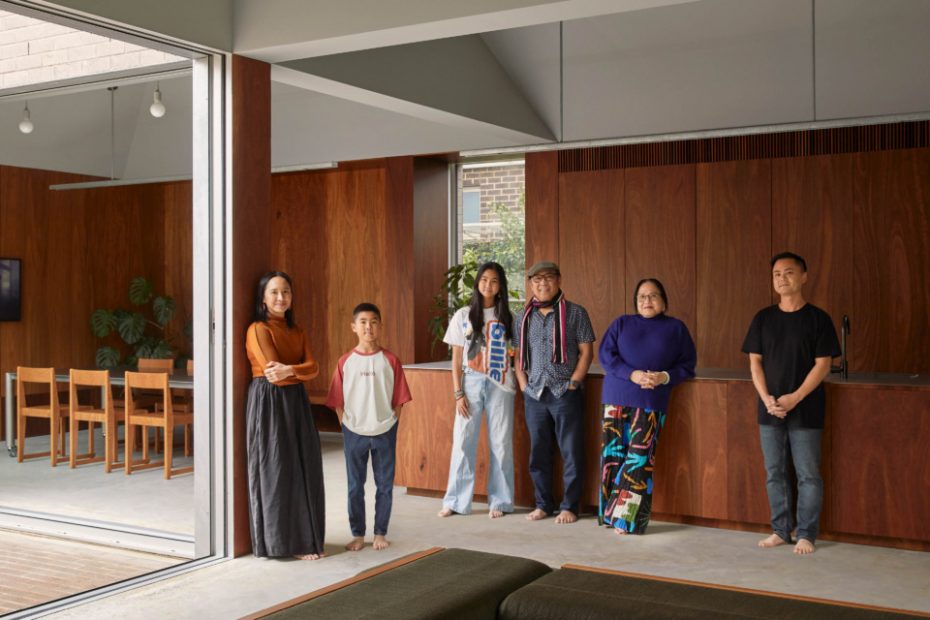
Susana Le, Chi-Lieng Be, Camilla Be (12), Maximus Be (11) with Susana’s parents, Huu Chung Le and Kim Eng Lay in their Box Hill South home by Edition Office.
The living room. Kubrick Stool 450mm by Nau. The Frame TV by Samsung. NÖDMAST lamp by IKEA.
Custom dining table designed by Edition Office. Chair 01 by Frama. Photograph by Ben Hosking, framed by Fini Frames.
The view across the central courtyard. Landscape design by Florian Wild. Exterior clad in Bowral Bricks 76 Simmental Silver. Pendant lights by Muuto.
Landscape construction by Tuckeroo Landscape Design & Construction.
The retired grandparents often pick the kids up from school and spend time together in the home.
Growing up, both Susana Le and Chi-Lieng Be lived in multigenerational households.
Susana’s parents came to Melbourne in 1981 as refugees from Vietnam. Their first home was on the fourth floor of a Richmond housing commission building, where they lived with Susana as a newborn, her teenage aunty, and grandma, until her parents later moved into a space in the floors above.
‘When Mum and Dad secured enough to buy their own home, they landed on a humble brick house in Blackburn South, where I spent the remainder of my childhood,’ the dentist and dancer says.
For engineer Chi-Lieng, it was a similar story. He arrived in Australia at three-years-old in 1985, with his Chinese Cambodian family, who had fled Pol Pot’s regime in Cambodia. For his whole childhood, his grandmother lived with them — Chi-Lieng, his brother, and their parents — in Clayton.
‘Mum and Dad were always working, so Grandma would prepare all meals, do the groceries, washing. My cousins had similar situations, so to me, that was the normal way of living… It was a very comforting arrangement,’ Chi-Leing adds.
When the couple decided to build their family home in Box Hill South a few years ago, it was never a question that the house should accommodate themselves, their children, Camilla (12) and Maximus (11), but also, have enough space for Susana’s parents to live with them later in life.
‘It was one of the first things we told architects Edition Office when presenting our brief,’ Susana says.
Edition Office came up with an innovative single-story residence that wraps entirely around a central courtyard, with plantings by Florian Wild.
Taking inspiration from Susana and Chi-Lieng’s childhood homes, the striking house has a uniform appearance, clad entirely in grey bricks. Inside, alternating folded rooflines are revealed, while burnished concrete floors are paired with rich spotted-gum joinery and timber linings across internal walls.
One corner of the 280-square-metre floor plan features the children’s bedrooms, the main bedroom and en suite, before opening up to the main living and kitchen areas.
On the opposing edge, across the sculptural ‘garden room’, there’s a second living zone, a compact study, and another principal bedroom suite designed especially for grandparents Huu Chung Le (68) and Kim Eng Lay (67).
‘The two hallways allow for us to move through the home without bumping into each other. On the other hand, the windows opening into our courtyard give us a sense of visual connection,’ Susana adds.
While her parents currently still live independently not far away, they already have their own set of keys and the three generations spend plenty of time together under the one roof. The grandparents often pick up the kids from school or bring over food, which Chi-Lieng calls ‘their love language’.
And when the time is right, they’ll move in, to age in place with the family’s support.
‘It’s an unspoken understanding. I think this stems more from a cultural value than anything else, that we will be there to look after them when they need us. We are also aware of the increasing cost of living, so it makes sense to be able to take the pressure off,’ Susana says.
‘Though they don’t say it out loud, I know they are proud of what we’ve created with our home.’
Multigenerational living arrangements like this are still relatively uncommon in Australia, but the topic is on the rise amid the current national housing crisis.
In data reported by the ABC, the Australian Bureau of Statistics (ABS) recorded a 20 per cent increase in households containing three generations, from 275,000 in 2016 to 335,000 in 2021.
Dr Edgar Liu, a senior research fellow at the UNSW City Futures Research Centre, says his years-long research into multigenerational living in Australia revealed financial challenges were the largest driving factor for the formation of multigenerational households.
Participants noted unaffordable rent, being unable to save for a housing deposit, and the cost of childcare and aged care as some of the key economic pressures. The second-most common reason given was to provide care for ageing parents.
‘Despite finance being the most-cited reason, economic benefits were not as commonly highlighted,’ Dr Liu says.
Instead, companionship was the most overwhelming benefit, noted by 78 per cent.
The data also revealed that young adults living with their parents remains the most common type of multigenerational household.
This new house was designed by Ben Callery Architects for retiree Maddy McMaster, in the backyard of Maddy’s existing Edwardian home in Northcote. Built by Truewood Constructions. Landscape design by Sam Egan Gardens.
Maddy McMaster, her son Michael and their dog Redmond.
The kitchen and living area. Cabinets painted Tint Proxima-B. Redgum table made by Maddy’s late husband, Ken. Kelsey Chairs by Castlery. Art by Bernadette Twomey.
Door by Pickering Joinery. Lucciola Pendant by Vistosi. Art by Jen McMaster.
After her husband passed away in 2018, semi-retired academic registrar Dr Maddy McMaster found herself alone in the Northcote house where she’d lived for more than three decades.
Rather than selling the inner suburban Melbourne home to downsize, she approached her 36-year-old son Michael with an alternative: ‘I had often thought about building a small house in the backyard, as the property is on a corner block with a laneway at the rear.’
They engaged Ben Callery Architects to design an energy efficient ‘little brick house’ for Maddy, allowing Michael and his partner Liv to move into the original Edwardian home.
The new two-storey house takes up just 120 square metres (of the 567-square-metre block), but within this modest footprint, the architects cleverly carved out two bedrooms, two bathrooms, a study, and an open-plan living, kitchen, and meals area.
The downstairs area is self-contained, ensuring the house remains accessible on one level for Maddy in the future.
With a garden tucked between the two dwellings, the two generations are enjoying living together but separately, sharing gardening tasks, putting out the bins, and caring for Michael and Liv’s dog, Redmond.
‘It has allowed Michael and Liv to have a home of their own for the cost of building of a smaller unit,’ Maddy says.
‘I jumped at the opportunity as it gives me a sense of security as I approach old age. I am quite self-sufficient and love the idea of being able to continue to live independently knowing that the family is there at any time if needed.’
The challenge was getting the plans for the second dwelling approved by their local council, with Maddy noting regulations were not well set up to encompass multigenerational arrangements.
She’s also just received a ‘hefty’ land tax bill, with the State Revenue Office treating the home as two properties, even though the two dwellings are on one block that hasn’t been subdivided.
Maddy says she’d still encourage anyone in her position to speak with their children about multigenerational living. In fact, two others in her street are pursuing similar arrangements.
‘I think it’s a legitimate response to the housing crisis, because for many, this type of arrangement suits their needs and wants,’ Dr Liu adds.
‘The arrangement doesn’t need to last forever, just for as long as these households need them for, but we need to provide housing and policies and regulations that can support these decisions.’
Adapting Australia’s existing housing stock — which was primarily designed for nuclear families, couples, or singles — to accommodate for more than one generation, is a significant challenge.
However, perhaps the first barrier to confront is our culture’s individualistic mindset.
Dr Liu says many participants in his study were met with surprise when others found out about their multigenerational household, with many asking what ‘went wrong’ to lead to this arrangement.
‘The classic reflection from our participants was that they couldn’t just want to live together but always needed to justify their arrangement with some reason,’ he adds.
While it’s not for everyone, the benefits can be transformative. From increasing density in established neighbourhoods, to creating more affordable housing or offering support for the elderly.
The success of these multigenerational households offers a heartwarming reminder about the importance of community — and the very real benefits of living just a little closer together.
An edited version of this story originally appeared in The Design Files Magazine Issue 03. Subscribe to the biannual print magazine here.