A Barn-Style Home Built For The Six Noongar Seasons
Architecture
Wildwood Barn by Bare Architects responds to its microclimate, facilitating outdoor living and nature views throughout all six Noongar seasons.
The house is is located on subdivided remnant farmland in Yallingup, in the south west region of Western Australia.
The client always loved the beautiful simplicity of barn style architecture, leading them to discover Bare Architects.
Originally designed over two levels to create a larger undercover area under the second storey, Wildwood Barn was reworked to navigate rising building costs across a single storey.
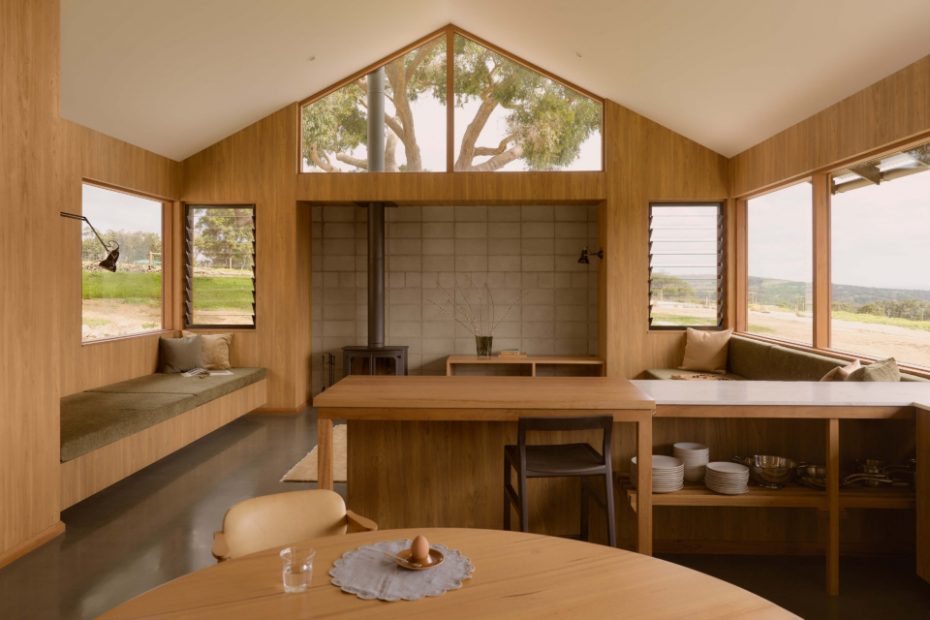
‘The wall lining in the living area was going to ideally be timber veneer… however to once again, combat rising cost of construction, we opted for PaperWall by Evenex which is a wallpaper applied over plasterboard,’ says Matilda.
A protected outdoor area was cut into the floor plan.
Costs were invested into timber doors and windows, which provide both internal and external appeal.
Additional doors and furniture provide subtle pops of colour.
A bathroom features nature-harmonising green tiles.
The protected outdoor dining area.
Dark Colorbond cladding was selected for durability, speed of application, and to suit local planning requirements.
Wildwood Barn is located on subdivided remnant farmland in Yallingup, in the south west region of Western Australia.
The site was essentially a blank slate for the design — the only feature to preserve was a large marri tree on site, which became central to Bare Architects’ concept.
The client always loved the beautiful simplicity of barn-style architecture, leading them to discover Bare Architects’ nearby Petit Eco Cabin. The architects referenced this project and subsequent learnings in the creation of Wildwood Barn, albeit on a larger scale appropriate to the client and family’s specific needs.
Originally designed over two levels to create a larger undercover area under the second storey, Wildwood Barn was reworked to navigate rising building costs, without losing previous outdoor space.
Matilda Brealey, principal architect at Bare Architects, says, ‘We lost the L-shape, condensing the floor plan and perimeter of the building. Whilst both designs were around 180 square metres, the earlier design had a much higher perimeter (more cladding) and naturally incurred cost increases with the second storey.
She adds, ‘Bare Architects are passionate about facilitating outdoor living for all parts of the year, throughout all six Noongar seasons.’
As a result, a protected outdoor area was cut into the floor plan, to be used throughout Makuru (the coldest and wettest period of the year, roughly June-July), Djilba (the period of rains and renewal, roughly aligned to the start of spring) and Kambarang (the season of birth and wildflowers, occurring around October-November).
A secondary ‘garden room’ defined by a singular concrete block wall and stone flooring has been designed for Birak (hot and dry days at the start of summer in December-January), Bunuru (the hottest season from February-March), and Djeran (characterised by cooler nights, dewy mornings, and south-westerly winds in April-May).
Dark Colorbond cladding was selected for durability, speed of application, and to suit local planning requirements.
Costs were invested into timber doors and windows (which provide both internal and external appeal), and concrete as an anchoring material, used within the slab and the blade walls that hold the floorplan ‘like a spine’.
‘The wall lining in the living area was going to ideally be timber veneer… however, to once again combat the rising cost of construction, we opted for PaperWall by Evenex, which is a wallpaper applied over plasterboard,’ says Matilda. ‘There is real wood pulp in the wallpaper, and the quality of the product is integral to the success.’
The clients are now treated to nature views every day through highlight windows framing the large marri tree and beyond.
‘The kitchen, dining and living become a spectacle of light and shadow throughout the afternoons, and it is equally enlivening and calming,’ says Matilda. ‘Similarly, the way the marri tree shades the ‘garden room’ in the summer afternoons, and the [way the] tree’s shadow falls away from the house in winter, all work superbly in the performance of living there.’
Bare Architects, builder Honeypot Homes, and the clients have all forged strong friendships – a testament to the seamless design and construction process and unified goal.
The house is rented out as short-term accommodation when not in use by the owners.