According to Wikipedia, “under the U.S.‑led occupation after World War II, the Allied authorities and Japanese government adopted the Cannabis Control Act (CCA) in 1948. The law aimed to align Japan with the international drug‑control framework and to suppress recreational use.” This has resulted in 80-some-odd years of cannabis demonisation and to Japan having some of the strictest laws and possession penalties of all the democratic/capitalistic countries when it comes to weed usage.
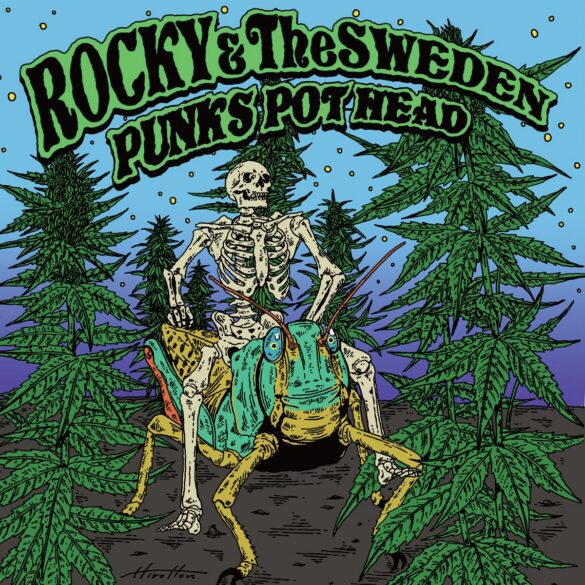
Tokyo’s Rocky & The Sweden have been thumbing their nose at their nation’s draconian drug stance via 30 years of hardcore punk rock that employs an overarching weed motif underpinned by themes of freedom and liberty. All these points are hammered home through the lens of ragin’ and rockin’ sounds that count equal amounts of UK ’82 punk, American hardcore and old-time rock ’n’ roll/rockabilly as influence and inspiration. The band’s latest and fourth album, Punk’s Pot Head was released by Relapse a couple weeks back alongside a remastered back catalogue that includes their 1998 debut Total Hard Core, 2000 second album God Save the Green and an collection of early years singles called Singles Collection 1997-1999. And in the interest of full disclosure, I admittedly discovered the band, their fantabulous energy and THC-flavoured puns following the Relapse-released split they did with Boris in 2022 and have been a giggly fanboy ever since.
We braved the language barrier to catch up with Takeshi “Takeshi Sweden” Fukushima — the lineup is completed by drummer Masaaki Sweden, guitarist Sukekiyo Sweden and frontman Rocky — via email for a brief look into one of the most exciting hardcore punk bands making the smoky-filled and bleary-eyed rounds these days.
Historically, weed has been strictly illegal in Japan for 80 or so years, though regulations appear to be slowly loosening. With Rocky & the Sweden having been a band for 30 years, how have you seen attitudes towards marijuana, and by default the band, shift over the years?
Takeshi Sweden: It’s incorrect to say regulations are being relaxed in Japan. In fact, enforcement and penalties have been strengthened since last year. This is due to foolish bureaucrats who can’t even distinguish between soft drugs and hard drugs. It’s the government’s responsibility. However, we do feel public perception is gradually shifting in a more positive direction. One reason is that knowledge about cannabis’ benefits and effects has become widely accessible through the internet, and the global trend toward deregulation is gaining recognition. We also feel that the educational efforts by leaders in the music world who support cannabis, such as reggae and hip-hop artists, are bearing fruit. We hope to join them as pioneers within the punk scene.
I noticed the Cheech & Chong references on the new album which made me curious about how stoner culture and depictions are viewed in Japan? How do you feel when you see weed fully legal or decriminalised in other parts of the world while the laws make examples of Japanese public figures like Saya Takagi, Junnosuke Taguchi and Yusuke Iseya (who, by the way, happen to all be actors)?
You’ve done your research [Lol]! As stated in my previous response, the Japanese government is completely corrupt. Whether they’re blindly accepting the claims of the so-called “Japan Desk” within the U.S. government, acting as puppets for the FFWPU (Family Federation), or simply calculating how much they can profit, we don’t know. But foolish, greedy individuals who don’t even understand the separation of church and state — a fundamental pillar of democracy — hold power and are tormenting the people.
I imagine a large part of you looking forward to your west coast U.S. tour later this year is that you’ll have the ability to partake freely?
Of course that’s one reason, but honestly, is there any band member who doesn’t love touring? We’re really looking forward to seeing my American friends again!
Have you, or how often have you, found yourselves on the wrong side of the law and in trouble with local or state police?
Of course, I’ve had my share of run-ins with the cops. But I’m the type who forgets the negative stuff right away.
Going back to the beginning, how did you come to settle on weed as the central part of the band’s theme, message and topics?
“Scream for peace!”—is that weird for a punk band? Haha
Beyond the weed motif, how the did the whole ‘Sweden’ naming theme come to be?
People always ask about our name, but that’s the band’s biggest mystery! Haha
When one looks at Rocky & the Sweden and the overall concept, it appears there’s a broader message of ‘freedom from restriction and regulation’ to what you’re saying and doing. Agree/disagree?
Of course! We’re glad you feel that way!
How do you account for the gap between God Save the Green in 2000 and City Baby Attacked By Buds in 2019? Where were you and what were you doing during that time?
Keeping a band going is really tough, and bands that’ve kept at it for decades without a break deserve respect. But it’s only natural that everyone has their ups and downs. Besides, we’re not doing this as a business!
Is it safe to say that Relapse getting involved for the split with Boris and now the new album has rejuvenated the band?
No, it’s actually the opposite. Relapse came together after we resumed our activities. Boris are old friends. It’s like introducing each other’s work to our different audiences.
How did you come to be associated with Relapse?
It all started when we pitched our release to the label.
Tell us about the new album. How long did it take to write and record?
We first started recording in June 2024. After that, we had to repeatedly interrupt the East Coast tour due to studio equipment issues and the engineer’s health problems. Ultimately, the studio we recorded at, Noise Room, was just too popular, making bookings extremely difficult. We had to wait until April 2025 for the sound to be finalised. But we had absolutely no intention of continuing recording at any other studio. Shige, the owner of Noise Room, is a national treasure who has recorded countless Japanese hardcore legends.
How long did you work on the reissues? How has the response been to their being remastered and widely available?
It was a challenge that surfaced after we decided to release the new album. I felt it was a true test. For the remastering work, we hired “Mr. Brad” [Brad Boatright] who was recommended by Relapse. Wouldn’t you be curious about the skills of an engineer that label endorses? Frankly, I’m extremely satisfied with his work.
How has life changed for you and the band now that you’re part of the Relapse roster?
It hasn’t even been a week since the new release, so nothing’s changed yet! [lol] Maybe we’ll start feeling the impact soon?
What are your plans for promoting and touring now that the new album and reissues are available? Are you looking to get out more than ever before to play new and different places?
We have multiple domestic tour dates scheduled, including the southernmost and northernmost regions, plus the West Coast tour. Of course, if a good offer comes along at the right time, we’d be thrilled to add more tours. We’re always eager for overseas performances and look forward to playing in new places and for new audiences.
ROCKY & THE SWEDEN ON TOUR
May 8 – San Diego, CA
May 9- Los Angeles, CA
May 10 Bakersfield, CA
May 11 Oakland, CA
May 13 Portland, OR
May 15 Olympia, WA
May 16 Seattle, WA
The post An Interview with ‘Takeshi Sweden’ of Japanese Weed-Lovin’ Punks Rocky & the Sweden appeared first on Decibel Magazine.