In Canada’s 2025 federal election, the slogan ‘every vote counts’ was made hyperbolic as five races were decided by less than 50 votes. As Ontarians gear up for municipal elections in 2026, voters will again be asked to make every vote count.
Please raise your voice to help make the environment central to this election cycle. With voter turnout being only 38.3 per cent in the 2022 municipal elections, Ontarians can, and need to, do better for nature. The bedrock for our future is a healthy natural world. Together, we can be the voice for wild species and wild spaces in Ontario.
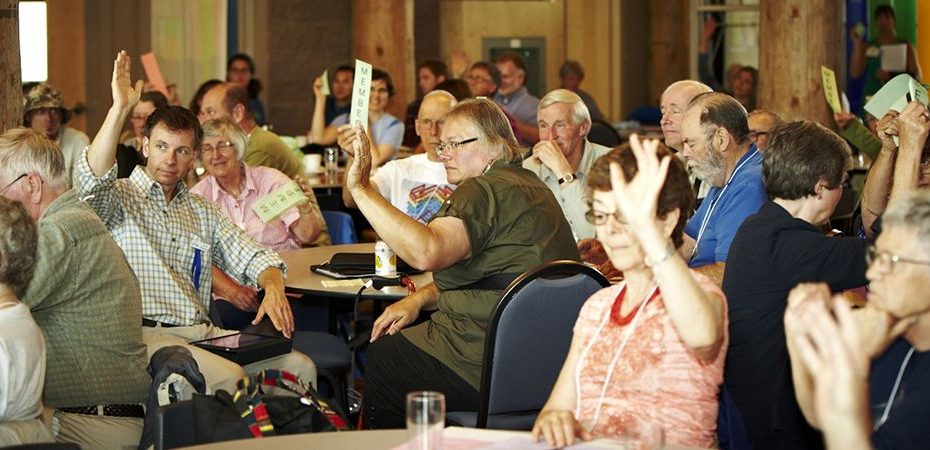
Members voting at Ontario Nature’s Annual General Meeting © Jeff Kirk
How to Vote
For those who have never voted, or need a refresher, the process of voting is simple. Register on the voters list before the general election, which can be done through Elections Ontario. On the day of the election, bring a piece of identification that has your name and current address to your voting place (note, you must vote where you live).
At the voting place, the election official will give you a ballot and you’ll choose one candidate for city councillor, one candidate for mayor and one candidate for school board trustee. Once you make your selections, you put your ballot in the ballot box with the help of an elections official.
Why Vote?
Municipalities govern the local matters of our everyday lives. In Canada people are increasingly living and/or working in cities.
Who is elected to municipal office, especially considering Ontario’s strong mayor powers and duties, will set the focus and direction of city issues for the immediate and long-term future.
By voting for nature, you’re voting for our home to thrive. Please take the time to express your values at the municipal ballot box.
Municipal Issues
These are just some of the interconnected issues that govern municipal decision-making. Municipal governments:
Enable and respect Indigenous Protected and Conserved Areas, and other Indigenous-led conservation efforts.
Set the direction for protecting natural areas and systems in our communities.
Prevent sprawl and preserve farmland by freezing urban boundary expansion and embracing smart growth.
Increase housing supply and affordability by updating zoning rules to promote infill development and gentle density which means adding small-scale homes like triplexes, multiplexes, backyard cottages and laneway suites to established neighbourhoods.
Invest in the protection of natural areas and farmland.
Take action to address the climate emergency.
Make decisions about local public transit, active transportation, highways and roads.
Control parks, parkettes, sports fields, recreation facilities and bike lanes (note, there is an impending appeal on a recent court decision on municipal bike lane construction in Ontario).
Determine garbage, recycling and composting programs and contracts.
Are increasingly being asked to incorporate flood prevention and forest fire responses into their urban planning.
Races to Watch
Ontario has 444 municipalities, which present 444 opportunities to support nature, and while climate action is becoming mainstream for world’s cities, each municipality faces a unique set of issues. For instance:
In Mississauga, the city has shifted from its decade-old Living Green Master Plan to focus on climate action and goals to reduce emissions and building resilience to extreme weather.
In Hamilton, it has been reported that “breathing the air in parts of Hamilton is like smoking a cigarette a day”.
For Thunder Bay, how will climate change “affect Thunder Bay and what’s being done about it”?
At the City of Toronto, “Climate, Energy & Resilience” are top of mind.
And in Windsor, there are big “climate pollution problems” and concerns enough isn’t being done.
What You Can Do
Consider the issues that matter the most to you and see where your local candidates stand on them.
Write a letter to the editor.
Talk to your friends, colleagues, neighbours and family about the importance of voting for nature.
Send letters to candidates running in your municipality asking for specific commitments.
Volunteer for candidates that commit to addressing the climate and biodiversity crises.
Register to vote and be informed about voting.
Keep nature in mind when you head to the polls and vote for the candidate who will best protect Ontario’s wild species and wild spaces.
With files from Anne Bell.