The Complexities Of Modern Life Fade Away In This Regional Home
Architecture
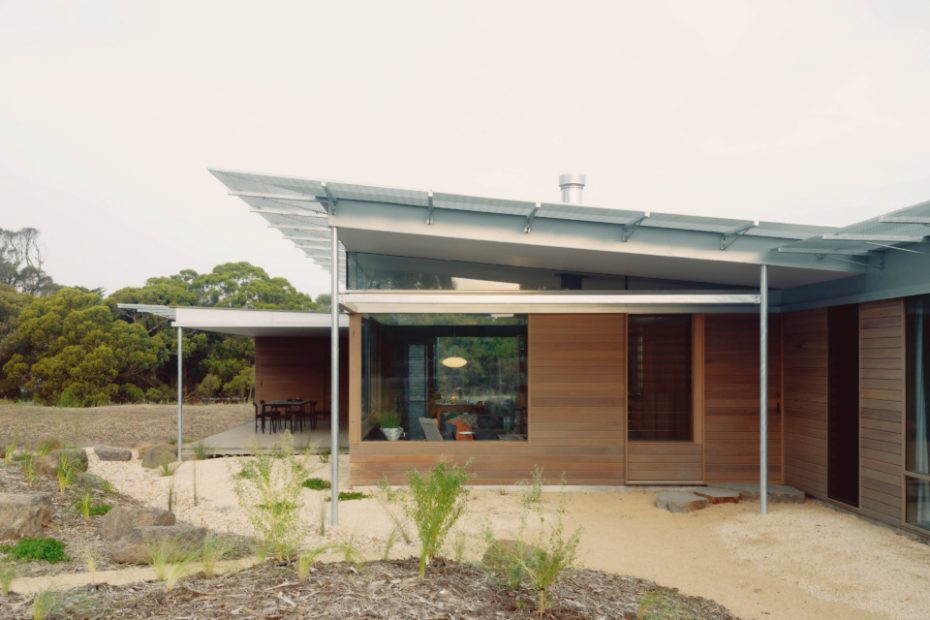
Ironbark House by Not All Architecture is a relatively simple project in appearance, driven by a sophisticated set of design principles and quality materials.
The house was designed as a family’s permanent new residence, serving as a retreat from the complexities of modern life.
Not All Architecture was inspired by Danish architect Jørn Utzon’s design concept of ‘additive architecture’.
The floor plan is structured with communal areas at the centre and two bedroom wings of differing lengths on either side — one for adults and one for children.
Various ceramics, art and furniture from Craft Victoria. DCM Chairs designed by Ray & Charles Eames. Antique table from Graham Geddes Antiques. Pendant designed by George Nelson.
Horizontal beams located at door height are common to all rooms of the house.
Various ceramics, art and furniture from Craft Victoria. DCM Chairs designed by Ray & Charles Eames. Antique table from Graham Geddes Antiques. Pendant designed by George Nelson.
Stool by Tanchen Studio, towel by Baina, both from Bleu.
The bedroom wings are deliberately separate from the main living area.
Materials speak to the home’s context (a bushfire prone area) and the desire for quality over quantity.
Class 1 ironbark timber cladding meets BAL 29 requirements.
Ironbark House by Not All Architecture is a relatively simple project in appearance, driven by a sophisticated set of design principles and quality materials.
First and foremost, the house was designed as a family’s permanent new residence, serving as a retreat from the complexities of modern life as they transition to regional living on Victoria’s south-west coast.
In designing the floor plan, Not All Architecture was inspired by Danish architect Jørn Utzon’s design concept of ‘additive architecture’ — conveying that complex, organic forms can arise from repeating a simple, basic element.
This concept is referenced in the horizontal beams located at door height, common to all rooms of the house.
‘Above this the ceiling can develop freely. The guttering follows above this horizontal beam in this instance, on the rear of the skillion roofing for a simple construction method,’ says Phoebe Clarke, director of Not All Architecture. ‘It is the many variations in repetition that give the building its character.’
Ironbark House is structured with communal areas at the centre and bedroom wings of differing lengths on either side — one for adults and one for children.
Phoebe explains the rationale, ‘The architectural spatial planning avoids isolated areas and facilitates connection through the central core living, kitchen and dining, with a staggered plan guiding diagonal movement through a central form.
‘You must make connection [with one another] by traversing through the main living area… adults coming from the east wing, and kids from the west wing. This solved the concern and briefing requirement from the owners to ensure they were always connecting with their children in the house.’
The floor plan also addresses the seasonal winds of the coastal area, with a series of courtyards providing sheltered areas throughout the year.
Materials speak to the home’s context (a bushfire-prone area) and the desire for quality over quantity. Class 1 ironbark timber cladding meets BAL 29 requirements, paired with steel structural elements that serve as the primary skeleton of the building.
‘The galvanised structure has detailed reversible connections, taking into consideration the building’s lifecycle and demountability for repair or future uses,’ says Phoebe.
Located on a previously vacant bush clearing in the Otways, the architects worked with Simon Taylor Landscape Design to clarify the building’s relationship with the landscape and restore the site with local Indigenous flora.
The completed home satisfies both the client’s brief and the needs of the local environment. Roof harvesting and large water tanks supply all the house’s water, and the property is equipped with a 10kW solar array, battery, and onsite waste treatment.