“How about doing a moth survey at Sydenham?”
“A moss survey?” Asked Roberta Buchanan, local property steward for Sydenham River Nature Reserve, who didn’t quite hear me while we were walking outside.
“No, moths. Like a nocturnal equivalent to the butterfly survey. Who knows what we’ll find?”
It was 2023. I knew how unique the reserve was through my involvement with the annual butterfly and breeding bird surveys, and I suspected this oasis of biodiversity had fantastic potential for moths.
Compared to their diurnal counterparts, moths are relatively under-surveyed. Most species are nocturnal and inconspicuous, and documenting them requires specialized survey techniques – sheets and live traps baited with light or food. It also requires dedicated surveyors willing to stay up all night!
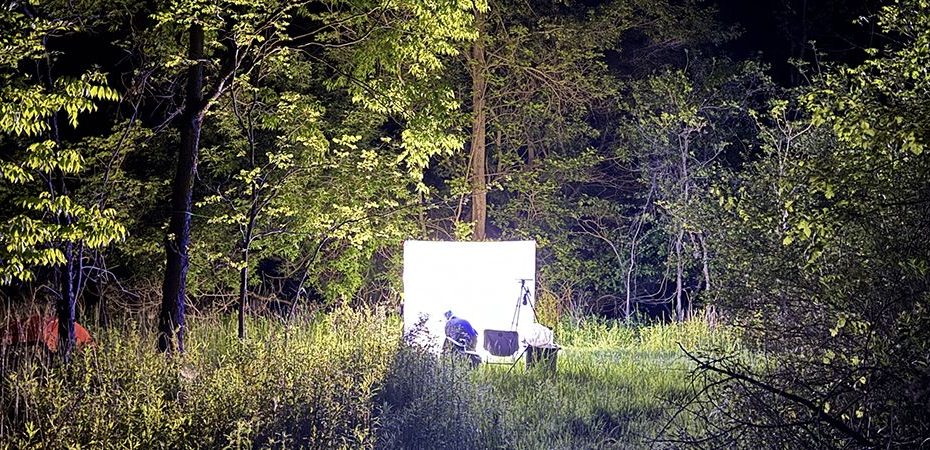
Moth sheet setup at Sydenham River Nature Reserve © Allanah Vokes
On the evening of June 24, 2024, a team of volunteers (Roberta Buchanan, Mark Buchanan, Paul Carter, Pete Chapman, Scott Connop, Deryl Nethercott, Dale Buchner, and myself) from Lambton Wildlife set up two light sheets and two traps across the Sydenham River Nature Reserve property. We documented hundreds of individual moths well into the night, and even more when we opened the traps the following morning. Then came the real fun: sorting through thousands of photos and identifying every moth.
Identifying all these moths is no trivial task. There are over 3,000 species of moths in Ontario, so field guides include only the most common species. Encountering moths that aren’t in the guide is common, and several groups of moths are notoriously hard to identify, even for experienced moth-ers. My approach is to photograph every moth, upload these photos to iNaturalist with my tentative ID, and wait for confirmation by a moth expert. For those who don’t know, iNaturalist is an online platform where you can post photos or recordings of an organism and crowdsource identifications from experts all over the world.
A moth trap in use, Sydenham River Nature Reserve © Allanah Vokes
To keep track of the growing species list, I created an iNaturalist project which automatically consolidates all the moth observations from the property. The strength of this approach is that it stays current, as taxonomic changes and revised identifications will update the species list automatically. This makes it more reliable over time than a static checklist, which inevitably becomes outdated. As of 2026, we have documented 196 species of moth that first night, 13 of which are considered vulnerable at some level. After a second survey in May 2025, the total moth species count at Sydenham River Nature Reserve stands at 328, including 30 vulnerable species.
Fast forward to July 2025. I was checking my iNaturalist and saw there was a comment on one of my moth observations from the 2024 survey. Someone disagreed with my identification of what I believed to be a common white-fringed emerald, suggesting instead a species I hadn’t heard of – a tuscarora emerald.
I quickly checked the range map, and my excitement spiked: this was a very rare moth, with only about fifty observations, all from the eastern United States – mostly localized populations in the Appalachians. If this was actually a tuscarora emerald, it would likely represent the first record for Canada.
Tuscarora emerald found at Sydenham River Nature Reserve © Allanah Vokes
The identifier, Daniel Kluza (d_kluza on iNaturalist), a New Zealand-based biologist and iNaturalist taxonomy curator, pointed out a critical detail: our moth lacked the pure white spot on top of the abdomen which is present on the white-fringed emerald. This was a subtle difference, but potentially a decisive one. I needed a second opinion.
I reached out to Seabrooke Leckie, co-author of the Peterson Field Guide to Moths of Northeastern North America, and asked what she thought of it. Her response was unequivocal:
“I pulled out the Moths Of North America fascicle for this group to have a look at the official description of both species, Tuscarora and White-fringed, and I agree that this is Tuscarora. What a find!… Besides the presence/absence of the white spot at the base of the abdomen, the fascicle also says the white costa is very narrowly bordered inwardly by an apricot colour, and the AM and PM lines are wider than in White-fringed, both of which appear present here. There are no other eastern species that have both the white fringe and no markings on the abdomen.”
What makes this record especially meaningful is not just the rarity of tuscarora emerald, but the way in which it was found. It was the result of methodical work by a team of volunteer community scientists, combined with the expertise of moth specialists. Not too long ago, access to such expertise was a significant roadblock, but it’s now easily facilitated through platforms such as iNaturalist.
We don’t know if this observation represents a previously overlooked population, a vagrant individual, or a northern range expansion driven by climate change. What is clear, however, is that protected places like Sydenham River Nature Reserve continue to demonstrate their conservation value in unexpected ways. When we take the time to look closely and collaboratively at under-surveyed groups like moths, we reveal hidden layers of biodiversity, uncovering the true richness of landscapes we thought we already knew.