How This Kyneton Garden Embraces Windy + Dry Conditions
Gardens
This new Kyneton garden has a ‘wild and untouched’ look owing to its minimal hard landscaping and dry plant palette.
Besides some clusters of exposed boulders and deciduous trees, the site had little existing garden infrastructure,
Tim designed a garden conducive to these elements, taking into account the appropriate scale and weather conditions.
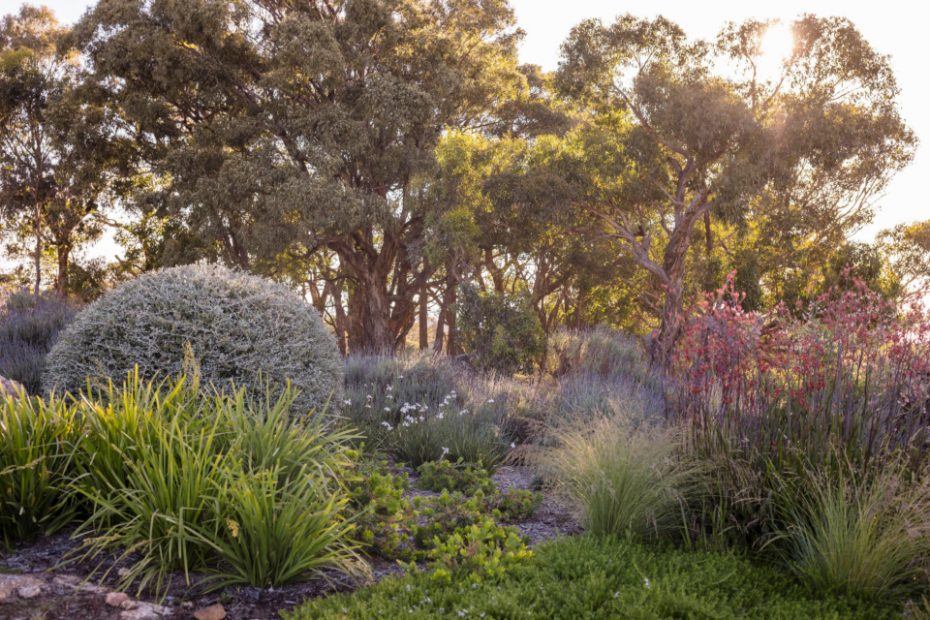
Anigozanthos ‘Big Red’ (kangaroo paw) in the garden.
Nailing the scale was a key challenge of the project.
The layout is structured as a central courtyard with ‘serpentine’ offshoots connecting to other parts of the property.
Paths are functional, taking the user from the house to the kitchen garden, shed, or the car park below.
Creating the paths was an intentional move to immerse the owners in the landscape at every opportunity.
Pycnosorus globosus (billy buttons) are a feature of the planting.
‘We tried to be minimal with flower colour, and played with sunset colours that play to the light and aspect, such as yellow, burnt orange, dusty mauves, pops of hot deep reds and burgundies,’ says Tim.
The granite boulders on the property weight up to 10 tonnes.
Poa labillardierei (common tussock grass) echos the movement of the pasture grass in the paddocks below.
The central courtyard with the fire pit.
The granite hilltop overlooks undulating farmland.
‘We used the shapes and colours of what we could see in the view and brought them in, with generous drifts of these shapes, colours in repetition.’
Existing deciduous trees help filter the wind and add shade.
The nearby architectural house will eventually be surrounded by two acres of garden.
When designing a new garden for an architectural home in Victoria’s Macedon Ranges, Tim Pilgrim Gardens knew a sensitive approach was needed.
‘We all knew that it had to be sympathetic to the place, and not over done with hard landscaping elements,’ explains Tim. ‘The thought was that the planting had to feel right, and not forced.’
The existing elements were some giant granite boulders (weighing up to 10 tonnes each) and deciduous trees across the vast 100-acre central Victoria site – including half an acre (of a wider two-acre section) to be transformed by Tim.
Tim designed a garden that balanced all these factors, taking into account the appropriate scale and weather conditions. The result is a diverse yet cohesive plant palette, encompassing a strong native selection, as well as plants from New Zealand, South Africa, and the Mediterranean.
‘Being on top of a hill, the wind was a big factor, as well as the thermal mass that radiates off the boulders over the heat of summer,’ says Tim. ‘We decided to lean into the wind factor, planting large ribbons of Poa labillardierei that echo the movement of the pasture grass in the paddocks below.’
The first stage of the garden (pictured in this story) sits next to the house and a shed, appearing almost ‘nestled’ into the hillside instead of sitting ‘on top of’ the land.
The layout is structured as a central courtyard with ‘serpentine’ offshoots connecting to other parts of the property. ‘From an aerial view it looks like a four-tentacle octopus,’ explains Tim. ‘The tentacles weave around the natural granite formations on the hillside.’
He describes the central courtyard as a landing place to encourage a moment of pause and contemplation, while the paths are functional, taking the user from the house to the kitchen garden, shed, or the car park below – an intentional move to immerse the owners in the landscape at every opportunity.
Tim adds, ‘It’s one large composition, and the beauty is that from the central courtyard you have a vantage point to oversee the whole garden… We used the shapes and colours of what we could see in the view and brought them in, with generous drifts of these shapes, colours in repetition.’
Overall the new garden feels wild and untouched, owing to its minimal hard landscaping (steel edging, cut basalt steps, and Tuscan topping), which allows the plants to ‘lead the way and provide all the drama’, in Tim’s words.
Pycnosorus globosus (billy buttons) are a feature, along with Anigozanthos ‘Big Red’ (kangaroo paw). ‘These plants love the granite soils that we have here, and we knew they would provide quick growth and height fast while everything else catches up,’ says Tim. ‘Shortly after the time of this photoshoot, the Dietes grandiflora became the dominant, and the succession continues through the summer months.
‘We tried to be minimal with flower colour, and played with sunset colours that play to the light and aspect, such as yellow, burnt orange, dusty mauves, pops of hot deep reds and burgundies to provide that depth through the hotter brighter months.’
Like any good garden, the newly established landscape instilled by Tim and Macedon Ranges Garden Services looks like it’s always been there.