An Architect’s Thoughtful Six-Year Family Home Reno
Homes
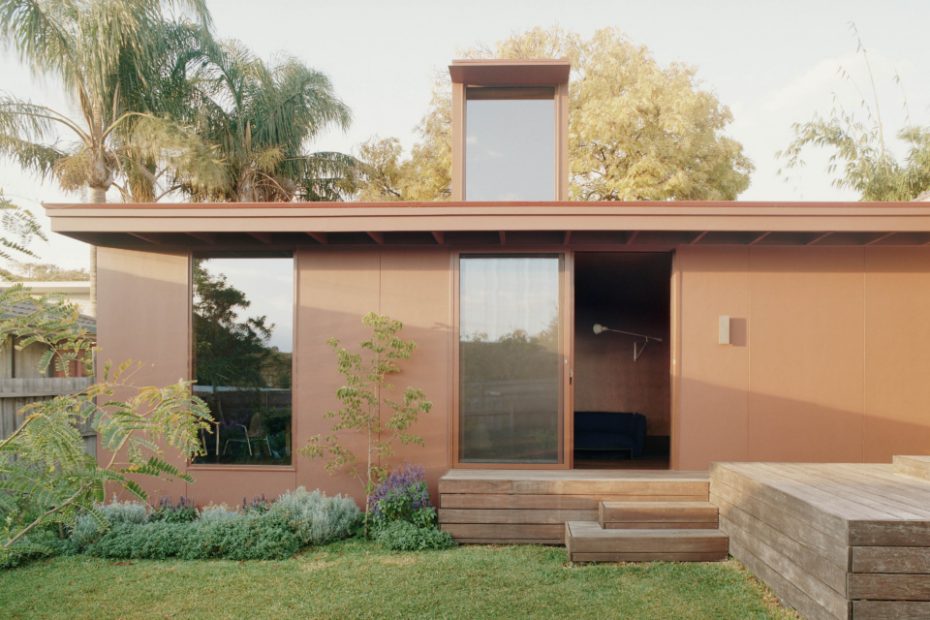
Wilson Tang, director of Sonelo Architects, designed the extension to his family home to sit quietly behind the triple-fronted post war facade.
James Hardie Easylap panels.
A singular ‘pop-up lantern’ in the new extension floods the living space with natural light.
An engawa wraps around the house, internally and externally, to connect the home to the backyard.
A new second porch in the centre of the house, equipped with a genkan (traditional Japanese entry) has been added so the family can easily remove their shoes before entering the home.
Wilson Tang, Elodie Lim, and their children, Miya (2) and Miro (5).
Stainless Unit Shelf by Muji. Flos Tab Floor Lamp and Flos 265 Wall Lamp from Euroluce. Phantom Sofa by Cameron Foggo for Nonn from District Furniture.
Stainless Unit Shelf by Muji.
Stainless Unit Shelf by Muji. Flos 265 Wall Lamp from Euroluce. Phantom Sofa by Cameron Foggo for Nonn from District Furniture.
The genkan (traditional Japanese entry) opens into the living room, wrapped by an engawa. Made by Mayfair wall lamp from Beacon Lighting.
The view from the sunken lounge, into the dining room.
Flos Glo-Ball Suspension lamp from Euroluce. Bespoke charred elm tabletop made by Hugh Makin and designed in collaboration with Sonelo Architects, with Ishinomaki Laboratory AA stool legs. Ariake armchairs with woven leather seat from Apato. Art by Ronan Bouroullec from Wrong Shop.
Looking into the dining room from the kitchen. Storage cabinetry in Amaro from Polytec.
Inax Yuki Border tiles from Artedomus. White Serpenggiante benchtop from Signorino. Evenex Limewash Elm cabinets from Elton Group.
Stainless steel kettle by Muji. Ishinomaki laboratory Kobo High Stool from Apato.
A suggestion of the ‘pop-up lantern’ in the extension can be viewed from the facade of the triple-fronted post-war home.
In Japanese architecture, an engawa is a covered walkway that runs along the outside of a building, often serving to connect the house with nature.
‘It can act as a pathway, seating space, and, sometimes, a launching pad for the kids,’ explains Wilson Tang, director of Sonelo Architects.
In Cascade House, the Coburg North home Wilson shares with his wife, Elodie Lim, director of Sonelo & Co, and their two children, the idea of an engawa has been adapted in the form of steps and plinths that run both internally and externally, to connect spaces and transition between the level differences in the rear of the home.
It’s a design element that’s unlocked a connection to the garden the couple have always craved, after moving from a two-bedroom Collingwood apartment to the triple-fronted post-war home in 2018.
But further to that, this design has facilitated space for a new second porch in the centre of the house, equipped with a genkan (traditional Japanese entry) where the family can easily remove their shoes before entering the home.
‘It is a blessing to be able to dedicate a space for this ritual adjacent to the lush green in the entry courtyard,’ Wilson says. ‘We added an external built-in cupboard to the porch for shoe storage.’
The renovation of their family home has been a four-stage process over six years, first with the addition of an extra bedroom and bathroom, plus a revamp of the garden as their family grew with the arrival of their son Miro (5) and daughter Miya (2). Then came the extension a few years later, allowing Wilson and Elodie to relocate the living areas to make the most of the northern aspect of the site.
‘It was inspired by our desire to raise a family in an earthy sanctuary that speaks to simplicity and celebrates connection to nature,’ Wilson says.
The extension, clad in James Hardie EasyLap panels with a terracotta painted finish, creates an earthy ambiance, referencing the clay overlay in the area.
‘It is intentionally made discreet and distinct,’ says Wilson. ‘Tucked behind the original house, it fits snugly under the existing eaves and the presence of the new dark clay-tone is hinted at only by the singular pop-up lantern rising above its low-lying roof.’
Inside, the sunken lounge and study are a similar warm bronze hue, sitting in contrast to the fresh palette of lime-washed elm cabinets and warm white walls in the kitchen and dining spaces, located in the original part of the home.
‘The semi-separated arrangement of these spaces works better than expected for our young family,’ says Wilson. ‘It provides good separation for the kids to mingle in the sunken living room and the adults around the dining table, while remaining visually connected.
‘In the existing part of the house we wanted to create a light and airy, timeless feel that still upheld the essence of the post-war home.’
The home has transformed with the family, and will continue to evolve as they grow. The garden — ‘our first ever’ — has produced bountiful harvests, including the family’s first crops of tomatoes, persimmon, pomegranate, and fig.
‘Seeing the house transform from its original state as we inherited it to present has been a great blessing,’ says Wilson. ‘We hope to carve out more standout memories in years to come.’
An edited version of this story originally appeared in The Design Files Magazine Issue 03. Subscribe to our print magazine here.