How This 1915 Cottage Renovation Makes The Most Of Its Inner-City Block
Architecture
Stack & Field is a renovated period cottage by Steffen Welsch Architects.
A view into the extension, nestled beside a narrow plunge pool.
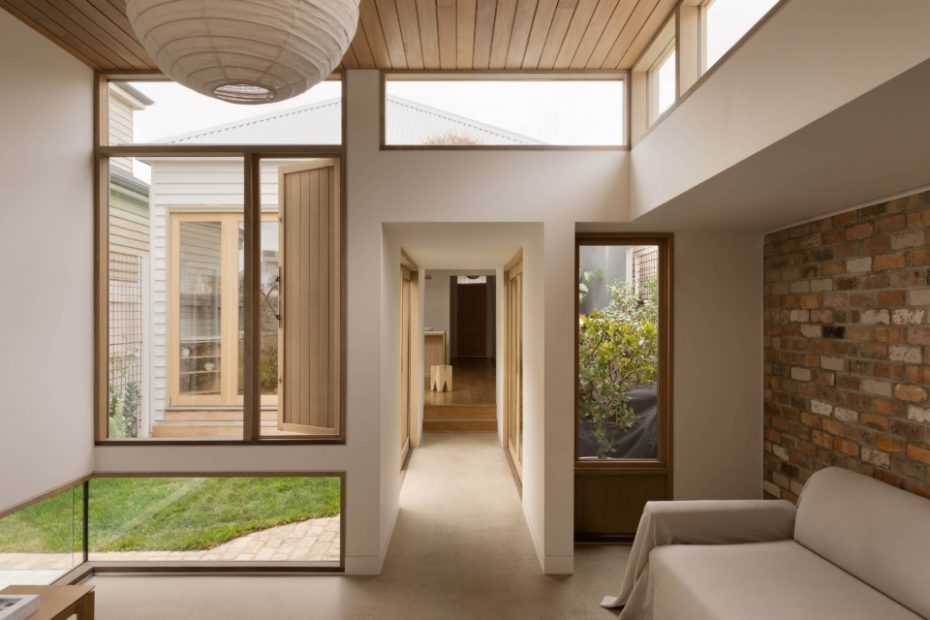
Instead of a backyard, there’s a courtyard at the centre of the home.
The calming kitchen.
An island bench and multipurpose joinery maximises functionality.
Sliding doors reveal a utility zone with the laundry concealed in the kitchen.
‘We opened up the roof space for a cathedral ceiling above the dining area to create a sense of openness and generosity without excess floor area,’ Steffen says.
Stairs lead to the main bedroom inside the extension.
The bedroom overlooks a green roof.
Layered neutrals feature across the interiors.
The original front room is now a guest room and study nook.
The hallway marks a threshold where old meets new.
The cottage facade.
When faced with renovating an inner-city block in Seddon, Steffen Welsch Architects looked for ideas in Japan’s compact, but famously innovative, housing.
‘The inspiration for our design came from the Japanese idea of “ma”, or negative space, and the way traditional Japanese houses reveal themselves gradually through compressed entry sequences and borrowed landscape,’ director Steffen Welsch says.
‘We were less focused on stylistic citations — the site itself was the primary reference.’
Despite being built in 1915 during the end of the Federation era, the weatherboard cottage follows a typical Victorian floor plan, with bedrooms occupying the front, and a poor lean-to kitchen and bathroom at the rear.
Beyond its initial heritage appeal, the house required significant work to turn it into the owner’s ‘forever home’ fit for their young family.
Steffen and his team neatly repackaged the floor plan to create a series of spaces that strike the right balance between openness and enclosure.
The front bedroom now contains a home office and guest room – a must-have for the client who migrated to Australia years ago and needed somewhere to accommodate visits from international friends and family. They also inserted a new bathroom, while combining the second bedroom with the lounge led to the multifunctional kitchen, lobby, laundry, and dining room.
This communal zone sets the tone for the restrained interiors by Amanda Tiernan from Neutral Instinct. Recycled messmate flooring, timber joinery, and neutral walls are defined by a cathedral ceiling – a strategic detail that cleverly increases the sense of space.
‘It can be hard to work out how large the house is. Depth, vistas and layering make it feel genuinely generous without needing the floor area,’ Steffen adds.
The lean-to was demolished in favour of an extension shaped around a central courtyard, as a small hallway leads to the new family room on the ground floor.
Upstairs, the main bedroom is nestled beside a green roof, which Steffen describes as an important visual and sustainable feature. ‘Looking at the green roof in a wider context of increased density in the inner suburb, it helps deal with the heat island effect [where cities experience increased temperatures caused by dark roofs], and it can also collect water to retain stormwater on your property,’ he notes.
Perhaps most importantly, the renovation also sought to future-proof the period cottage. The house is deliberately fragmented, allowing it to be used by multiple parties as separate dwellings if required one day, ensuring the structure can adapt to meet the owners’ needs without additional construction work.
On a day-to-day level, passive solar principles, improved insulation, and ventilation also help lower the household’s energy consumption.
Steffen says the best reward is seeing how well the 160-square-metre home works in practice, noting the project could be replicated to increase housing infill on similarly constrained sites.
‘I appreciate the way the house reveals itself gradually rather than all at once,’ he adds. ‘When you design, you are always nervous if it really works, but it is good to get that feedback from the family and their friends experiencing the house.’