It’s Easy Being Green In This Essendon California Bungalow
Architecture
Buy Me Flowers’ by Cassandra Lynch; Red Jug by Remy Pajaczkowski-Russell, both from Pépite Gallery.
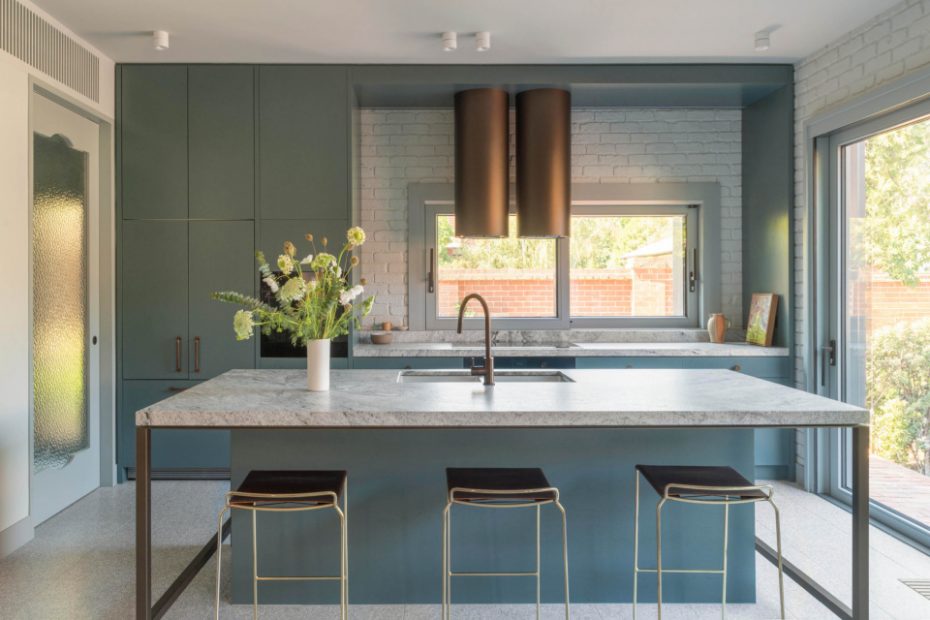
Uccio stools by Barbera Design from Design Considered.
Ceramic Vessel by Rina Bernabei; Doughnut Line Kintsugi Sculpture by Jennifer Oh; ‘Neighbours’ Sculpture by Debbey Watson; Ceramic Sculpture by Melinda Wallis, all from Pépite Gallery.
Original details were retained where possible.
Doughnut Line Kintsugi Sculpture by Jennifer Oh; Ceramic Sculpture by Melinda Wallis, both from Pépite Gallery.
A small extension for the main bedroom’s en suite was added in the narrow area available between the main bedroom and the boundary.
Durability and serviceability were as important to consider as colour, tone and texture for the materials.
The laundry was relocated to functional space.
The luxe powder room.
Deeper green tones in the front rooms work to lighten the original home.
The brief for this California bungalow renovation was nothing out of the ordinary.
The original rooms of the Essendon house had some lovely internal detailing, whereas the two-storey 1990s extension was very dated and not ageing well, calling for an overall refresh.
‘It was big enough for its large family but in need of reformatting and improving in terms of the types of spaces and how they flowed from one to the other,’ explains architect Lisa Breeze who designed the renovation. ‘The building envelope, particularly the windows from the 90s, especially needed attention.’
Lisa’s job was to rework the internal layout to suit the needs of the family, without adding too much space. The interiors also needed a refresh to feel lighter and suited to the client’s taste, who loves the colour green.
‘The space was there,’ Lisa says. ‘Through an early floor planning exercise, we worked out that a small extension between the house and boundary would be beneficial, as well removing a ground floor atrium space to provide a small extension to the first floor.
‘There was a lot of dark timber with curves, indents and layers to the paneling and doors. It was lovely, but the tone of the dark timber was oppressive.’
The only real must-haves for the client were a functional and beautiful kitchen with a walk-in pantry, bedrooms for each family member, and two work from home spaces.
To achieve this, Lisa adjusted internal walls throughout the house. ‘Removing an internal wall towards the back of the home, while relocating the laundry, enabled us to create a larger and well-proportioned open family area with living, meals and kitchen, plus the walk-in pantry,’ she says.
‘The laundry was relocated to an old bathroom space, and we built a small extension for the main bedroom’s en suite in the narrow area available between the main bedroom and the boundary.
‘These relatively minor interventions vastly improved the layout and usability of the home. It is not always possible, but this was preferred over knocking down and rebuilding large sections of the house.’
For the material palette, Lisa retained as much original detailing as possible, while reinvigorating and lightening the home up with colour. Taking into account the client’s love of green, Lisa implemented various green tones that fade to grey, using the deeper tones in the front of the home on the timber work to lighten the front of the home.
Durability and serviceability were as important to consider as colour, tone and texture. ‘We used granite with a leathered finish on the stone bench tops and vanities (easy to clean) and terrazzo tiles for the floors which conceals all manner of day-to-day debris,’ Lisa says. ‘The green painted timber veneer of the kitchen joinery elevates the finish. It is functional and beautiful.’
An expert at injecting colour into period homes, Lisa has unsurprisingly nailed the brief.