A California Bungalow’s Surprisingly Lush Suburban Garden
Gardens
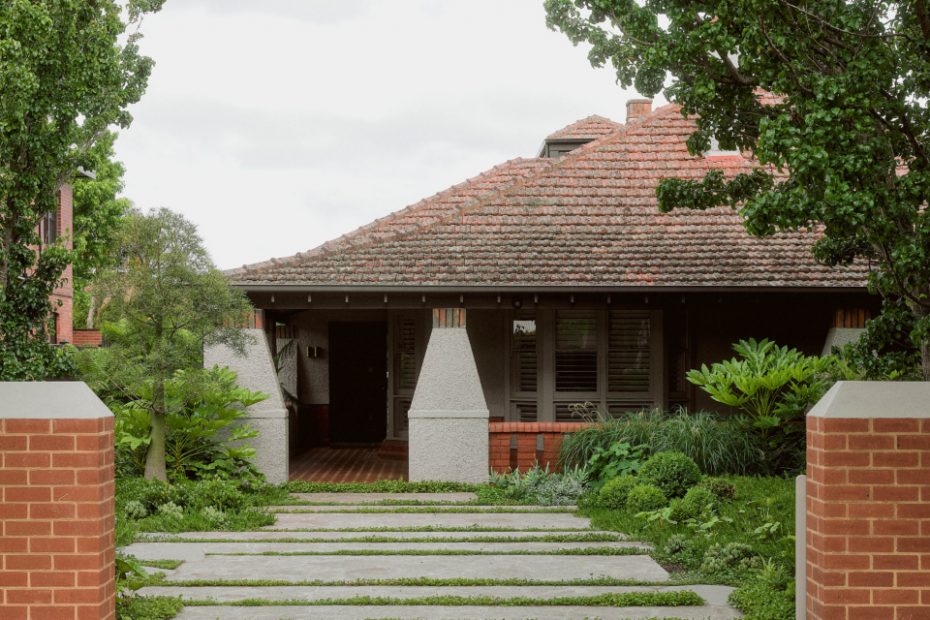
The charming facade of the Essendon home.
‘We loved the wide flat verandah and front façade with its bulging columns, brick balustrade and the mass of texture in the lichen-covered roof tiles,’ Overleaf director Paul Smith says.
Ligularia reniformis (tractor seat plant).
The landscape design maximised greenery over flat lawn spaces.
A path leads to the front door.
Eco outdoors Torino bluestone features in the pathways.
Brachychiton Rupestris (Queensland bottle tree) mimics the columns of the facade.
The existing pyrus trees perfectly frame the front yard.
Calamagrostis Karl Foerster was chosen for movement and texture.
The low fence allows passersby to interact.
Tall planting offers privacy screening along side boundaries.
Steps lead down to the pool in the backyard.
Furniture from Tait.
The modern extension is paired with more restrained planting.
The garden helps enhance the home’s rustic character and new structures.
For Overleaf director and landscape designer Paul Smith, the best thing about this Melbourne garden doesn’t pertain to a singular feature — it’s more about how it makes you feel when you step on the property.
‘The further you progress into the garden, it seems to envelop and protect you and I feel an instant sense of calm,’ Paul says of his Essendon project.
‘I love how the planting is a subtle combination of texture, shades of green and movement.’
It’s come a long way since Overleaf first set foot on the site of the California bungalow a few years ago. At the time, construction for the renovation with Bagnato Architects had already begun, which stripped away a large portion of the previous landscape.
‘Originally, the front garden featured red brick paving, conifers, roses and magnolias; a jumble of styles with no real focus,’ Paul adds.
However, two tall Pyrus calleryana (ornamental pear) trees had been retained. With luscious, shiny green leaves and narrow trunks, these two provided the perfect anchor point for the new garden.
At the front of the house, the landscaping now creates a sense of arrival. A series of bluestone pavers mark out a pathway to the front door, framed by the towering trees and a sea of layered greenery on either side.
The architecture itself was also a key source of inspiration for the planting selection. Brachychiton rupestris (Queensland bottle tree) echoes the distinctive columns on the facade, as the bold foliage of Fatsia japonica (Japanese aralia) brings a sense of lushness with its large leaves.
Arched fronds of Dicksonia antarctica (tree ferns) introduce an elegant softness, enhancing the flowing textures of Calamagrostis Karl Foerster (feather reed grass) and masses of white flowers, thanks to Anemone x Hybrida honorine jobert (Japanese windflower).
‘We wanted to create a garden that both [highlights] the character of the facade, while not conforming to a traditional response,’ Paul says.
At the rear, the design becomes more restrained to match the contemporary extension. Paving flows seamlessly from the interior to the outdoors, opening onto a simple expanse of lawn framed by boundary planting.
Steps lead down to the pool, where a vertical trellis introduces a lush green backdrop, softening the harder edges of the built elements.
Beyond the garden’s beauty, the landscaping has also created a series of different microclimates. It is now a haven for local pollinators and birdlife, thanks to the mix of native and exotic plant species across the garden.
Since completion, the garden has settled into itself, growing into a defining feature of the home. It offers a distinct identity within the streetscape, without feeling out of place. And it’s easy to see why passersby pause at the low front fence, to appreciate its abundant greenery.