Alyssa Nuttall’s Ceramics Are Inspired By Fragile Ecosystems
Creative People
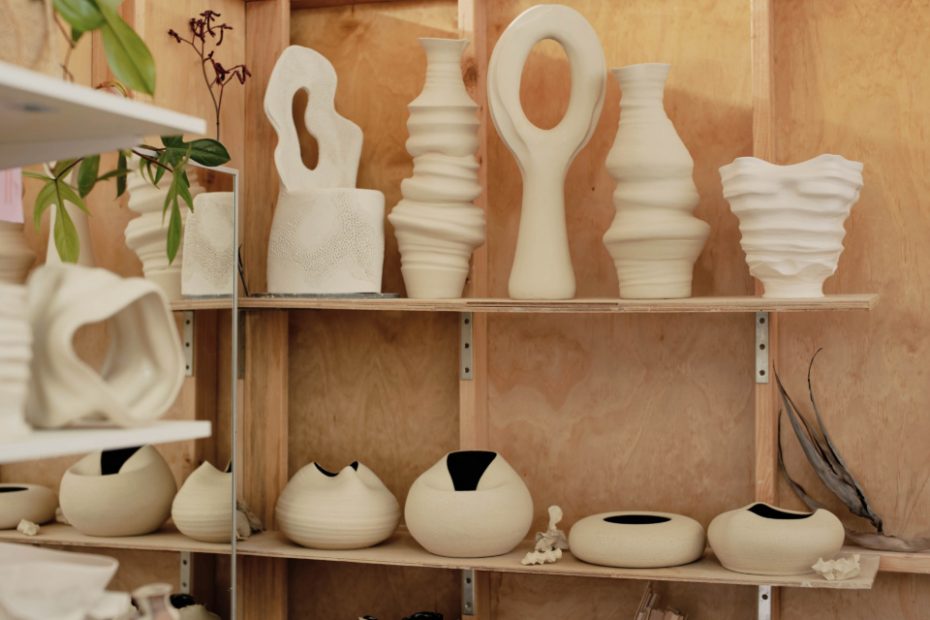
The organic-shaped ceramics of Alyssa Nuttall.
Alyssa Nuttall in her dedicated studio space at Lygon Street Pottery.
Alyssa took an untraditional path to ceramics via a degree in psychology with a minor in music.
She came across a ceramics class at Slow Clay Centre in Collingwood, and in Alyssa’s words, she ‘never really left.’
Alyssa’s current works are coral-like forms developed through processes of erosion, growth, and pressure.
The larger coral-like forms are wheel-thrown, altered, and textured both inside and out.
Creating each piece requires constant negotiation with the material, and not everything resolves as intended.
The sweet spot of Alyssa’s work lies controlling the controllable, while allowing the uncontrollable to play an equally important role.
‘I spend a lot of time recycling materials,’ Alyssa says.
See Alyssa’s work at multiple exhibitions during Melbourne Design Week 2026.
Alyssa Nuttall took an untraditional path to ceramics via a degree in psychology with a minor in music, which had her yearning for a hands-on creative practice.
She came across a ceramics class at Slow Clay Centre in Collingwood, and in Alyssa’s words, she ‘never really left.’ She now teaches wheel throwing at Slow Clay Centre, while maintaining a dedicated studio practice at Lygon Street Pottery.
Like many students, Alyssa’s initial works were guided by repetition, observation, and guidance from teachers and other artists. Over time, she’s learned to trust her own instincts and ongoing interest in fragile ecosystems, such as coral reefs, eroding coastlines, and drought-affected landscapes that hold life while remaining inherently vulnerable. ‘That direction emerged gradually, and quite frankly, out of frustration and a ‘mistake’ with a piece. I saw an interesting direction I’d not observed before and that excited me,’ Alyssa says.
Her current works are organic-shaped, coral-like forms developed through processes of erosion, growth, and pressure. They’re visually beautiful, but also conversation starters, as Alyssa explains, ‘I’m interested in embedding ecological concerns into everyday lived spaces, so they are not held at a distance, but encountered through physical, daily interaction. This allows for a quieter, more accessible awareness to sit within domestic or familiar contexts, and hopefully opens up conversation around what endures, and what is at risk.’
Each piece requires constant negotiation with the material, and not everything resolves as intended. ‘I spend a lot of time recycling materials,’ Alyssa says. The sweet spot lies in controlling the controllable, while allowing the uncontrollable to play an equally important role. She explains, ‘I spent so much time trying to be “the boss of the clay”, but sometimes it’s so beautiful to have it direct me and to follow it.’
It’s a constant learning process, and one that Alyssa hopes never stops. ‘I think it’s deeply personal work, and it feels important to stay open to that ongoing shift. I love the idea that our best work may still be ahead of us, at any age.’
See Alyssa Nuttall’s work during Melbourne Design Week 2026 at the following events: Tall Poppy at Kelli Lundberg; 100 Chairs at Abbotsford Convent; Relics and Remains at Nord; and Finite at Dowel Jones.