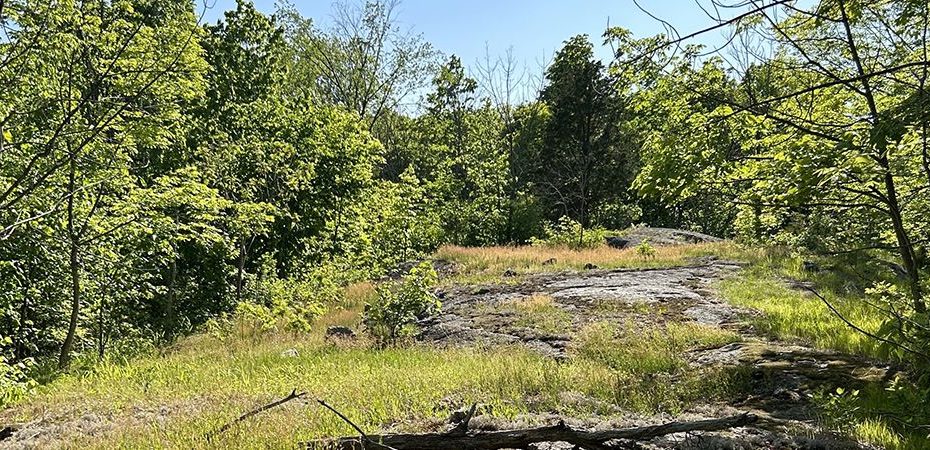
Lost Bay Nature Reserve contains an incredible concentration of biodiversity found within the unique landscape of the Frontenac Arch, one of the most biodiverse regions in Ontario. This year, Ontario Nature is looking to expand protected areas within the Adirondack to Algonquin corridor, a natural wildlife corridor between Adirondack State Park in New York and Algonquin Park in Ontario.
Canadian Shield outcrop, Lost Bay Nature Reserve © Smera Sukumar
Last spring, the Nature Reserves team visited a new addition to Lost Bay Nature Reserve, hiking through the mature deciduous forest of towering sugar maples, ironwood and shagbark and bitternut hickories. Spring ephemeral plants like trout lily, blue cohosh, false Solomon’s seal, wild leek, white trillium and spring beauty draped across the hills and valleys of the forest. From above, the canopy sang with the flutish sounds of the wood thrush, the whistled “pee-a-wee” of the eastern wood-pewee, and the buzzy call of the cerulean warbler.
Cerulean warbler © Terry Parker
Scattered through the mature forest, large granite ridges or rock barrens characteristic of the Frontenac Arch can be found. These impressive rock formations provide important habitat for species like the gray ratsnake that use the rocky outcrops for foraging, nesting and hibernation.
Gray ratsnake © Smera Sukumar
In the spring, run-off from these ridges feed into vernal pools, ephemeral streams and wetlands found throughout the nature reserve. A wide array of species depend on these habitats and the natural corridors they provide, from amphibians laying eggs in the vernal pools to great blue herons nesting in the wetlands and foraging in the nearby Lost Bay.
Vernal pool, Lost Bay Nature Reserve © Kirsten Dahl
Located within 600 m of two Provincially Significant Wetlands: Lost Bay Wetland and Wiltse Creek Marsh, the new expansion would connect surrounding wetland and terrestrial habitats. At the convergence of five forest regions, Lost Bay Nature Reserve supports globally significant biodiversity, important ecological functions and a unique suite of species at risk.
This addition to Lost Bay Nature Reserve would extend a recent 57-acre expansion in 2023, adding 18 acres to the 643 acres of permanently protected area. Along with the nearby Gananoque Lake Nature Reserve, 1,059 acres of the Frontenac Arch are now conserved through Ontario Nature’s nature reserve system.
The protection of an additional 18 acres marks an exciting step forward in extending ecological corridors in the region and increasing protected habitat for the 33 rare and at-risk species found at Lost Bay Nature Reserve. Learn more about the nature reserves near you and the expansion of Lost Bay Nature Reserve! You can help protect the health and beauty of these important natural areas by supporting the acquisition project for Thickson’s Woods and Lost Bay Nature Reserve today.
Help Us Expand and Protect Lost Bay Nature Reserve
As a charitable organization, Ontario Nature depends on the generosity of our members and other partners to protect and expand our Lost Bay Nature Reserve. Together, we can ensure it is permanently protected. Please consider helping us reach our goal to take urgent action for this time sensitive and rare opportunity to secure permanent protection.
Resources
By Melissa Thomas and Emily Edgley
Melissa Thomas is Ontario Nature’s Research Coordinator, Nature Reserves. Melissa holds a B.E.S. in environmental studies and geography from York University, and a diploma in ecosystem restoration from Niagara College. She has worked as a Wildlife Technician with a focus on Ontario’s reptiles and amphibians, and as a songbird rehabilitator at the Toronto Wildlife Centre. Melissa has a passion for education and engagement, and has worked in multiple outreach and education roles.
Emily Edgley is Ontario Nature’s Nature Reserves Technician. She holds a B.Sc. in Marine and Freshwater Biology from the University of Guelph and a diploma in Ecosystem Restoration from Niagara College. Emily has experience conducting watershed monitoring, invasive species monitoring and management, and has been involved in citizen science programing.