Disability is a deep and meaningful word, encompassing a variety of identities and experiences. It represents sensory, psychiatric, neurodivergent, physical, invisible and undiagnosed disabilities. In Ontario, 28% of Ontarians identify as having a disability. Under the Accessibility for Ontarians with Disabilities Act (AODA), disabilities can be “present from birth, caused by an accident, or developed over time.”
To understand the world through the lens of disability requires a fundamental shift in how we perceive the structures of society. Steps become impossibilities without a ramp, washrooms are inaccessible unless designated as single stall with operating buttons, nature trails are hazards without proper infrastructure, signs are illegible without colour contrasts and/or braille, benches provide respite when exhaustion sets in, transportation that does not have ramps exclude and some lighting and sounds can trigger pain depending on the person. Accessibility isn’t extra, it’s essential.
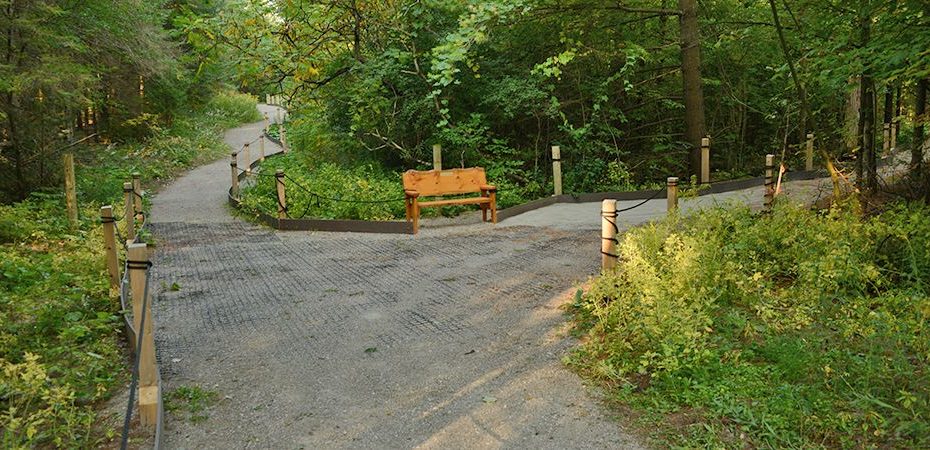
Accessible trail at Cawthra Mulock Nature Reserve © Noah Cole
There is mounting evidence that demonstrates the benefits of nature for everyone, however, if you are isolated from it, how do you stand to gain? Informed choices are integral to participation and inclusion. By creating the infrastructure for accessibility, as Universal Design Theory demonstrates, we offer more meaningful choices for those with visible and invisible disabilities.
Accessibility at Ontario Nature’s Nature Reserves
One way Ontario Nature is contributing to accessibility is by offering three accessible trails: Cawthra Mulock Nature Reserve, H.N. Crossley Nature Reserve and Petrel Point Nature Reserve.
At Petrel Point Nature Reserve, the boardwalk has been upgraded to improve safety and accessibility for better outdoor recreation experiences and there is a system of well-marked trails, including newly installed interpretive signs. At Cawthra Mulock Nature Reserve, the 538-metre trail includes guiding ropes, is graded to a maximum of 10% for 20 metres and the surface is pea gravel. There is also a system of well-marked trails, including interpretive signs. And H.N. Crossley Nature Reserve features a 130-metre wheelchair-accessible trail that is made of crushed gravel, which leads to an accessible lookout platform over the fen and surrounding Provincially Significant Wetland. These design details are significant in the quest to make nature accessible to all.
Accessible boardwalk at Petrel Point Nature Reserve © Gabriella Zagorski
Prescription for Nature: A Routine of Wellness
Over the last two hundred years, alarming rates of disconnection between some people and nature has developed. This can be attributed to a complex combination of erosion of nature, lack of green urban environments, the climate emergency and people not being introduced to nature at a young age. Combine this with a lack of accessible infrastructure for those with disabilities, and accessibility, in this sphere, becomes even more imperative. This is partly why Canada has adopted the prescription for nature initiative (PaRx).
PaRx is an evidence-based nature prescription program “driven by health-care professionals who want to improve their patients’ health by connecting them to nature.” It is a program that encourages people to engage in outdoor programming, both in their daily routines and local communities. It also fosters easier and better access to nature by working with partners to provide “special offers” that reduce barriers.
Accessible lookout at H.N. Crossley Nature Reserve © Zane Davies
In 2021, PaRx was launched in Ontario with great success and support from Ontario College of Family Physicians, Nurse Practitioners’ Association of Ontario and Association of Family Health Teams of Ontario. So far, program participants include Halton Healthcare with Conservation Halton, the Toronto and Region Conservation Authority, the Northern Ontario School of Medicine and Windsor Essex Ontario Health Team. PaRx has proven to be an innovative and accessible way to get more people in nature.
There is a growing accessibility movement within environmental conservation that prioritizes advocacy, adventure, wellness and inclusion. Its significance cannot be overstated. Disability encompasses a wide range of lived experiences and looks different from person to person. What remains certain, however, is that accessibility is about reducing barriers and that benefits everyone.