A studio with the pedigree of Remedy Entertainment and the launch of a franchise as incredible as Control gives Control Resonant everything it needs to succeed – or so it appeared.
Control Resonant is at its very best when following the blueprint set in the original Control. The self-contained side quests and the linear sequences of the main story are as engrossing and immersive as one can hope for. However, these moments of narrative brilliance find themselves marred by the needless open-world sections that do little to add to the experience.
Rather than feeling immersed and excited to see the next crazy twist, the by-the-numbers open-world design proves to be its greatest downfall.
Control Resonant Review
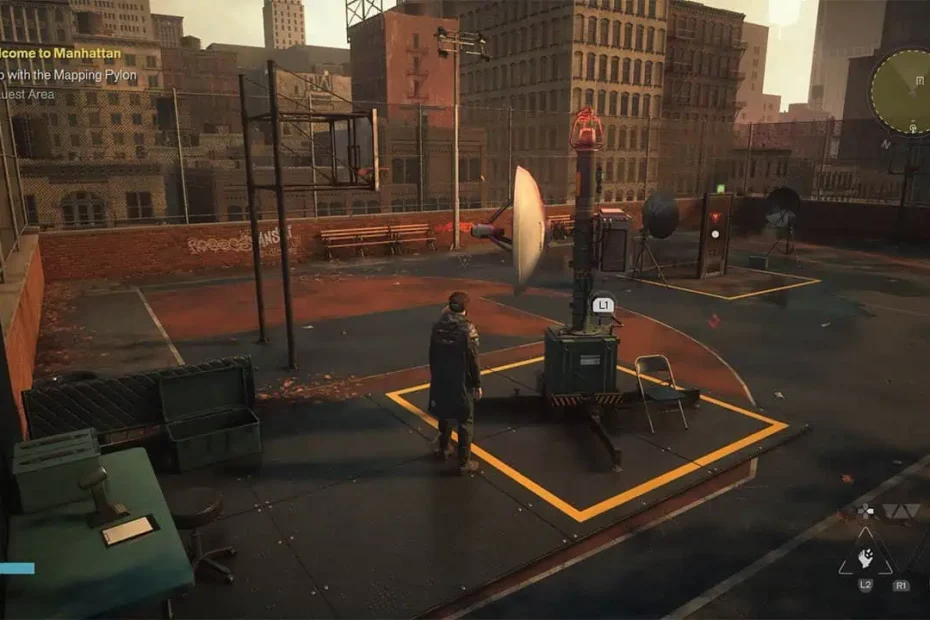
An annoying tower mechanic to reveal the map, a radar that shows no terrain – each of these elements leaves players constantly checking the map to navigate a needlessly complex world. When paired with repeated puzzle mechanics and the same “exploration” rewards throughout, it stands out as jarring when compared to its visually stunning world.
It almost feels as though two completely different games were mashed together at the last moment in Control Resonant.
On one hand, its world and story can be terrifying, creepy, fascinating, and a true wonder to explore. However, a shallow and soulless sequence of open-world challenges and tasks could not be more in conflict with the rest of the game.
Even the term open-world feels generous, as it’s anything but open.
When tracking down one quest, I met an area that I could not reach until I unlocked a specific traversal ability. Swapping to the next quest, my progress was blocked by a door I was unable to access without progress elsewhere. In another quest, I was met with enemies too high to defeat.
Far too often I became frustrated because I hadn’t managed to find the single alleyway and door that led to progress in the right quest. This ended up making exploration more of a chore than a rewarding venture.
Although the weakest area of the game, the open-world sections aren’t completely void of value. One of the more outstanding features comes in the form of a traversal ability: the Gravity Shift. When navigating Manhattan, Dylan can use this ability to alter gravity, walking up vertical walls or attaching to ceilings, which then become the floor.
It’s a feature that has to be played to be understood. Switching between different dimensions as you’re avoiding attacks from the Hiss and the Mold is a sight to behold.
Faults offer new traversal abilities and the chance to learn more about Dylan and Jesse’s past
Although visually cool, its near-perfect implementation is what stands out as truly impressive. In a world where nothing is normal, entire streets have vanished, roads litter the skies, and cars and bodies float at every turn, trying to direct the player to the exact locations that support the Gravity Shift was no easy feat, but it works throughout.
It definitely messes with your brain, and you’ll get a bit discombobulated in a couple of places, but it adds a level of excitement and wonder to an open-world that is otherwise missing.
Probably the single best aspect of a much bigger Control game, the lore in Control Resonant is incredible.
In my Control review, I mentioned how often I was lost in the gathering and reading of every collectible I could find, absorbing the knowledge of the world at every opportunity.
The same rings true in Control Resonant. Despite its shortcomings, the narrative and world are as intriguing as ever, and Remedy Entertainment uses every storytelling tool to deliver one of the most fascinating worlds in gaming.
There are several sections where you’ll avoid the open-world Manhattan for a couple of hours, such as navigating a time conundrum in The Underpass. These sections carry the same quality and awe of the original – but are few and far between.
Hunting down Resonants is another worthwhile distraction from its admittedly unimaginative open-world activities.
Massive and disturbing boss battles interact with the world in different ways; once a Resonant has been defeated, a new Resonant Cycle begins. This alters the game world by introducing more enemy types, resetting many encounters, refreshing World Feats, increasing rewards, and increasing combat difficulty.
If combat is too challenging or not very engaging, you can turn it off.
Control Resonant features an “Assist Mode” option that allows players to alter a variety of settings that include increasing or decreasing both player and enemy damage, changing the speed of projectiles, and increased Power recovery.
Alternatively, players can turn on Immortality to never die, or turn on One-Hit Kills to kill all enemy in a single swing.
Yes, this includes every boss in the game.
I tend to normally ignore these features, but the One-Hit Kills definitely removed a level of frustration when growing weary of trying to find the right route to the next objective.
Combat and progression are probably the two areas in Control Resonant that have seen the most improvement. While breaking away from Jesse’s more range-focused style, Control Resonant delivers a faster-paced style of play complete with combo attacks, status effects, and dodge bonuses.
Personally, I enjoyed the original game’s combat more. However, the level of depth and variety found in Control Resonant makes this a sequel in every sense of the word, one I think most players will see as the better of the two.
An interesting respec mechanic gives players access to a unique area in which to test unlocked abilities and combos, with the option of resetting progress and switching paths readily available.
Control Resonant is another masterclass in storytelling from Remedy Entertainment, but its potential for greatness is hindered by a completely detached open-world experience.
Control Resonant Review
Reviewed On: PlayStation 5 (A digital code was provided)
Release Date: September 24, 2026
MSRP: $59.99
Platforms: PlayStation 5, Xbox Series X|S, PC (via Steam)
Developer: Remedy Entertainment
Publisher: Remedy Entertainment
Aggregate Scores: Metacritic / OpenCritic / CriticDB
Whether taking on Daredevils or tapping into its deep customization elements, Hot Wheels: Infinite Rush and its vast open world truly lets players race beyond the track.
While The Blood of Dawnwalker and its dark fantasy vampire setting is well worth exploring, best wait for a few patches before exploring its vast open world.
The way of the samurai shines bright in Onimusha: Way of the Sword, marking a triumphant return for Capcom’s long-running action RPG series.
Star Wars Zero Company is, simply put, the greatest tactics game in the galaxy.
Continue Reading Star Wars Zero Company is the Chosen One of the Tactics Genre – Review
Those fiending for the start of the NFL season will enjoy Madden NFL 27, but this title can still use a few patches to iron out its balancing.
While there is something special brewing in The Sinking City 2, the development team simply needed more time with this release.
The post Control Resonant Review appeared first on GamersHeroes.