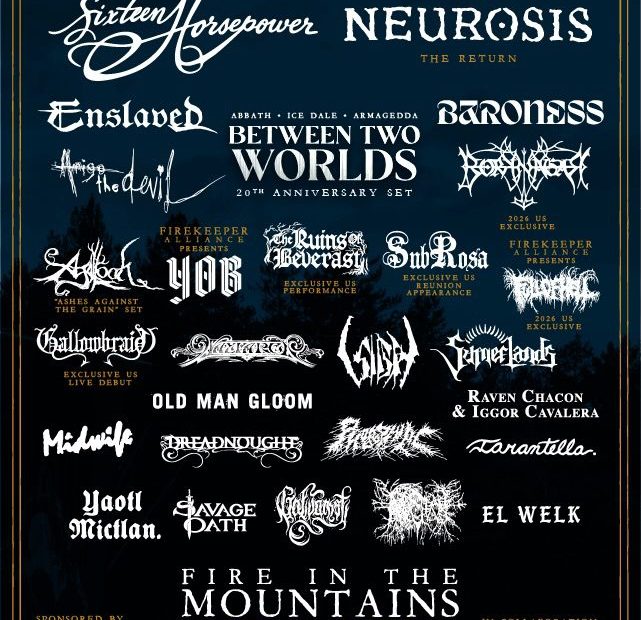
Over the course of its history, Fire in the Mountains has become one of the most talked about and highly anticipated extreme music festivals running. That was even before it was announced that this year’s edition will showcase the reunited Neurosis! The festival’s focus goes beyond curating a killer and exclusive line-up to include and incorporate focus on environmental activism, mental health initiatives, indigenous history, bridging gaps between communities and, through the work of the Firekeeper Alliance, shining a light on the plague of indigenous suicide. As well, the work of the organisers and promoters extends beyond the mere show dates to include months of preparation and participation with the people of the Blackfeet Nation, the festival’s hosts, at the Red Eagle Campground in northwestern Montana. With such a broad mandate, mission and involvement, it seemed only natural to sit down with all the principles involved to discuss the nuts and bolts of Fire in the Mountains and what separates it from other festivals, outside of the reunited Neurosis being on the bill. Included in the group call were Ryan Kendall (site director and chief operations officer), Ollie Tripp (operations director), Wayfarer guitarist/vocalist Shane McCarthy (head of programming, curating and booking), Shannon Void (director of PR and social media), and Jeremy Walker (owner, cofounder and festival director). [*Note: the lack of Neurosis fanboying was the direct result of this interview being conducted before the surprise announcement of their performance]
This is going to be the second year for the festival at the Red Eagle Campground/Blackfeet Nation site. What did you learn from the first year and apply to this edition? And how would you characterise the differences between the previous site and the Blackfeet Nation site?
Shane: It’s been a massive change. For a little bit of history, the very first Fire in the Mountains event was in 2015 and that was Jeremy, Ollie and our old partner, Alex [Feher] who put together an off the grid event in the mountains of Wyoming near where they lived in the Jackson/Yellowstone area. It was less official than it is now. I was brought in pretty early from the Wayfarer side, but it seemed like the goal from the onset was a pairing of music and landscape — powerful music with a powerful place and building a community gathering that is somewhat of an escape, but also somewhat of a cathartic experience to be shared involving music, nature and the outdoors. That spirit has definitely continued, grown and evolved as the festival has grown and evolved. Moving to the Blackfeet Nation in a beautiful valley next to a lake on what is called the “backbone of the world” has changed so much about it. We’ve all learned and are actively learning so much about the process of that change. It’s really being welcomed by a community that wants us there and believes and trusts in what we’re doing. On their side, they have things they want to tackle using the festival as a platform. That’s mostly centred around combatting youth suicide on the reservation and in Indian country. We’ve learned so much over the time working with the people there and working with the tribal council, the community, the Firekeeper Alliance and how their community works. They’ve welcomed us with open arms and it’s been truly special to learn about the community and find ways to help and contribute, especially to the youth involving music and what we do.
Jeremy: Without question the new site is a really dynamic piece of land to have a festival on when it comes to having the lake there, more wooded areas and established campsites as opposed to where we did come from in the Jackson Hole area which was more of a horse pasture in a field. It certainly had beautiful views, but it was a different landscape.
Shannon: Just to piggyback on what Shane said, there’s more purpose in this new location. I joined with Fire in the Mountains in 2022 when the mission was more land-based and environmental. We still have a sense of place, environmentalism, caring and being stewards for the land, however I think our mission has shifted. We’re now amplifying the beauty and grandeur of the Blackfeet people, helping to hear their voices and trying to have people understand that indigenous cultures aren’t just about sadness and tragedy; there’s also beauty, tradition and celebration and that’s been big part of the shift in the vibe.
What happened with the previous site?
Shannon: Money gonna money. Rich people gonna rich [Laughs].
Jeremy: To be honest, it was a lot of NIMBY-ism with people who didn’t want a music event like this close to private property. We even made concessions to make it once every other year, not even an every year thing, and that wasn’t good enough. There was a lot of that attitude with the decision makers within Teton County and the county commissioner in particular who didn’t renew our permit on grounds of the festival needing to get to a certain population size to make it viable. They didn’t want to give us the ability to get to where we wanted to go. They didn’t really want it there at all. We’ve moved to a community of people who are excited to have us and, in all honest, deserve to have us there. Especially with being invited to be on the land of the Blackfeet Nation at Red Eagle Campground; it’s an honour we don’t take lightly. We’d do this inherently but it means a lot to us when we can repay that honour and privilege of being there by having an awesome impact on the community in a lot of ways.
Shane: It comes down to judging a book by its cover. We were going through so many lengths and bending over backwards to be good stewards in the community. Ultimately, they could not get past having a heavy metal festival in their quaint town that they already bring big money tourism into. The world of difference of how it feels to be invited and welcomed and wanted in the area we are now is beyond words.
It must be infinitely easier on all levels to do this when you’re not having to fight a bureaucracy. How does that cooperation help in terms of wanting to do or try things differently than other fests?
Shannon: I think it’s given us a new sense of purpose and allowed us to create this truly special and unique environment where people want to come and reunite with their band mates they haven’t spoken to in years. Look at 16 Horsepower and SubRosa. These bands are choosing to come to Fire in the Mountains to have this reuniting ceremony of sorts in this beautiful landscape. I know this is going to sound really cheesy, but it’s created a vibe that people can feel outside of the festival. When I talk to people in the industry, people are like “I have to go!” I can see it on their faces and they can feel the energy coming out of the words that I’m saying and the vibe I’m putting out. It’s created a path for us that’s much different than the path we were on previously. Don’t get me wrong: logistically, it’s still very difficult to run.
Jeremy: We had our fair share of logistical issues and red tape in the Jackson location that we don’t have here, but putting on an event like this on a reservation has its share of logistical issues. Even if it wasn’t on a reservation, this location is more remote than it was previously which creates a ton of logistical and operational issues. People need to be motivated and really pumped to come to this thing because it’s harder to get to. People need to understand that the journey is part of the allure of this festival and event. There’s nothing like driving through Montana and I hope that people really take that as part of the holistic experience of the event.
What’s going to be different this year?
Shane: One thing that immediately comes to mind is the ceremonial aspect that was brought in by the Firekeeper Alliance, the tribe and the tribal council. Last year we opened with the Blackfeet ceremonies on the Thursday of the festival. At that time, it being our first year and that aspect being developed later in the planning of the 2025 festival, it was only open to the people arriving early for camping and for VIP ticket holders. That Thursday opening ceremony, to me, was one of the most special parts of the entire thing. I got to watch several of my favourite bands play and a lot of incredible metal things happened, but the part that stuck with me was being invited to witness and be a part of a ceremonial experience like that, the pow-wow, the performances, the presentations. One of the big things taken away from that was wanting to open that up to everyone and integrate that aspect further into the festival, making it available to everyone and encouraging everyone to join in and experience.
Ryan: Logistically, we were taking notes the entire time last year since it was the first time the property had ever been used in this way. Our site design was a first time rinse and we were all taking notes about every little aspect the entire time, what we liked and didn’t like. Coming back to the drawing board this year, we added new roads, we’ve moved vendors around and made small changes that make for big changes on site. People who were there last year and are coming back are going to feel a much smoother entry, easier ingress, easier parking, easier to get around, more options of things to see and do in one nice flow path whereas last year we were working through some of the new site challenges.
Jeremy: I think the vendor experience is going to be better. Not that it was bad last year, but it’ll be larger and people are going to be able to hang out in almost more of a shopping experience kind of thing with vendors from all walks of life, especially the Blackfeet vendors.
So, the vending isn’t limited to band merch?
Shannon: Band merch is a completely separate area. It more like a marketplace where we have our Fire in the Mountains merch, then we have our general store, then vendors from outside the Rez and Blackfeet vendors.
Ryan: We’re super-focused on unique craft offerings and artisanal vendors. We’re also having a tattoo shop this year which is something that is very rare at festivals that Shannon’s husband is running. We’re really trying to go after an artisanal craft experience that incorporates the local artisans as well as people from all over the pacific northwest and west coast.
Jeremy: Economically, one of the biggest successes at Fire in the Mountains for the Blackfeet people was the vending. This is something the tribal council was really happy about with us being there, the vendors all said it was the most revenue they’ve pulled in at any event they’ve ever vended at on their land. That’s huge and we’re expanding upon that. It’s a really cool opportunity for people coming from all parts to see some pretty unique Blackfeet and food vending. I’m excited to see that aspect of the festival grow and become a big pillar of the festival.
What were the reactions from locals like to the festival? What did people who don’t normally have a metal festival in their backyard have to say about a metal festival in their backyard? On the flipside, what were the reactions of artists and patrons who came from elsewhere and witnessed life on the Rez and Blackfeet land?
Ollie: The biggest things I heard from the people I was working with ahead of time during the set up was that they were blown away because they didn’t expect anything this big or organised. They were all stoked that we pulled it off on their land. People were saying they were going to come back this year and tell their friends that they can’t miss this event. I felt like that, because we were people coming in and setting stuff up in their tight-knit community, the level of trust we got by the end of the festival went through the roof. We came in and people were like, “I don’t know what you guys are planning here. It looks like it’s going to be cool…I think.” And you could see it in their eyes when they came in and saw the two stages, people were like, “What the fuck is happening right now?!” And it was wild because it was so unexpected that it was even there. Like the first year we had a wood stage and finished it the morning of, right before the bands went on. I think that’s sort of what they expected. They could feel the level of care we put into this festival, and the improvements we’ve been talking about for this year are all because of that.
Jeremy: I’ve had Blackfeet friends use words like “ceremonial,” “spiritual awakening” and “healing” to describe Fire in the Mountains and that is huge and brings rushes of all sorts of emotions.
Shannon: Jeremy and I participated in a buffalo harvest ceremony last week and the leader of that ceremony said to me that this event is crucial for us to have every year because it is a ceremony that starts the day we start planning it and it goes until the day the fire burns out in the fire pit. I lost my shit when he said that. It also helps that we’ve gotten involved in the community there and there’s a trust we’re building with a lot of people who are skeptical about what we’re doing because, let’s be real, it’s very christian there. However, we do a lot of work there and I think the community seeing their children, grandchildren, cousins, aunts and uncles participating in such a powerful even in an intimate way has really changed people’s hearts. We have the internship program where we are taking up to 40+ kids and placing them with workers on the Fire in the Mountains team and giving them this real life experience and options. Maybe they do or don’t want to work in music, but it’s giving them perspective and options and the community seeing us do things like that is really a game changer.
Ollie: One of my favourite things happened when we were still planning everything out. We were talking to the sheriff’s department and he kept saying, “Look guys, I don’t know how we’re get along with you people. No offence, but you guys are kinda weirdos.” That’s what I went into, which is kind of what we all expected. But the comment I got from everyone is that these are the nicest people I’ve talked to in a really long time. That, coupled with the sober camping stuff, made it that people were better able to communicate more with the people who lived there and they were stoked with our attendees.
Jeremy: Being alcohol-free has a lot to do with that.
Shane: It does and from the artist’s side, we received a lot of feedback. Some artists had a little bit of trepidation in coming to an Indian reservation: are we going to be welcomed here? Is it going to be strange to have us here? But so many artists had the experience where everybody here seemed happy this was happening and welcomed with open arms to have the event here and to have the artists perform. Bands like Wardruna and Converge had pretty deep experiences being involved in a lot of the ceremonial aspects that the Blackfeet brought and they were all so moved by how welcomed they were and the merging of cultures on display. Most of all the artists I talked to enjoyed the experience of the festival, not just because it was a beautiful campground to be in, but that the people were welcoming and the culture was on display.
I don’t know if it’s too early to tell, but has the festival and its engagement with the community had any noticeable impact on suicide rates?
Shannon: I can’t speak to the numbers, but I spent the whole past week at the school helping with the music symposium class and there’s absolutely a difference in the confidence of the kids, the participation of the kids, the kids showing up to school wanting to be part of the class and the festival. The first year, when the internship program was mentioned to the class, most kids were hesitant. They didn’t know what to expect, some of them were scared and had a lot of anxiety about it. This year it was like every hand was in the air wanting to do it. I had over 50 applications filled out on the spot. Last year, a lot of the kids were not as communicative. A lot of them had their hoods up, were sitting at the back of the room, not really talking to anyone. All those kids now have little groups of friends and whatnot. I’m not saying that this is a direct result of what we’re doing, but I can tell you that it’s helping and it’s definitely giving these kids purpose and giving them a reason to come to school instead of staying home and dwelling on their shit. The class was full, the kids were engaged, they were stoked to talk about the internship program and fill out an application. It was a complete about face from last year and that’s awesome to see. I think they feel a part of something. They see the festival and think, “I helped build that stage. I helped put this merch area together. I helped with the lighting on the stage” and that is special to see and hear.
Jeremy: I think it was Ollie who came to me last year and told me that some kid told him that he had never looked forward to anything before in his entire life before Fire in the Mountains. We’re talking about high school kids — 15, 16, 17 years old talking about how they’ve never looked forward to anything in their lives and they are now looking forward to Fire in the Mountains. Statistics are important, but man, that’s just as good as any statistic.
Has this created a host of booking challenges for you? Are you finding yourselves having to juggle more requests and fend people off because of the reputation the festival is building?
Shane: We’ve been getting a tonne of interest from all sorts of areas, which is awesome. It’s cool to see that not only is it getting a good reputation as a cool thing in the world of metal, but people are starting to catch on to what it is beyond just the show and want to be a part of it. We’re getting a lot of interest from people who we might have had to knock on a lot of doors and bark up a lot of trees to get to talk to us. People are more willing to talk to us or straight up approaching us at this point, which is awesome. We have such a long backlog of artists and friends in bands who’ve gotten in touch wanting to play, which is awesome. We have a list of 150 artists we have to weed through each year and each year new ones get added of who we want on it, which is a great problem to have. It’s awesome to see that what’s happening is circulating and resonating enough with people that artists are interested in being a part of it and we don’t take that for granted.
Was the collaborative set between [indigenous experimental musician/artist] Raven Chacon and Iggor Cavalera something they planned or your suggestion?
Shane: That was something they suggested. We were already in touch with Raven because he’s connected to some of the artists we had play in 2025 and some of the cool experimental music stuff that he does. We actually reached out to him about performing and he mentioned he’d been doing this collaboration stuff with Iggor, and would we be into that? Yeah, of course we’d be into that! We’d actually already tried to book the Cavaleras, but I believe Max is busy with Soulfly at the time. It’s super exciting to have Iggor come and I think he’s going to participate in some of the workshop and panel discussion stuff.
What about those workshops and panels?
Shane: We’re going to be rolling out and making the first announcements this week or next. It’s a cool spectrum of things that are based around nature and the land, things that are connected around mental health and wellness in a general sense, things involving Blackfeet culture, Blackfeet perspective and things involving musicians and their art and combinations thereof. There’s one being put together about performing metal vocals and singing and having some of the artists be part of that. There’s another edition of a panel that happened last year called Music as Medicine which has moderators from the Blackfeet Nation speaking with some of the artists there, there’s the Missing and Murdered Indigenous Women panel which will be returning from last year. There are 20-plus workshops over the three days.
Ryan: The workshops are spread between two unique areas and overlap each other and basically start at 8AM everyday and go until music goes. The workshops are an integral part of our daily activities before music becomes the thing.
Have you found an uptick in inquires from indigenous metal bands — the ones that would normally tour reservations and only play for those crowds — about wanting to play?
Shane: Yeah, we’re definitely seeing an increase in inquiries from bands that are new discoveries for us, that are indigenous metal or indigenous performers, which is awesome. Again, it’s one of those things that goes back to having a good problem and wishing there was space to bring on so many more than we can. Even though 29 bands seems like a lot, once you start putting together the lineup, you’re telling 100 bands no. That’s definitely a cool thing: to discover new bands and artists. There’s definitely some we’re familiar with and are fans of previously, but I think as we dive deeper into what Fire in the Mountains is, we’re discovering indigenous artists all the time. We’ve had some help either from the Firekeeper Alliance or Alan from Pan-Amerikan Native Front who was invited last year to perform and speak at some of the panels. He’s been continually in touch with us and put us in touch with Nocturne who are coming up from the Navajo reservation to play. It’s a cool, ever-expanding world of indigenous heavy metal and related things that everyone should keep an eye on and we’re definitely trying to integrate more of it into the festival.
And you wanted to end with a note about the sobriety aspect of the fest?
Ryan: From my perspective as someone who’s been working with Fire in the Mountains for my second year and who full-time produce events all over the globe, I’d say one of the more unique things about Fire in the Mountains, aside from all the things we’ve touched upon, is the fact it’s a dry festival. Not only in that we don’t sell alcohol, but that we don’t allow alcohol in. What I noticed is that creates is an environment to connect. You asked about how the Blackfeet perceived metalheads and what I noticed was this open door for communication and connection almost immediately and I think sobriety has a lot to do with that because people were genuinely interested in being there and not overcome by alcohol, drugs or whatever else. It was a lot easier to connect with people and I myself connected with tonnes of 70+ year-old Blackfeet. But you also had these extreme looking people sitting down and eating lunch with old cowboys. It was a commonality across the board; every Blackfeet elder I gave a ride to or helped get to a place, I asked them what they thought and they were all like, “I hate the music, but everyone is so cool that I’m definitely coming back to this.”
Info and tickets: www.fitmfest.com
The post Q&A: An Interview with the Fire in the Mountains Festival Crew appeared first on Decibel Magazine.