How This Terrace Makeover Solved An Unconventional Problem
Interiors
Pinch light designed by Coco Flip for New Volumes. Esoteric sconce by Mariza Galani. Scala travertine by Eco Outdoor.
Pinch light designed by Coco Flip for New Volumes. Scala travertine by Eco Outdoor.
The garden entrance to the Parkville home.
Calacatta Viola by Artedomus. Model 2065 Pendant by Mobilia. Stools from CCSS. Anton Micro light by Volker Haug. Nieve tiles from Tiles of Ezra.
Calacatta Viola by Artedomus. Model 2065 Pendant by Mobilia. Stools from CCSS. Anton Micro light by Volker Haug. Nieve tiles from Tiles of Ezra.
Calacatta Viola by Artedomus. Model 2065 Pendant by Mobilia. Stools from CCSS. Anton Micro light by Volker Haug. Nieve tiles from Tiles of Ezra.
Art wall hanging ‘Assemblage I’ by Sundance Studio.
Artwork ‘Air Field Landing’ by Evelyn Crocker.
Ginger Wall light by Est Lighting. Dining chairs form CCSS. Dining tables designed by Studio Heck and built by Proper Carpentry. Anton Micro light by Volker Haug.
This Parkville house had many problems typical of inner-city Melbourne terraces, except for one feature: it had too much sun.
‘Due to its orientation and flanking neighbouring terraces, natural light to internal and outdoor spaces is largely western. Direct summer light could be at times overbearing,’ says Jack Monte, director of Studio Heck.
This shortcoming was one of the key issues addressed in a recent renovation by Studio Heck, focused on improving the overall liveability of the family home’s ground level.
‘The project scope was never to extend the house and given the limited site area, increasing the footprint would have come at the expense of valuable outdoor space,’ says Jack of the brief. ‘As such, we focused our efforts on making the existing volume work harder rather than expanding it.’
To maximise the 55-square-metre ground floor plan, Studio Heck drew on their experience in hospitality design from their recent projects, including Pendant Public Bar and Esplanade Hotel Inverloch.
Jack explains, ‘In hospitality design we often plan the circulation routes first and then map the seating areas accordingly. This ensures a practical layout where the maximum number of patrons feel comfortable in the space and functionality is maintained.’
Built-in elements such as banquette and bench seating further consolidate functions and free up circulation space, while curvilinear geometries help negotiate misaligned existing conditions, soften transitions, and allow the plan to resolve more fluidly.
With practicalities addressed, Studio Heck turned their attention to the material palette, opting for a largely neutral but textural palette to ensure a light and airy feel for the space, with Artedomus Calacatta Viola as the centrepiece.
‘The viola is a beautiful, timeless calacatta and brings all the design elements of the space together,’ says Jack. ‘We used it vertically as well as on the horizontal surfaces of the kitchen joinery to create a kind of sculptural focal point. It has a presence that holds its ground, but also doesn’t overwhelm.’ Walnut features across the joinery elements including the custom made table and booth seating.
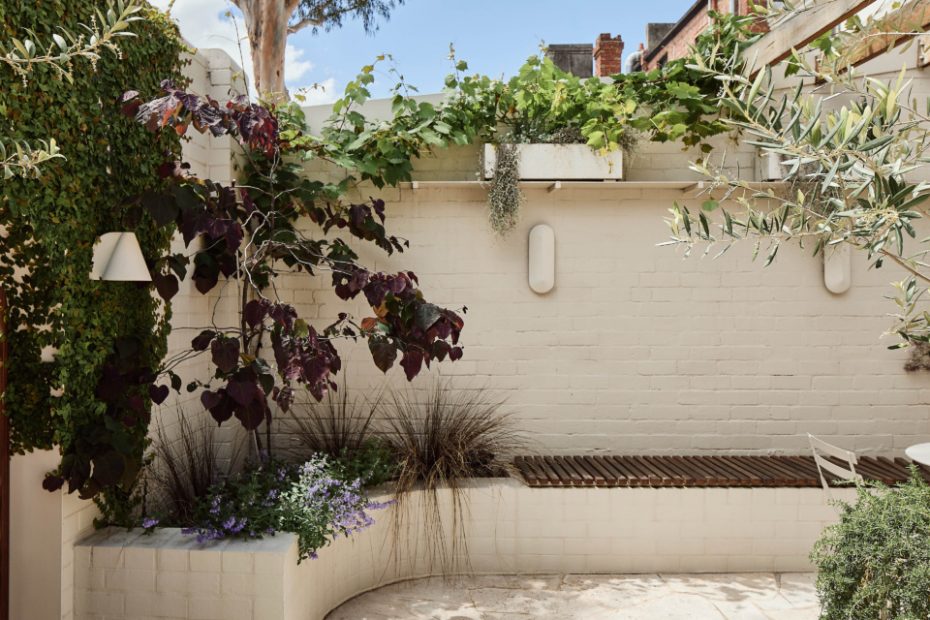
Last but certainly not least was updating the courtyard to shield the house from harsh sun and provide a treasured outdoor space. ‘We tried to include as much garden as possible in an effort to create a little microclimate that could cool the west facing courtyard and the adjacent internal spaces,’ says Jack.
In response, Studio Heck designed a timber trellis for an ornamental grape vine to eventually grow over the space, with Scala travertine crazy paving underfoot that plays with scale to make the compact space feel larger and more dynamic.
Despite being an interior design firm, this garden became Studio Heck’s favourite element of the project. ‘We applied lighting fixtures and joinery ideas as though it was an interior space, so it has the feel of an additional room for the house,’ says Jack. ‘This area was previously very utilitarian and has now become something of a garden sanctuary for the clients.’
Post renovation, the home better accommodates both everyday routines and social gatherings, offering the family owners spaces for connection, rest, and retreat as per Studio Heck’s design philosophy.
Jack adds, ‘Anything we can do to make the lives of our clients a little more joyful keeps us motivated to continue what we do.’