How To Transform Your Balcony Or Rooftop Into A Thriving Garden
Gardens
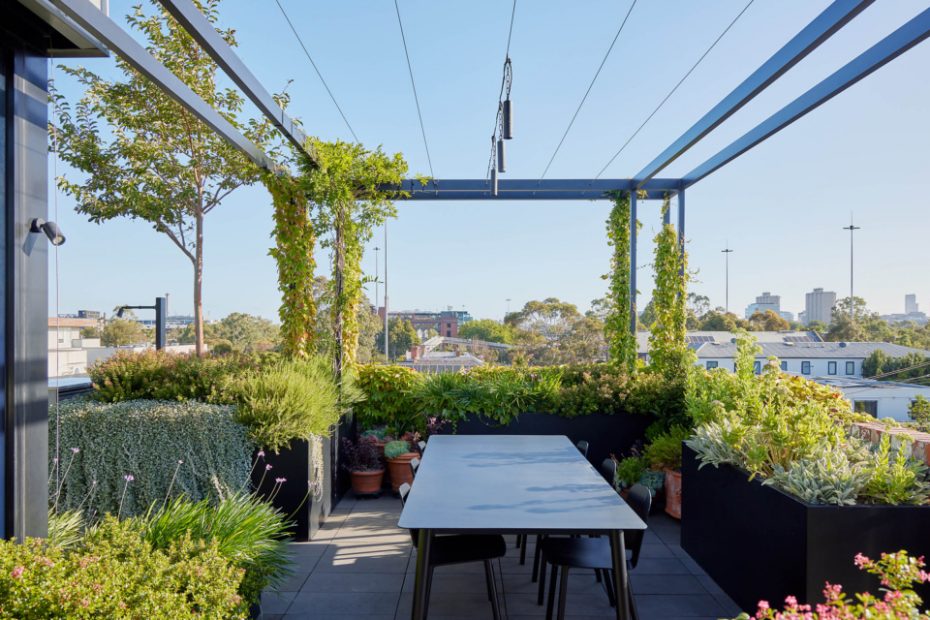
Clifton Hill Rooftop by Ian Barker Landscapes. Photo – Holly Hawkins
Boxed planters are great for giving a rooftop or balcony garden some structure. Photo – Holly Hawkins
Photo – Holly Hawkins
Wisteria floribunda ‘Royal Purple’ climbs across the overhead structure. Photo – Holly Hawkins
Dichondra ‘Silver Falls’, Trachelospermum jasminoides, Tulbaghia violacea, Lagerstroemia x ‘Biloxi’ trees and Sedum ‘Autumn Joy’ are some of the key plants. Photo – Holly Hawkins
The planting frames views of the city. Photo – Holly Hawkins
Waverley Rooftop by Ian Barker Landscapes. Photo – Claire Takacs
The planting palette for this rooftop garden consists of naturalistic plants. Photo – Claire Takacs
Helenium ‘Mahogany‘, Sanguisorba ‘Tanna‘, Achillea ‘Terracotta‘, and Calamagrostis ‘Karl Foerster’. Photo – Claire Takacs
Living in an apartment or small home shouldn’t mean giving up your dream of having your own garden.
In fact, with the right amount of sunlight, plants, and a bit of determination, you can still create a lush little outdoor space on a balcony or rooftop.
With more than 30 years of experience designing, constructing and maintaining beautiful gardens of all shapes and sizes, below Ian Barker reveals his advice for establishing a thriving rooftop or balcony garden.
What are the biggest challenges rooftop or balcony gardens present?
Water is the first practical challenge, and it’s a curse if you’re not prepared. You need to make sure your balcony or rooftop is genuinely waterproof before you do anything else. Wind is another major factor that people underestimate. On a rooftop, wind will knock over a round pot faster than you’d think, and cushions will fly away if they’re not tied down.
Fall protection is also critical — you need to consider carefully what you place against a balustrade where a toddler could step on it and fall over the edge. Finally, there’s the question of weight loading. You can’t just put anything you like on a roof without understanding how much weight it can bear.
What are your top tips for overcoming these challenges?
Start with a flood test before you do anything else — block the drains temporarily, put a thin layer of water on the surface and check for leaks. It’s far better to know before you’ve done all the work. Once you’ve confirmed the roof is waterproof, make sure nothing is fixed directly to the membrane – everything should float above it. We use pavers on a product called VersiPave, which lifts them off the membrane and allows irrigation to run underneath.
When it comes to weight, a good rule of thumb is a maximum of 240kg per square metre. There are also potting mixes specifically designed for rooftops that can halve the weight, so seek those out.
For safety and fall protection, even if you don’t technically need council permits, I’d strongly recommend consulting a building surveyor. That’s exactly what we did for our Clifton Hill rooftop project – not because we had to, but because we wanted to be 100% safe and legal.
Are there any environmental factors that need to be considered?
Sunlight and shade are really important. On a balcony, you’ll either have too much sun or not enough. West-facing sun in particular comes in at an angle that is very difficult to soften, and morning sun can be equally challenging. You need to understand what that looks like across both summer and winter before you start planting.
Shade is something I consider mandatory in any rooftop or balcony garden. A garden should be layered with low ground covers, mixed middle planting and something for elevation — without some kind of shade element, you just end up with a hot pocket that no one wants to sit in.
What plants lend themselves well to these spaces, and why?
My personal go-to tree for rooftop and balcony gardens is the Crepe Myrtle. They’re as bulletproof as you can get at that height, handle wind well, and, crucially, they’ll be naturally stunted by the pot once the root system fills the space, so they’ll never outgrow the setting, as people sometimes fear.
For shrubs, I tend to go back to our bulletproof plants: Escallonia, Pittosporum tobira, and the like. They’re hardy, require minimal maintenance, and make great backdrop fillers. On a rooftop garden, you really don’t want to be scheduling a gardener every two weeks — so low-maintenance is key.
I also love plants that trail and spill over the edges, like Rosmarinus officinalis and Dichondra ‘Silver Falls’ — they give a beautiful softness to the space. Succulents are also excellent for their drought tolerance.
And I’d always encourage some deciduous plants and perennials to give you that genuine change of seasons, like Sedum ‘Autumn Joy’ – the autumn foliage and the arrival of spring make a rooftop garden feel truly alive throughout the year.
What pots or garden beds would you recommend for these spaces?
Square and rectangular pots for the backdrop — they’re more stable in wind and create a strong structural foundation. Then offset those with some circular pots to soften the look; because they sit inside the line of the square pots, they’re less exposed to the wind.
On pot size, for trees, you really want depth of at least 900mm, and the width of the base needs to be greater than the canopy to ensure stability.
For suppliers, The Balcony Garden is a great starting point for retail.
If your budget allows and you want something truly special, the handmade Italian clay pots from Cosh are in a league of their own — they’re works of art in their own right, just be prepared for the weight.
What is something that might surprise people about balcony or rooftop gardens?
How much they’re enjoyed from the inside. Gardens are looked at 90 per cent of the time from indoors — you come home, put the garden lights on, and the garden becomes part of your interior living space all year round. That’s why we design rooftop and balcony gardens from the inside out first — standing at the kitchen bench and asking: What are the best views to frame, and what do we want to soften?’
Lighting is a huge part of this, too. Mood lighting in a rooftop garden is transformational.
The other thing that surprises people is how much greenery you can achieve without sacrificing usable space. There’s a temptation to push everything to the edges to maximise the open floor area, but that actually makes the space feel smaller by highlighting the boundaries. Being willing to give up a little floor space for plant life changes the whole feel of the garden.
Any final words of advice for those not sure where to start?
Start simple. Put a couple of chairs on the balcony, sit there at different times of day over a few weeks, and work out exactly how you use the space and where you feel most comfortable. Then identify how much space you genuinely need for seating and make every other square centimetre count with plants. Plants are the heroes.
If you’re not sure where to start, find a landscape designer whose style resonates with you — there are designers of all shapes and sizes, with very different aesthetics. Find the one that suits your personality, and if you can, use them!