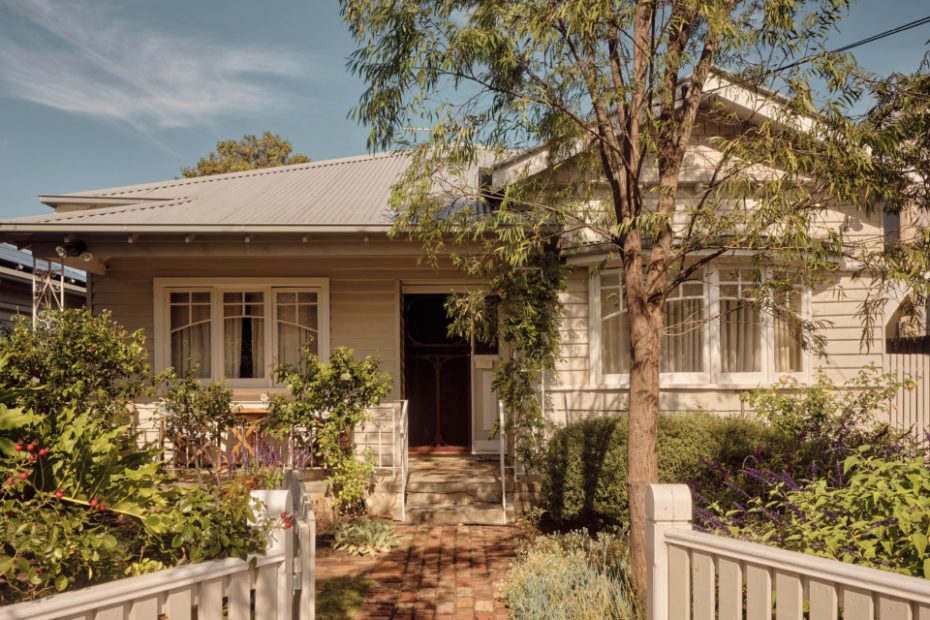
How This Melbourne Family Can Reduce Their Bills, Without A Renovation
Climate
Copy and content strategist Sally Tabart and teacher Jeremy Barr with their daughter Lila (15 months) outside their Melbourne home.
Energy and home comfort advisor Tim Forcey chats with Jeremy beside the switchbox.
Tim starts each consult with some insights he’s learned from his 18 years of working in energy efficiency.
A digital thermometer gun helps read the varying temperatures to gauge cold and hot spots.
The air-con filters are only about a year old, but Tim says they should be checked and cleaned every few months.
This kind of build-up could be reducing the split-system’s efficiency by about half.
The French doors and fireplace are charming features, but do require draught proofing for improved comfort.
Tim shows an example of the adhesive strips used for daught proofing.
Tim examines the home’s energy bills.
While Sally Tabart and Jeremy Barr love their Thornbury weatherboard for all of its heritage charm, the old-school features also play a big role in why the property often feels like a ‘wooden tent’.
‘Our home was renovated just before we moved in [about seven years ago], but still retained many heritage features, such as the windows, which all have many gaps and thin glass that leaves our home exposed to the elements,’ Sally adds.
‘You really feel both the heat and the cold here, and there aren’t many days where we don’t have to use either the heating or the cooling.’
But when the couple had their first child, Lila (15 months), it encouraged them to make some cosmetic and functional changes — including installing three new split systems and some much-needed insulation in the roof.
While Sally and Jeremy still have their sights set on a major renovation down the track (including exploring solar panels one day), energy and home comfort advisor Tim Forcey says there’s still some low-cost updates that can make a big difference in their home’s efficiency in the meantime.
Heating and cooling
Tim says the couple have ‘done the right thing’ by installing the split systems in the main bedroom, Lila’s room, and the living room: ‘these electric reverse-cycle systems are about a third of the cost of running gas heating’.
Sally explains these have been life-changing for cooling in summer, but her goal is to stop using the gas heating entirely and sometimes the split-systems don’t feel powerful enough for the whole home.
Upon taking a look at the filter, Tim shows how much dust has become trapped, which would significantly impact the unit’s efficiency. It also means dust is circulated around the home every time they are in use, so it’s ‘absolutely critical’ to check the filter every few months and give it a quick hand-wash and gentle vacuum.
The house also has a central gas heating system, however, Tim says it’s best to avoid using this in favour of the split-systems both for heating and cooling. Any ducted vents also require similar maintenance to the filter; however, Sally and Jeremy’s vents are actually missing the filter and are full of dust inside.
‘This is another motivation to encourage you not to use the gas heating and seal these up,’ he tells the couple. ‘Not only because of the cost but the health impact.’
Since the house doesn’t have a door between the hallway and the kitchen-living-dining room, Tim suggests something like a Japanese noren curtain could also ‘zone’ the space and help better retain heat in the central area.
Draught proofing and insulation
The home is very prone to draughts in winter, with the family noting they often feel cold air from kickboards in the kitchen, the skirting boards, and between the floorboards.
Tim says these little gaps causing air leaks can be easily filled with a caulking gun, while also recommending getting a big piece of foam or a purpose-fit draught-stopper from EcoMaster to plug up the chimney.
The evaporative cooling vents on the ceiling are currently already loosely covered by plastic coverings, but Tim suggests going one step further by using a clear contact or plastic film wrap to seal them up further: ‘There’s plenty of DIY videos and hacks available online,’ he adds.
One of the updates Sally and Jeremy made before Lila was born was getting new insulation in the roof — something that’s made a ‘massive difference’ in the home’s comfort. Using his temperature gun, Tim can tell there’s currently no insulation in the floors or walls, which could benefit from being filled by blow-in insulation at a later date.
Windows
Sally asks if it’s worth upgrading to double-glazed windows at this stage, or if they can hold off until they tackle their big renovation in future.
Tim explains while they are the gold standard, he acknowledges it’s a huge financial investment that can set you back a few thousand dollars per window.
‘It’s better to tackle the insulation and draught proofing as the priority,’ he adds. For now, he suggests further sealing up the windows with adhesive draught proof strips, especially around the French door in the living room.
There’s also a clear contact film from businesses like ClearComfort that you can cover the existing windows with to mimic the effect of double-glazing for a fraction of the cost.
Cooking and hot water
Both the stove and hot water systems are currently powered by gas. Sally and Jeremy are keen to get off fossil fuels eventually, and given the age of the current cooktop, they anticipate making the switch to an induction one in the coming years.
‘While you do have the gas cooktop, it’s important to use the extraction fans to keep the air quality healthy,’ Tim says.
The water system from 2017 is ‘not old, not new’, so it’s not a huge rush to have it replaced. But Tim says it’s worth looking into the current federal and state government rebates available to make installing an electric heat-pump hot water system more achievable.
He suspects it would cost around $2000-$3000 to upgrade, but these units are far more efficient and could end up paying a third of the cost of their current water bill.
Overall assessment
Tim’s unofficial rating for the house sits around three stars out of 10, as per the Victorian residential efficiency scorecard. This is at the average of most homes in the state, largely due to their current use of gas ducted heating.
Looking at the household’s energy bills also reveals they are paying for power all through the night, which Tim says could come down to something simple like their fridge running at a high speed constantly — when a more efficient model should actually be switching between on and off to maintain temperature.
Getting a smart meter, such as a PowerPal, is an easy way to help Sally and Jeremy better understand their energy usage and decide what upgrades to make next.
Next steps
Sally says they are keen to take up most of Tim’s recommendations, including installing a little curtain in the main living space, and only using the split-systems for both heating and cooling as they look towards getting the rest of the house off gas in future.
‘I’ll also be looking into closing up some of the gaps in our doors and windows, and potentially putting a contact film over the coldest windows in our house to act as DIY double glazing,’ Sally says.
‘The most surprising takeaway we got from Tim was how surprisingly cost-effective transitioning away from gas would be. Last year, we had to have our gas pipes replaced, and the cost of that would have been about the same as getting a heat pump for our water and an induction stovetop. I wish we’d done that instead!’
Momentum Energy is 100% owned by Hydro Tasmania — Australia’s largest generator of renewable energy. Find out more about signing up to an energy retailer that supports the transition to renewables.