How This Classic 1930s Brick Home Was Masterfully Reimagined
Architecture
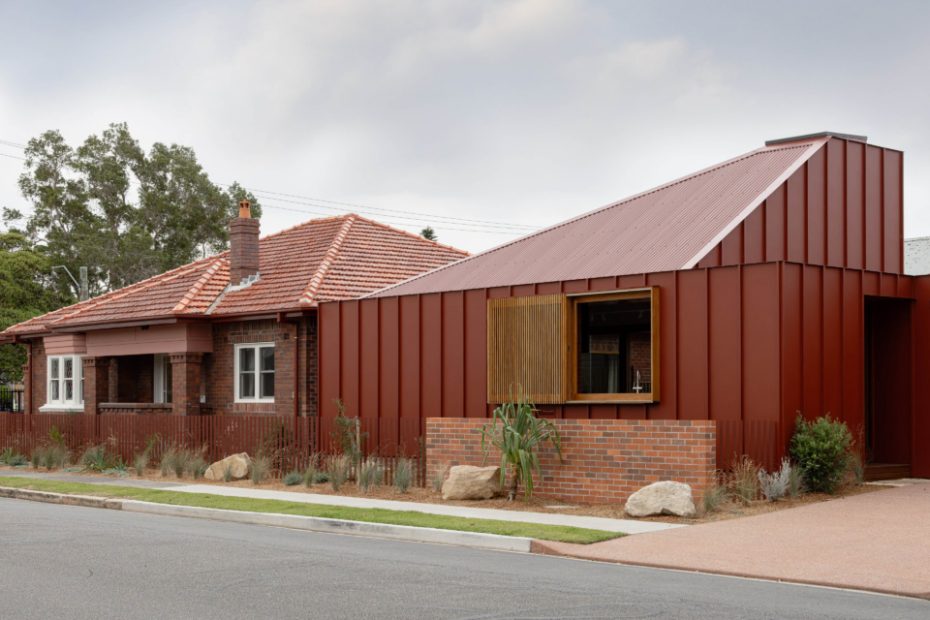
The project maintains the rhythm and detail of the original facade.
Heritage controls specified the new works needed to remain concealed behind the existing dwelling.
The extension is characterised by its deep red Colorbond cladding, designed to marry the new structure with the original red bricks and terracotta tiles.
The living room opens to the courtyard and pool with dramatic sliding doors.
Spotted gum is used across the flooring and wall linings.
The kitchen combines timber joinery with tactile Japanese tiles.
The restrained palette is filled with warmth.
The tonal materials allow the considered detailing to shine.
‘The skylight [in the living room] acts as an oculus measuring the time and season, allowing sunlight to move through the space differently across the day and throughout the year,’ says the architect.
The cosy living room.
The main bedroom enjoys calming views across the pool.
Original leadlight windows, ceiling details and art deco flair was carefully maintained.
The updated bathroom.
A terracotta-toned tiled bath.
Located in a heritage-listed ‘Garden Suburb’ precinct of Newcastle, this 1930s brick house in Merewether was largely untouched when builder Guy Bunder purchased the property a few years ago.
The director of Made Homes admits it was in ‘extremely poor condition’. But the opportunity to reinvent one of these beautiful homes — complete with many original, albeit dilapidated, features — was too good to pass up.
After purchasing the property at auction in 2024, Guy and his wife Madeline engaged Curious Practice to transform the house on an expedited timeline, so the family could move in as soon as possible. Impressively, the entire design was completed and approved within the three-month extended settlement, and construction was completed in just six months.
‘The addition was to include an extra bedroom, separate living and lounge rooms, a new kitchen, dining and outdoor entertaining with a swimming pool as well as a double garage,’ Curious Practice director Warren Haasnoot says.
It also had to adhere to the ‘incredibly tight’ heritage controls, which generally requires new work to remain concealed behind the existing dwelling.
As a result, the renovation takes its cues from the original single-storey home, with its terracotta tiles and gabled roof forms. It’s not until you turn the corner that the full scope of the new works is revealed, with distinctive, deep red Colorbond cladding that both complements, and clearly distinguishes, the different eras of the house.
‘The scale of the addition is broken down into smaller pavilions arranged under separate roofs,’ Warren says.
The new living space, kitchen and dining are captured under a singular volume that opens expansively onto the pool and landscaping, while a second pavilion hides the double garage and utilities at the opposite end of the courtyard.
‘Rather than trying to replicate the existing built fabric, the addition mimics the lightweight batten detail in a refined uniform silhouette, maintaining the existing building as a whole.’
Inside, restoring and maintaining the home’s original decorative ceilings also became a big focus: ‘These ceilings carry a strong sense of character and craftsmanship, which would be difficult to replicate today.’
In contrast, the ceiling of the new addition becomes its own defining feature, with dramatic proportions and a skylight that allows glimpses of the changing weather throughout the day, and across each season.
There’s an understated elegance that stretches across both the original and new interiors, united by a restrained palette of spotted gum flooring and wall linings, Breccia Rosso marble, and Japanese glazed tiles.
‘These materials were selected for their ability to balance darkness and light, texture and refinement, bringing a warmth, depth and sense of calm to the spaces, while giving the house a timeless and enduring quality,’ Warren adds.
It’s a masterful reinvention, that proves how old and new can coexist without imitation.