How This Renovated 1910s Cottage Expands Beyond Its Limited Footprint
Architecture
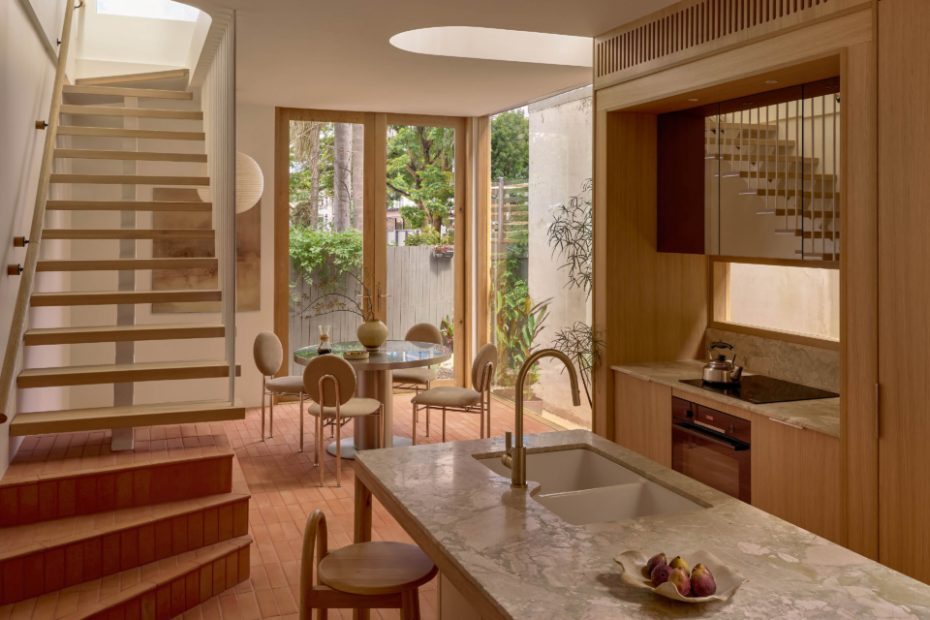
The kitchen, living and dining space has been designed for maximum flexibility.
The architectural void floods the space with light from above.
The staircase was positioned to integrate naturally with room below for a seating nook.
The kitchen features floor to ceiling timber.
A glimpse at the internal courtyard beyond the kitchen.
The main suite upstairs has a secondary lounge, bedroom and bathroom.
One of the two front bedrooms on the ground floor.
The bathroom echoes the home’s earthy palette.
Arhces are a repeated feature throughout. ‘Where an opening could have been simply functional, the arch gives enclosure… a form of intimacy,’ says Joanne Song, director of Aomura Studio.
The charming facade remains relatively untouched.
The addition of an olive-green front door nods to the leafy street.
This 1910s cottage in Birchgrove, NSW, sits among a row of neighbouring cottages, originally built by a couple for each of their children.
It’s a quaint scene: the tiny terraces lined up side by side along the leafy street, with the kind of character that instantly draws you in.
Yet, this 105 square-metre cottage — owned by a couple and their three cats — came with the familiar set of challenges typical of older terraces from this era.
‘The structure desperately needed improvement,’ explains Joanne Song, director of Aomura Studio. ‘And the interiors were narrow spaces that felt restricted and outdated.’
Tasked with reimagining the classic cottage into a home that balances private sanctuary with open living, Joanne, along with architect Sonni Murata Joeong, conceived a clever design that avoided the dark, restrictive feel of traditional terraces.
They significantly altered the layout of the home to break up the building’s long proportions with the major addition of a central courtyard garden and architectural void — sacrificing usable floor space in order to dramatically expand the home’s sense of depth and volume, and, most importantly, to invite in natural light into the home.
‘The curved void above the stairwell lets light fall slowly through the interior… In a home of modest footprint, it is the vertical dimension that opens the space, dissolving any sense of constraint,’ says Joanne.
The material palette was equally crucial in giving the home a sense of space, whilst maintaining its character. For this, Aomura Studio turned to the best reference of all: the home’s location.
‘Birchgrove’s Federation terraces carry a particular character, one of panelled timber, leafy canopies, and the quiet intimacy of harbour-side streets. We honoured that language at the threshold, in the olive-green front door with its heritage paneling and handblown glass.’
Inside, terracotta floors reference the cottage’s history, whilst the colour of the tiles warm in the afternoon sun, their tactile thermal mass helping to regulate the home’s temperature.
Although only 40 square metres have been added to the charming terrace, Joanne says it feels significantly larger.
‘I am most proud of how we extensively expanded the feeling of the home despite the physical limitations of its micro footprint… We managed to make the spaces feel more breathable, while beautifully maintaining the intimacy and warmth you expect from a cottage.’