Why This Design Couple’s Compact Terrace Feels Surprisingly Spacious
Architecture
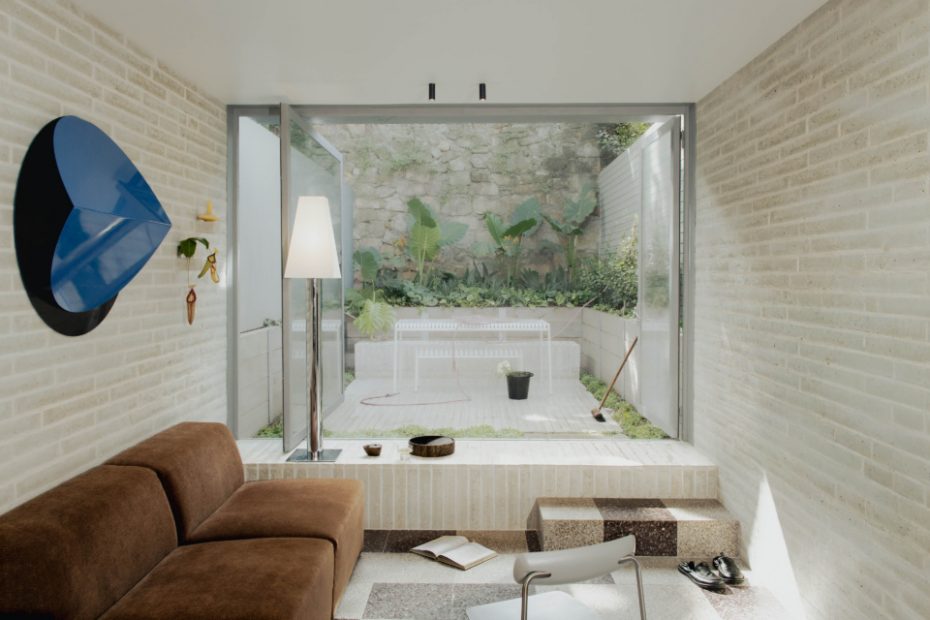
The living room opens to the courtyard, blurring boundaries between inside and out.
A custom elongated brick format carries the exterior language inward, appearing underfoot in the courtyard, rising into built-in seating, and the enclosing walls of key interior spaces.
A floating stone slab consolidates dining table, island, and social anchor into a single object for flexibility.
Terrazzo floors add contrast to the sleek interiors.
Stainless steel was chosen for its durability and ability to reflect light.
The bedroom is characterised by striking glass block work.
The intriguing feature balances privacy concerns while providing natural light.
One of the immersive bathrooms.
Mosaic tiles blanket the space from floor to ceiling.
Three bedrooms are nestled into the floorplan.
Skylights help increase the sense of space throughout.
A study nook inside the first bedroom on the ground floor.
The narrow hallway opens to the wider living zone at the rear.
The compact terrace was rebuilt to maintain its character.
In designer Nicholas Carson Kelly’s own words, Little James is ‘a small house that doesn’t behave like one’.
‘It has warmth, personality, and a spatial generosity that its footprint has no right to produce — and that’s entirely the point.’
Nicholas and his husband, Klaus, the co-directors of Studio Carson Kelly, bought the Bondi Junction property years ago. It was a modest Victorian terrace, spanning just four metres wide, with a promising rear orientation.
But inside, the compartmentalised layout, awkward proportions, and lack of light made it a tricky canvas. Perhaps that’s why it also quickly became a compelling ‘testing ground’ where the formidable design duo could experiment with new ideas for their clients, which in turn led to a sharp vision for the renovation.
‘For a year, we lived in the house as we redesigned it — studying its light, its failures, and its latent capacity before submitting a fresh scheme for approval. That period of occupation changed everything,’ Nicholas says.
‘The problems were structural and spatial, and they ran deeper than any renovation could address. To get the house to where we knew it could be, we needed to start again.’
Inspiration for the project came less from external references and more from the couple’s determination to embrace the site’s relentless constraints in a sharp redesign.
The front facade was rebuilt to match the original, maintaining the terrace rhythm of the street. Everything else beyond is brand-new, featuring strategically placed skylights, a boundary-to-boundary lightwell in the centre of the floorplan, and a clerestory glazing.
‘When you can’t grow outward or significantly upward, you learn to make the most of what moves through the space: light, air, and the careful orchestration of threshold and view,’ Nicholas adds.
Redundant circulation was folded back into the architecture itself. A dog-legged stair is cleverly integrated with the laundry on the ground floor, while also opening to a compact landing that links the two bedrooms upstairs.
At the rear, the kitchen, living and dining area is characterised by patchwork terrazzo floors. Materials were carefully selected to create visual zones, as a floating stone slab consolidates dining table, island, and social anchor into a single monolithic object.
Mirrored joinery and stainless-steel catch fragments of natural light across the day, contrasted by the recurring brick textures that extend the living zone out into the courtyard.
It’s a house where every design decision has earned its place, and the result performs even better than Nicholas and Klaus imagined.
‘We’ve entertained larger groups than you’d have any right to expect from a four-metre-wide terrace, and the house handles it without strain. That’s not accidental — it’s the result of every planning decision compounding in the right direction. A house that performs at that level, on a footprint this modest, is what we’re most proud of.’