An Accessible New Home, Designed For The Architect’s Parents
Architecture
Architect Blair Smith designed his parent’s new West Busselton, WA home to subtly challenge the status quo.
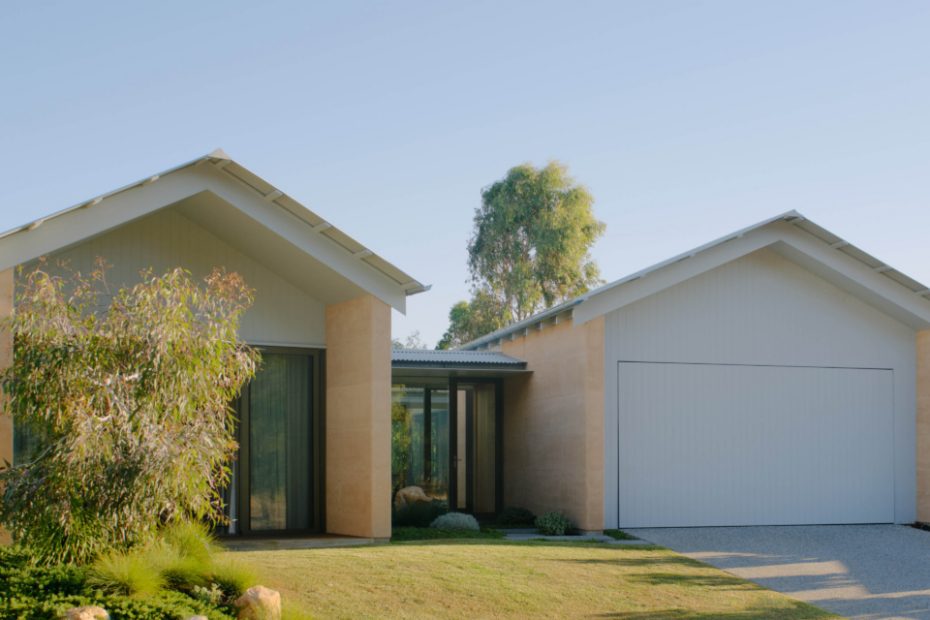
The new home consists of three rammed earth pavilions, linked together via a lower hallway and entry vestibule.
The garage and bedroom pavilions are positioned to frame a landscaped entry.
Cabinetry elements are a combination of blackbutt veneer, solid blackbutt and laminate. Tulip Dining Chair by Nathan Day Design.
The laminate has a very subtle warm, almost pink tone to it to match the rammed earth.
One of two bathrooms.
The hero material of the home is rammed earth, taking advantage of the several skilled rammed earth trades in the south-west area of WA.
The house politely subverts the suburb norm, without being at odds with its surroundings.
‘It represents the beginning of a new chapter in life evidenced in small moments, like sitting on the front deck with a drink, greeting neighbours as they pass, and slowly claiming a new sense of belonging in town,’ says Blair.
‘As you approach the house along the curved road, there’s a civic quality and a sense of movement to the street elevation because the building “unfolds”, or opens up, as you approach it.’
After 50 years living on a farm, architect Blair Smith’s retired parents were spending too much time driving into town for their various yoga, golf, shopping, and socialising commitments.
They decided to move into West Busselton, purchasing a vacant block ready for a new house to be designed by their son.
The brief functionally called for a three-bedroom, two-bathroom home on a single level to suit Blair’s parents and regular visitors, including Blair’s own young family based in Melbourne.
Designing the look of the home was the biggest challenge of the project, located in an area where volume-built homes are ubiquitous. The area has recently experienced rapid growth accelerated by an airport upgrade, creating more opportunities for FIFO workers.
Blair’s parents wanted a bespoke home, but the design needed to meet a stringent style guide and approval by a design committee.
‘The style guide and streetscape presented a paradoxical challenge: how does one balance an acknowledgement of the volume-built context while critically reconsidering it?’ Blair says. ‘Within the design process, I framed the approach as a “polite subversion” to the status quo.’
Through direct engagement with the committee, Blair was able to interpret and challenge prescriptive requirements — including portrait window proportions and garage door setbacks — while accepting non-negotiable elements such as roof pitch and materiality.
‘Ultimately the appointed architect and design committee were supportive of the scheme, but because a bespoke architectural home was so unusual to the area, it involved intensive consultation,’ he says.
The new home consists of three rammed earth pavilions, linked together via a lower hallway and entry vestibule that balances privacy, refuge, solar orientation and opportunities for community engagement on the keystone-shaped block.
Blair says, ‘’We spoke a lot in the design process about the building politely addressing the curve in the road without being at odds with the respective neighbours.
‘As you approach the house along the curved road, there’s a civic quality and a sense of movement to the street elevation because the building “unfolds”, or opens up, as you approach it.’
The garage and bedroom pavilions are positioned to frame a landscaped entry, while the living room is positioned at the private end of the site, with a northern aspect made possible by an internal courtyard.
Accessibility for ageing in place was an important consideration. ‘The guest area (two northern bedrooms and a bathroom) has been configured in a way that a live-in carer could be accommodated, if required in the future,’ says Blair.
The hero material of the home is rammed earth, taking advantage of the several skilled rammed earth trades in the south-west area of WA. ‘The soft orange-salmon colour of the locally sourced earth walls sit comfortably with the hues of the West Australian sunsets,’ says Blair.
Blair says the home politely subverts the suburb norm, without being at odds with its surroundings. ‘It represents the beginning of a new chapter in life evidenced in small moments, like sitting on the front deck with a drink, greeting neighbours as they pass, and slowly claiming a new sense of belonging in town.’
The house is also 100 per cent electric with an electric heat pump hot water system, energy-efficient hydronic slab heating via a heat pump system, and a 13.33kW solar array.
Blair says the house wouldn’t have been possible without a highly-skilled builder in Godden Projects, new direct flights from Melbourne to Busselton, and numerous virtual meetings.
‘With some physical visits at key stages, a great builder and the use of technology, we were able to manage designing at a distance quite well. I would love to do it again!’