Before + After: A Chic Warehouse Apartment Designed To Host Dinner Parties
Interiors
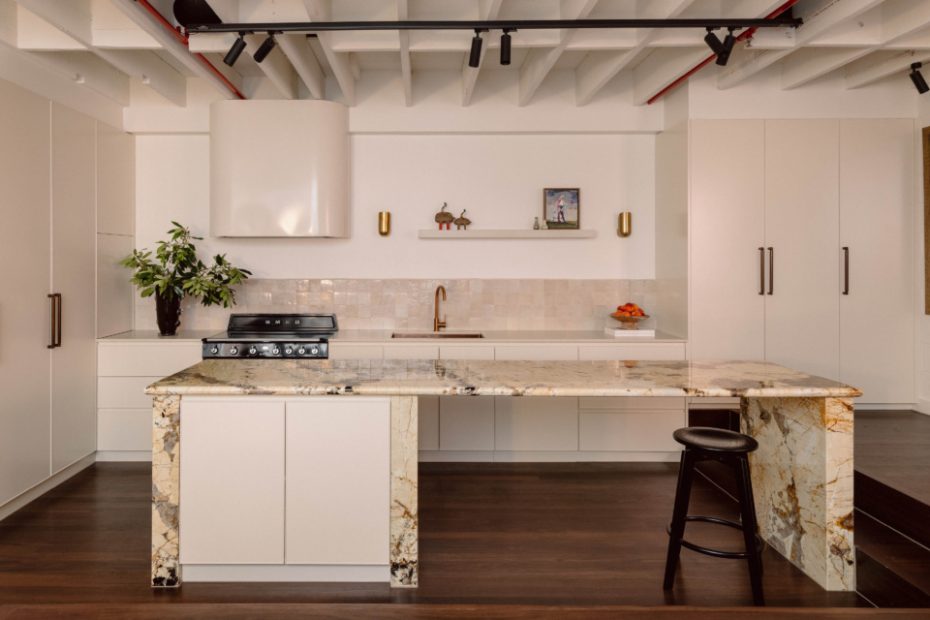
The Patagonia quartzite benchtop forms the heart of the renovated kitchen.
New joinery maximises functionality for the client, who is a ‘serious cook’.
The luxurious stone island complements the apartment’s robust original palette.
Plasterboard was removed to highlight the timber rafters overhead, alongside distinctive red pipework.
The ensuite bathroom features a show-stopping copper bath imported from India, Moroccan zellige tiles, and brass tapware.
A Patagonia quartzite vanity.
Textural detailing adds visual interest throughout.
A dedicated dressing area adds a luxurious touch.
‘Storage was a big focus too, particularly for Dee’s wardrobe, which spans everything from a busy surgical career to a serious festival circuit,’ the designer says.
The building’s distinctive exterior highlights its industrial past.
The living space now showcases original red-brick walls.
The apartment is unrecognisable after removing the stark 2000s finishes.
However, the footprint remains unchanged.
Both the owners and Fluent Studio founder Karina Harvey were somewhat perplexed at the monochrome fit-out of this converted warehouse apartment when they first laid eyes on it.
‘The apartment had a classic early-2000s renovation: stark white throughout, with plasterboard concealing the original brick walls and timber rafters that we suspected were hiding behind the ceiling lining,’ Karina says.
‘The ensuite featured a horrible black lino covering floor to ceiling that was perhaps someone’s idea of modern masculine?’
Located in the heart of Collingwood, the red-brick Foy & Gibson complex once housed a series of factories and warehouses, before being converted into a series of apartments sometime around the late ’90s.
While each of the homes inside varies dramatically in style and size, this 88-square-metre version sported an especially haphazard layout, with a kitchen that was ‘far too small’ for clients Dee and Dunc.
‘Dee and Dunc have been together for years and are one of those couples who make everything look effortless,’ Karina says.
‘Dee is a renal surgeon with a love of fashion, food and festivals. Dunc is the founder of The Plant Runner, a well-known Melbourne business, and is genuinely one of the warmest, most unflappable people you will meet — which is extremely handy during a renovation project.’
Leaving the apartment’s footprint unchanged, the transformation focused on uncovering the home’s original character and elevating it to new heights. Their suspicions about what hid beneath the oppressive plaster were confirmed when they stripped it back, exposing the industrial shell and rustic brick walls that formed the basis for the new palette.
Even the fire services’ pipework, which runs in red through the space, was retained and became a key part of the interiors.
In line with Dee’s sophisticated taste, new soft-toned joinery and metallic finishes were introduced as more contemporary accents throughout the three-level home. The bathroom is especially alluring, as Moroccan zellige tiles are paired with Italian Murano glass sconces and a striking copper bathtub imported from India that’s now the main character of the ensuite.
‘The kitchen island is a full slab of Patagonia quartzite, chosen by Dee at a stone warehouse for its crystalline patterning and the movement it brings to the space. It wasn’t in the original palette, but she couldn’t walk away from it after seeing it,’ Karina says.
They also reoriented the living zones on the ground floor to maximise room for entertaining, anchored by the expansive island, doubling as a comprehensive food-prep space and dining table with room for six.
It’s now the beating heart of the house, where Dee and Duncan can flex their hosting muscles across multi-course dinner parties with their loved ones.
‘The Foy and Gibson Building has a lot of history and a strong presence, and we felt strongly that the interior should respond to that rather than ignore it,’ Karina says of the resulting project.
‘A warehouse shell is a generous backdrop: it can absorb a wide range of design directions without losing its identity, which gave us real freedom in how we layered the palette.’
‘Collingwood itself operates in much the same way. It is a neighbourhood of accumulated layers, food, culture, creative industries, long-term residents and new arrivals, all coexisting in the same streets. The apartment sits comfortably within that. It does not try to be one thing.’