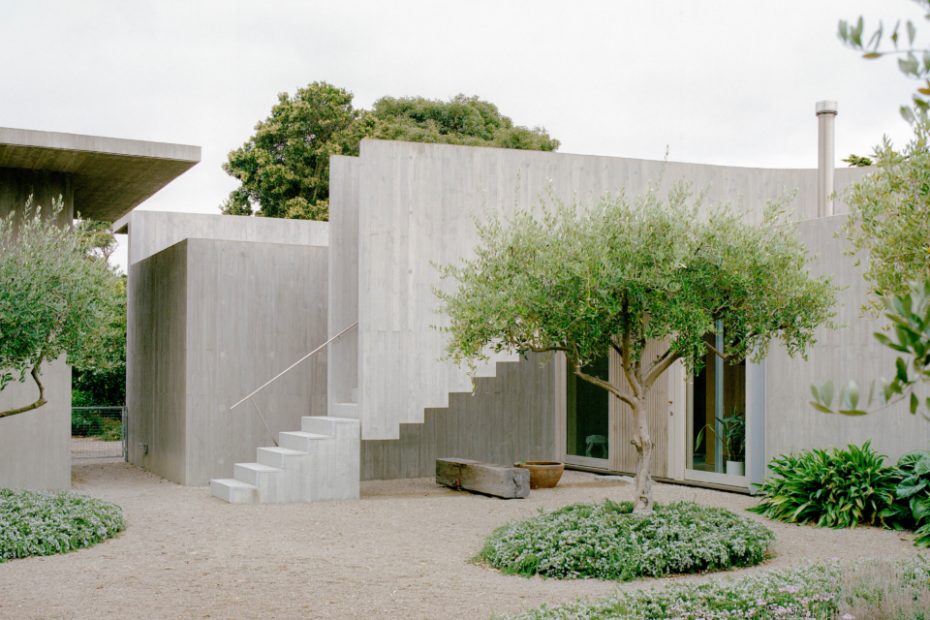
Why This Japanese-Inspired Concrete Home Wasn’t Designed To Be Lived In
Architecture
Mori House was designed by Jeff Provan in collaboration with Portuguese architect Manuel Aires Mateus and Melbourne firm MA+Co.
The house is a ‘concrete beach shack’, shaped roughly as a crucifix, allowing for four different gardens to wrap around the house exterior.
Concrete staircases access the home’s rooftop.
The stainless steel kitchen.
The materiality of the house is primarily concrete, poured in situ, to form most of the floors, wall, and roof.
While the architectural form is minimalistic, there’s plenty of character inside owing to Jeff and Mariko’s collection of art, books, and pop culture paraphernalia
There are nods to Mariko’s Japanese heritage in the use of austerity and simplicity in design.
The tatami room near the home’s centre.
Blonde timber and Akari lights soften the home interiors.
Jeff’s prerequisites for the house: no painted surfaces, no plasterboard, no downlights, and no shower screens.
Sculpture by Bruce Armstrong.
The house balances simplicity and complexity, revealing new perspectives with every movement through its rooms and gardens.
The residence can be intimate for two or open up for a gathering.
The project extends Jeff and Manuel’s shared love of concrete, as seen in their existing bodies of work.
Manuel Aires Mateus has been described as creating ‘ruins of the future.’
Each garden has its own identity and purpose, spanning a vegetable garden, enclosed courtyard, pool and lawn area, and planted area with a mix of native and European vegetation.
There’s something both futuristic and familiar about the work of Portuguese architect Manuel Aires Mateus that has long appealed to Jeff Provan, co-founder of Neometro.
The architect and design director had never worked together — in fact, Manuel had never completed a project in Australia — when Jeff approached him to design his holiday house on Victoria’s Mornington Peninsula.
‘Someone had quoted him as building “ruins of the future” and something about that resonated,’ says Jeff.
‘We had stayed in this particular home he designed for a client in Comporta — it was a beach resort with a number of bungalows that you stayed in — and one of them had a sand floor in the living and kitchen area.
‘It was only designed to stay in it for a few days — it’s not something you would live in — but I just loved the way he was thinking and his ideas of simplicity yet complexity. There was a real interest there in his philosophy in how we lived in places.’
Manuel and Jeff worked in collaboration to design the Mount Martha house, which was carried through the documentation stage by Melbourne-based architects MA+Co.
Jeff’s prerequisites for the house: no painted surfaces, no plasterboard, no downlights, and no shower screens. ‘I wanted it to be a beach house more than a permanent house’, he explains, ‘so there’s certain things that you might not tolerate in a house that you lived in every day of the week.’
Together, Manuel and Jeff devised a ‘concrete beach shack’, shaped roughly as a crucifix, allowing for four different gardens to wrap around the house exterior.
There’s no passages or hallways within, so residents move from one room directly onto the next, in turn creating distinct garden aspects from every wing. Each garden has its own identity and purpose spanning a vegetable garden, enclosed courtyard, pool and lawn area, and planted area with a mix of native and European vegetation.
‘There’s only one space you can see all four gardens at once, and that’s right centre of the house on the crucifix or from the rooftops,’ says Jeff. ‘The scale of the building really gives a sense of comfort. It’s not overwhelming — it’s quite subtle.’
Two outbuildings on the property are additionally used as guest suites when Jeff and his wife Mariko’s friends and family visit. ‘You come to the main house to eat, dine, play and do whatever, and then you can retire to the bungalow,’ Jeff explains.
The materiality of the house is primarily concrete, poured in situ, to form most of the floors, wall, and roof — extending Jeff and Manuel’s shared love of concrete seen in their existing bodies of work.
While the architectural form is minimalistic, there’s plenty of character inside owing to Jeff and Mariko’s collection of art, books, and pop culture paraphernalia.
There’s also nods to Mariko’s Japanese heritage in the use of austerity and simplicity in design, and more literally through the inclusion of a tatami room near the home’s centre Throughout the project, Jeff referenced a Japanese house he and Mariko often stay in that provides a similarly strong connection to its garden. His own Mount Martha house now shares the same name as this property, Mori, which is also Mariko’s family name.
This coastal house balances simplicity and complexity, revealing new perspectives with every movement through its rooms and gardens.