This Naturalistic Garden Takes Its Cues From The New Perennial Movement
Gardens
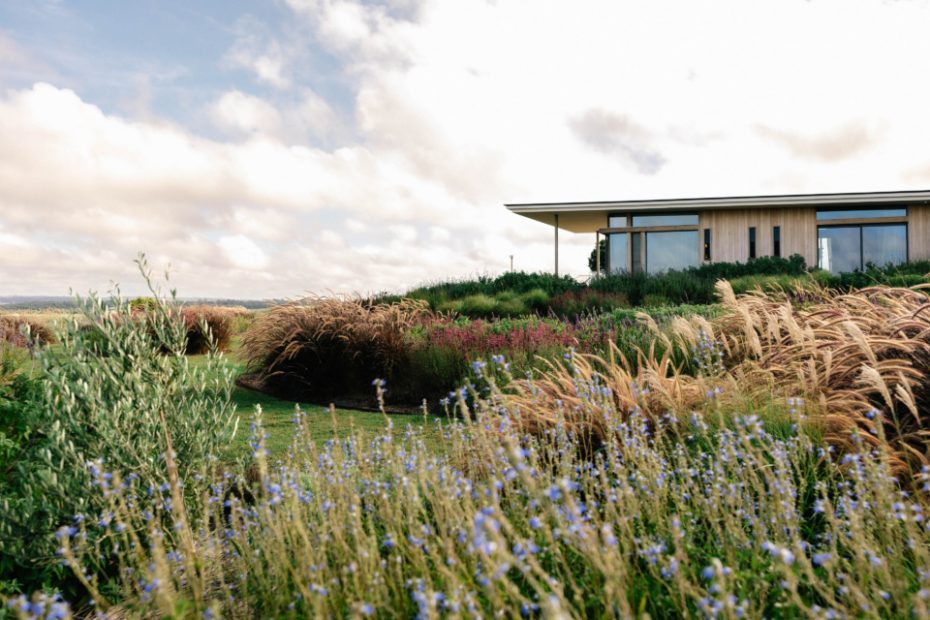
Perched high on a hill in South Burnett, this garden was conceived as a direct response to its landscape.
A bench seat provides a moment to take in the naturalistic design.
To the north of the house, the planting palette becomes more diverse and perennial-driven.
Key species include Rudbeckia fulgida var. ‘Goldsturm’ (black-eyed Susan), Salvia microphylla ‘Cyclamen’ (baby sage), Salvia ‘Indigo Spires’, Eutrochium purpureum (Joe Pye weed), Stachys byzantina (lamb’s ear), Salvia leucantha (Mexican bush sage) and Agastache ‘Sweet Lilli’ (hyssop).
Miscanthus sinensis (Chinese Silver Grass) were planted on mass.
Gravel paths create organic walkways throughout the garden.
Local sandstone boulders provide stepping-stone pathways and stair treads.
Salvia varieties provide pops of purple and indigo alongside evergreens for structure.
The existing Ficus macrophylla (Moreton Bay Fig) was a central piece of the new landscaping.
The design also carefully protects and frames important views to the north and west.
The walkway up to the family home.
At the front of the home, an expansive gravel forecourt with a grove of semi-mature Pyrus ussuriensis forms a formal, shaded space for outdoor dining and entertaining.
The New Perennial movement, often called the ‘Dutch Wave’, originated in the Netherlands and Germany in the late 1970s and early 1980s. Among the pioneers of the forward-thinking style was Dutch landscape designer Piet Oudolf.
Despite the stark differences in the climate of Europe, where this style began, and Queensland, Ladysmith Park Perennials founder Jacqueline Stevenson has brought a touch of Oudolf’s magic to this project in South Burnett.
Between the large drifts of ornamental grasses, vibrant flowering perennials, and winding garden paths, it’s hard to believe this landscape was largely a ‘blank canvas’ just five years ago.
‘The client — a devoted family man — had built a striking home overlooking sweeping valley views and wanted a garden that would both honour and elevate its setting,’ Jacqueline says.
There was however one defining feature on the expansive block: a mature Ficus macrophylla (Moreton Bay Fig), positioned to the north-east of the house.
‘Rather than competing with it, the design used the fig as a focal point and reference, integrating it into key views and circulation patterns to reinforce its role as a dominant and unifying landscape element,’ Jacqueline says.
A new circular lawn and mass plantings of Miscanthus sinensis ‘Adagio’ (maiden grass), alongside Miscanthus sinensis ‘Variegatus’ (variegated Chinese silver grass) helped frame the towering tree, while the rest of the landscape was reshaped to create an immersive ‘journey’ throughout the various garden spaces.
Gravel pathways and stepping sequences gently guide movement through the site, while also providing functional walkways to key destinations such as the fire pit, horse stables, tennis court, shed, and wood-fired spa.
‘I was drawn to the way Oudolf uses naturalistic planting design to create gardens that feel both structured and deeply connected to nature,’ Jacqueline adds.
‘I aimed to incorporate his use of organic geometry, where sweeping curves introduce visual tension and contrast while also serving a practical role in shaping movement, controlling sightlines, and influencing the emotional experience of the landscape.’
In addition to using plants on mass to mimic the look of a natural meadow, the north of the house reveals a diverse collection of perennial plants that come alive with vibrant flowers each spring and summer. Plants like Salvia microphylla ‘Cyclamen’ (baby sage) and Salvia ‘Indigo Spires’ bring in pops of purple and pink.
However, other perennials were deliberately excluded due to suitability issues, with careful consideration of the area’s high humidity and rainfall — something Ladysmith Park Perennials isn’t used to at their Wagga Wagga-based nursery.
To aid with biodiversity, more than 40 per cent of the planting is native. This also helped reduce the need for maintenance, something that was crucial for the client, who Jacqueline says has done an ‘exceptional job’ in executing and maintaining the design himself.
‘The outcome has exceeded my expectations. This success is largely due to the owner’s dedication to the ongoing care, craftsmanship, and stewardship of the garden,’ she says.
The garden has found a wonderful balance between the demands of the rural setting, the natural views, and the needs of the family’s lifestyle.
‘I am also very proud of the overall naturalistic effect achieved through the large sweeping garden beds and the use of drifts of ornamental grasses, perennials, and native species,’ Jacqueline says.
‘Together, these elements create a landscape that feels immersive and cohesive, closely echoing the rhythms and movement of nature — or at the very least, a heightened interpretation of its wildness.’