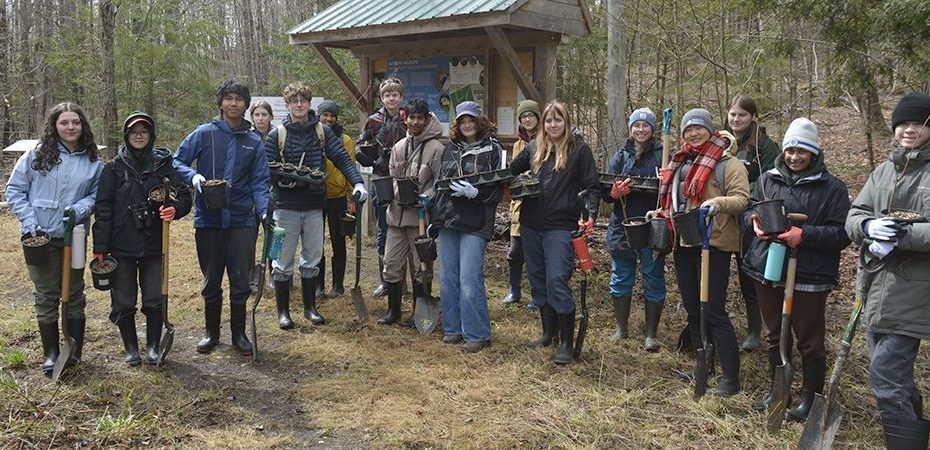
Each year, members of the Ontario Nature Youth Council attend the Wetlands Field Trip – a weekend-long retreat in the spring, packed with hands-on learning and wetlands education. This year, 18 Youth Council members ventured to Kilcoo Camp in Minden, Ontario from May 1-3, alongside program Alumni and Ontario Nature staff, for a weekend that not only inspired future careers in conservation, but also a deeper understanding of Ontario’s vulnerable wetland species and other species at risk.
On Saturday morning, two Youth Council members led a Wetlands 101 presentation for the group – a foundational, beginner-friendly presentation to provide the group with an understanding of what wetlands are and why we need to collectively advocate for these vital ecosystems. The session inspired a lively discussion on the need for wetland advocacy in our communities and the group left feeling connected and ready to explore at our next session located on the Altberg Wildlife Sanctuary Nature Reserve for the remainder of the day.
Planting native species, Altberg Wildlife Sanctuary Nature Reserve, Ontario Nature Youth Council Wetlands Field Trip 2026 © David Pugh
The day at Altberg started with planting native plant species in a riparian zone, the delicate area where land and water bodies meet. The concept of riparian zones was new to many of the youth and provided an important lesson in wetlands education: a wetland is more than a body of water; it is the entire ecosystem surrounding it, too. Together, the group planted dozens of native plants including red osier dogwood, swamp milkweed, and sugar maple.
After a successful morning, the group was introduced to the important conservation work of vernal pool identification and salamander long-term monitoring protocols. Vernal pools are temporarily or seasonally wet areas of wetlands that are crucial breeding areas for Ontario’s reptiles and amphibians, including salamanders. The session provided an opportunity for youth to dip their toes into the world of conservation field work while providing a space for exploration, discovery and learning.
After breakfast on Sunday morning, the group embarked on one last adventure of the weekend: A hike to an elusive waterfall tucked in a nearby forest. After crossing a stream, the group trekked onward through the forest reaching a waterfall situated between two marshes. The waterfall joined the two wetlands, creating a unique habitat where marsh, stream and forest meet. The trip to the waterfall provided an invaluable opportunity for the group to explore without a “to-do list”. While some youth went birding, others were turning over rocks in search of salamanders and invertebrates. Some youth explored the underwater wildlife, discovering crayfish and frogs. Others were content simply listening to the rush of water and taking in the scenery. No matter the choice of activity, the experience summed up the weekend perfectly – everyone’s interests, experiences and learning styles are different, but we are bonded over one commonality: a love for learning.
Early morning birding, Kilcoo Camp, Ontario Nature Youth Council Wetlands Field Trip 2026 © Chloe Chow
The field trip marked a meaningful shift in the group’s understanding of wetlands, a subject that is almost entirely excluded from Ontario’s secondary school curriculum. It provided a unique opportunity for youth to experience wetlands through hands-on, experiential learning while inspiring a young generation of leaders in conservation.
Beyond the field trip weekend, the Youth Council works to raise awareness on Ontario’s wetlands through educational presentations and outreach tables. Since 2023, the Youth Council has engaged over 3,100 people across the province with Ontario Nature’s Wetlands Campaign. Opportunities like this field trip are imperative for youths’ understanding of wetlands and the need for their protection, providing a knowledge base to inspire the same passion across our communities.
The wetlands field trip and salamander training is supported by Ontario Power Generation, TD Friends of the Environment Foundation, Nature Canada, and RBC Foundation.