A 1930s Melbourne House Renovation, Inspired by Malaysian Homes
Architecture
In Malaysia, where the owners of this Northcote house grew up, houses are traditionally built to maximise ventilation. Seeking this in their Melbourne home, the owners approached Ben Callery Architects.
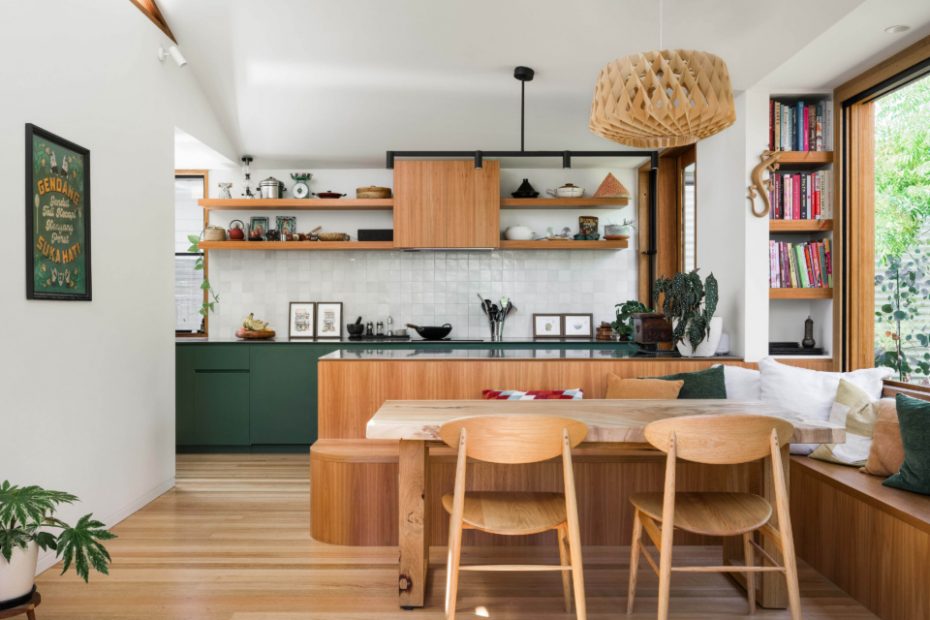
Direct backyard access from the open dry zone kitchen.
A more utilitarian back-of-house ‘wet’ kitchen tucked around the corner contains the preparation space, sink, dishwasher, fridge, rice cooker, steamer and plenty of storage.
The living room view looking back towards the internal courtyard and study beyond.
This new internal courtyard sits to the western side of the house, providing the owners more garden space for a vegetable patch.
The dining area sits to the east of the courtyard, with the backyard beyond.
The productive courtyard garden includes citrus, tomatoes, other seasonal vegetables and fragrant foliage.
Silvertop ash external cladding creates a beautiful warm backdrop to the gardens.
The courtyard sits to the western side of the house, providing a direct leafy outlook to the study to the north, dining room to the east, and kitchen to the south.
The 1930s house facade.
In Malaysia, where the owners of this Northcote house grew up, houses are traditionally built to maximise natural ventilation.
Seeking this in their home, the owners approached Ben Callery Architects whose projects often seek to ‘bring the outdoors in.’
While the front of the 1930s home was structurally sound, a lean-to rear extension containing the kitchen, meals, and laundry needed addressing. Ben recalls, ‘This area was tiny and dark, exacerbated by the block’s orientation — north to the front — meaning the back rooms received barely any sunlight.’
Ben saw an opportunity to introduce an internal courtyard to the plan that could simultaneously rectify these issues, while referencing the Malaysian homes the clients fondly remember.
This new internal courtyard sits to the western side of the house, providing more garden space for a vegetable patch, and a direct leafy outlook to the study to the north, dining room to the east, and kitchen to the south.
High raked ceilings and highlight windows draw in additional light, ultimately creating an uplifting sense of space and tranquility throughout the new rooms. ‘The courtyard does so much more, creating vistas between rooms and across the verdant gardens, expanding the sense of space in the relatively compact footprint,’ says Ben.
The kitchen layout is also a local interpretation of traditional Malaysian kitchen, featuring ‘wet’ and ‘dry’ zones. Ben explains, ‘They wanted to recreate the way Malaysian kitchens allow for intensely aromatic cooking to occur separately from the social heart of the home… especially when you don’t have a huge house.’
An open dry kitchen zone creates a space for sociable cooking and shared meals, while a more utilitarian back-of-house ‘wet’ kitchen tucked around the corner contains the preparation space, sink, dishwasher, fridge, rice cooker, steamer, and plenty of storage. ‘The dry kitchen does gently depart from tradition by incorporating a cooktop, and it also extends to an outdoor cooking and barbecue area for that intensely smoky, aromatic gastronomy,’ Ben says.
Materials in the addition are inherently warm, including Tasmanian oak floors, blackbutt timber veneer, and silvertop ash external cladding. ‘This creates a beautiful warm backdrop to the gardens,’ says Ben. ‘In courtyard design, the external walls become more like the internal walls of that ‘outdoor room’, so it’s lovely to be surrounded by natural materials.’
Conversely, stainless steel benchtops bounce natural light around the kitchen, punctuated with forest green laminate cabinetry.
With its energy-efficient and light-filled new addition, the rear of the home functions as well if not better than the retained front rooms — one of which was converted from a living area into the main bedroom and en suite.
Ben is proud of how the house transitions from new and old — an experience marked by changing ceiling heights, courtyard views, and highlight windows. ‘These draw in morning and midday sun and create a sense of space far greater than the compact footprint. But what they really do is create an emotion of wellbeing, lifting your spirit,’ he says.
‘I also love the courtyard and how brilliant a job the owners have done with the gardens. Their productive courtyard garden includes citrus, tomatoes, other seasonal vegetables and fragrant foliage. It’s wonderful being surrounded by this beautiful garden and bringing that right into the home.’