A Bushfire-Safe Beach House Designed Around Light, Shadows + Ocean Views
Architecture
House of Shadows is a new home on a bushfire-prone site in Rosedale, NSW.
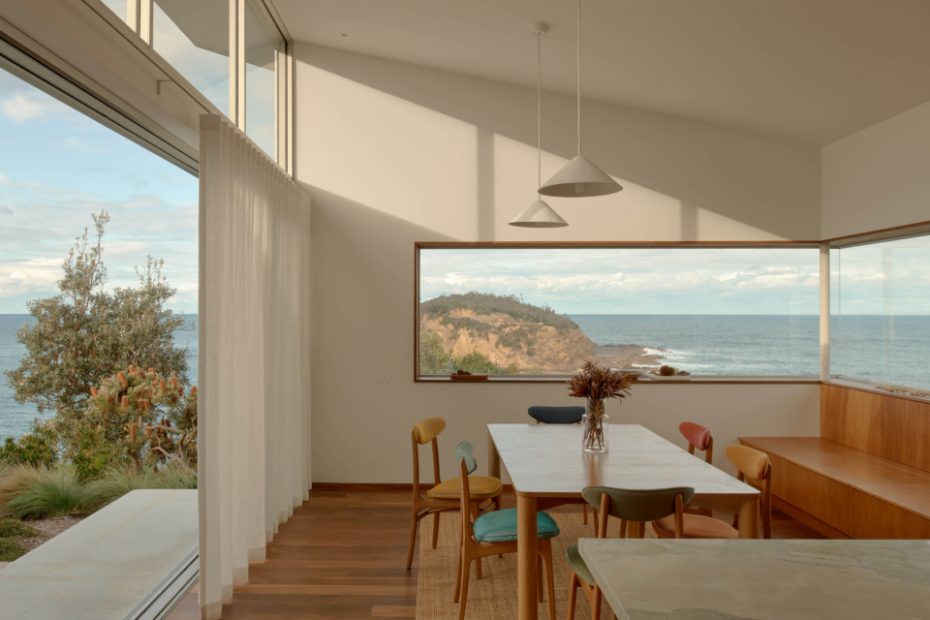
The sloped roof opens to frame the beauty of the coastal headline.
The dining space is anchored by a wrap-around window that captures a perfect outlook across Jimmy’s Island.
Native and endemic plants envelop the house.
Sliding doors open directly to the gardens.
The bathrooms were also designed to boundaries between indoors and out.
A deck located off the main bedroom.
The entrance creates a sense of arrival.
Fibre-cement cladding offers a nod to the nostalgic fibro beach houses of the past.
House of Shadows by Atelier Marks Gaal is a new home on a bushfire-prone site at the end of a narrow winding lane, perched just over the crest of the south Rosedale headland.
While the project was only complete in 2025, the property and its surrounds hold a special place in the owners’ hearts. For more than 30 years, the couple returned to the beachside town for their annual escape — a ritual they continued from their childhood into the present day, now working and living in Switzerland.
‘They had owned the site for a number of years before the 2019/20 fires decimated the original home and the forested land around it,’ Atelier Marks Gaal director Josh Marks says.
‘Struggling to find a responsive way forward after the devastation, the clients found themselves at a crossroads. They wanted equal connection to the wild of the ocean and the quiet of the garden; a home robust enough to leave unattended and low maintenance enough to simply arrive at.’
With the previous California bungalow and its forested surrounds in ruins, the starting point for the new build was driven by the beauty of the headland itself.
‘The concept began with the things that change rather than the things that stay fixed. Sun, moon, wind, rain, warmth, cold, shadows — their daily and seasonal movement across the headland — set the logic of the plan, so the building is organised around light and time rather than around a style,’ Mark adds.
Working to replicate a similarly modest footprint of the former bungalow, Atelier Marks Gaal crafted the 155-square-metre floorplan around these elements, using a series of deliberate openings to guide attention to the outdoors.
A nostalgic fibre-cement skin, reminiscent of retro beach shacks, wraps the building, selected for its softness within the coastal landscape and its suitability to the flame-zone site.
The front door leads to a central hallway, subtly dividing the core living spaces from the dedicated dining wing, which can be activated depending on the number of guests.
Timber-lined panels bring warmth to the restrained interiors, while frameless windows in the bathrooms dissolve the boundaries between indoors and the expansive oceanscape.
In a bid to overcome the challenges of the steep site, wild weather, and the rigour of BAL-rated construction, the architecture team was also directly involved in the construction and project management on-site. It meant detailed decisions about the architecture could be calibrated in direct response to the landscape.
For Mark, one of the most rewarding parts about the project is its quiet nature. He says this is reflected in the arrival sequence: ‘The way the entry garden holds you before the building opens, the way the apertures draw your eye through the living room to the enchanting framing of Jimmy’s Island and the Pacific Ocean beyond.’
‘The building does not announce itself. The humble patterns of life prevail — that is what we set out to make.’