This Auckland Renovation Proves Heritage Homes Don’t Have To Play It Safe
Architecture
Inside Rocket’s House by Pac Studio.
The classic villa-style house now combines coastal aesthetics, with vibrant pops of colour, and original heritage details.
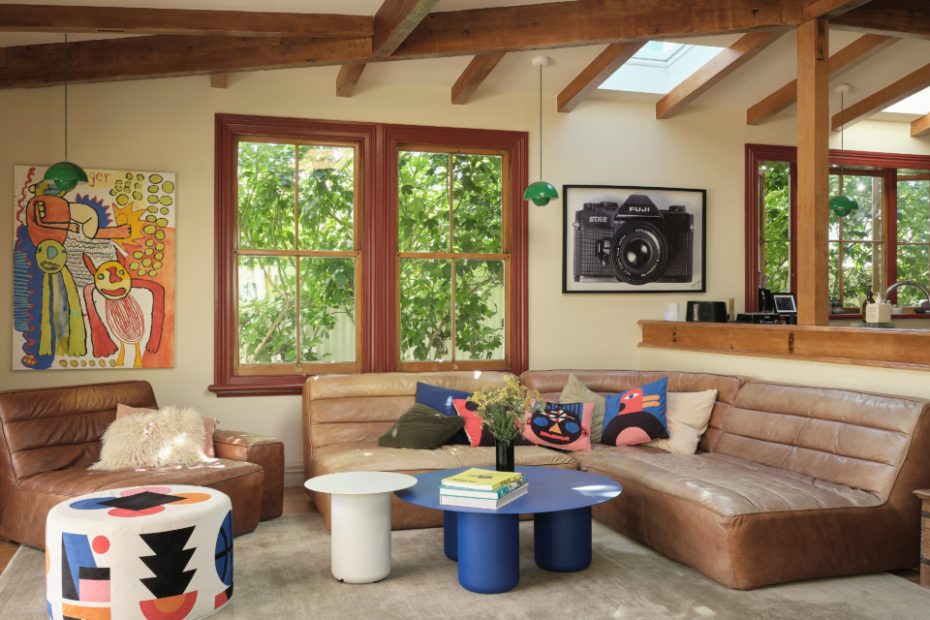
The living space.
Deep red accents bring new life to the interiors.
The dining area.
Leafy views outside add to the home’s palette.
Key interventions included reconfiguring part of the master bedroom and the adjacent ‘snug’ in the lounge room.
The room is drenched in a deep wine hue, bringing a sense of comfort and enclosure.
Each of the bedrooms also has its own personality, thanks to distinctive pops of colour.
Terracotta tiles in the new bathroom.
The family’s art collection also played a role in the expressive redesign.
The main bathroom reveals deep aubergines set against marble countertops and tiled surfaces, with brass fixtures adding warmth and refinement.
Roman bathing houses were a key reference for the luxurious space.
The lounge now has direct access to the new pool and cabana area.
The backyard is reminiscent of a resort-like retreat, where the pool and cabana create a sunny, relaxed environment that responds directly to its beachside setting.
A bright yellow appears on both the striped awnings and pool fence.
The space takes its cues from Palm Springs’ famous poolside settings.
The existing villa facade is full of heritage charm.
The family dog, Rocket, who inspired the project name!
There’s hardly a colour in the rainbow that doesn’t make an appearance in this exuberant Auckland home, and yet, the creative renovation still maintains a sense of harmony with the villa’s heritage roots.
This is a testament to the masterful redesign by New Zealand architects Pac Studio, who set out to inject a sense of fun into the young family’s home in Narrowneck Beach.
‘Named after the clients’ French bulldog, Rocket, the project’s name felt fitting from the outset. Bold, energetic and full of character, Rocket’s House is at max volume,’ Pac Studio director Sarosh Mulla says.
‘The existing villa was in reasonable condition, with much of its original character and detailing intact. While the front rooms retained a strong sense of traditional charm, the layout required refinement to better suit the clients’ needs and remove some odd bits.’
Rationalising the ‘awkwardly configured’ bathroom and laundry, improving flow throughout the home, and enhancing connection to the underutilised backyard were central to the brief.
To keep the cost manageable, the updates worked to maximise space within the existing building envelope, keeping the layout of the front bedrooms and kitchen largely unchanged.
‘Alongside these functional upgrades, the project was driven by a strong desire for expressive, immersive use of colour, with each space given its own distinct identity within a cohesive overall composition,’ Sarosh says.
The family’s openness to daring design decisions gave way to a diverse set of references. In the new main bathroom, the opulence of Roman bathhouses is reflected in the floor-to-ceiling marble tiles, lit by overhead skylights; the living room snug’ is equal parts comforting and stately, enclosed by wine-coloured walls and bookshelves.
Accents of mossy green, punchy pinks, and tonal reds bring new life to original fireplaces, balustrades, and ornate ceiling cornices throughout the interiors, preserving its heritage qualities.
Externally, the timber weatherboard cladding is grounded in a restrained neutral tone, which Sarosh describes as a ‘respectful backdrop’ to the home’s historic form.
‘In contrast, the laundry and rear cabana embrace a brighter, more playful energy, referencing the relaxed, sun-drenched atmosphere of Palm Springs,’ Sarosh says.
‘Together, these influences reinforce the home’s dual character, both intimate and expansive, but never boring.’