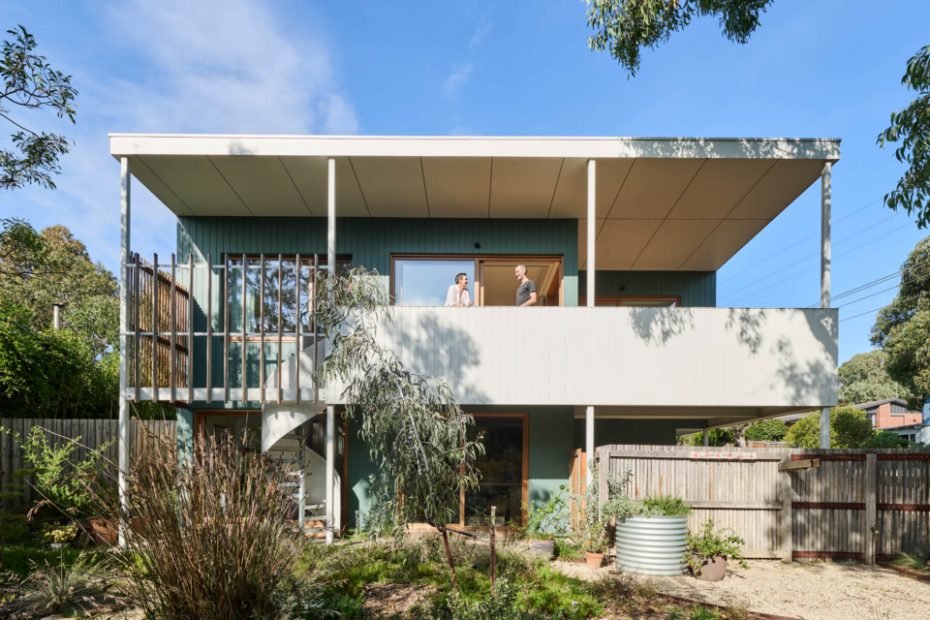
A Dreamy Coastal Home Designed For Maximum Energy Efficiency
Interiors
Director James Goodlet and studio manager Claire Thomas of Altereco Design have built a business creating sustainable homes, so they created one of their own!
The couple wanted a house that performed just as well as a certified Passive House with a 18 panel 6.6kW PV array, 13.5kWh battery, and all-electric appliances.
Most electric appliances are cheaper to run than gas and minimise reliance on the grid and fossil fuels when paired with solar.
James and Claire modelled the house using Passive House Planning Package (PHPP) software to achieve Passive House Low energy standards.
The combination of a relatively compact floorplan (118 square metres upstairs and 20 square metres downstairs) and strategically positioned windows sees the house maintain a comfortable temperature of 18-25°C year-round with minimal mechanical heating and cooling.
‘Most of the energy that we consume is either first thing in the morning or in the evening and therefore this is coming off the battery, which inevitably reduces our grid dependency and bills,’ says Claire.
‘Being in a regional area there are often power outages. One of the benefits of having the battery to back up your power supply is that our home office is entirely backed up, including our internet.’
Inspired by architect Nino Sydney’s iconic ‘beachcomber’ design, the house is a contemporary interpretation of the classic Australian beach shack, reimagined with high-performance principles.
The couple recently bought an electric vehicle, which they can easily charge on site, and will significantly decrease the running costs of their vehicle.
The Tesla Powerwall 2 13.5kWh home battery.
Keeping the house simple, and focusing on connections to the outdoors rather than flashy extras, was key to achieving the sustainable outcome.
Vegetable gardens on the property.
Claire and James at home.
The 18 panel 6.6kW PV array.
Director James Goodlet and studio manager Claire Thomas of Altereco Design have built a business creating sustainable homes, so when it came to designing one of their own, there was no compromising their values.
The couple wanted a house that performed just as well as a certified Passive House (a design standard that achieves thermal comfort with minimal heating and cooling) featuring an 18 panel 6.6kW PV array, 13.5kWh battery, and all-electric appliances, to minimise their energy consumption.
James and Claire modelled the house to achieve Passive House Low energy standards, without actually going through the official certification process, which can be cost prohibitive. ‘As a Passive House-accredited building design practice, applying these principles to our own home was non-negotiable,’ says Claire.
The combination of a relatively compact floor plan (118 square metres upstairs and 20 square metres downstairs) and strategically positioned windows sees the house maintain a comfortable temperature of 18-25°C year-round with minimal need for heating and cooling.
‘On hot days, we use the reverse cycle sparingly, and in winter, passive solar gain does most of the work on sunny days,’ says Claire. ‘The eaves are perfectly calculated to block summer sun while allowing winter warmth in.’
A 13.5kWh home battery completes the setup, allowing Claire and James to store excess solar energy created during the day, when the sun is at its peak. ‘Most of the energy that we consume is either first thing in the morning or in the evening and therefore this is coming off the battery, which inevitably reduces our grid dependency and bills,’ says Claire.
‘Being in a regional area there are often power outages. One of the benefits of having the battery to back up your power supply is that our home office is entirely backed up, including our internet.’
In their first full year of occupancy (2024), Claire and James sourced 52% of their home electricity directly via their solar panels, 41% from their battery, and 7% from the grid. Since installing a sauna in 2025, they’re relying a little more on the battery (42%) and grid (19%). That amounts to them spending $666 a year on energy bills (when accounting for feed-in tariffs, supply charges, and spending $0 spent on gas). For comparison, data by Rewiring Australia states the Australian household currently spends $9,200 per year on energy related costs, including natural gas and petrol.
Claire and James recently bought an electric vehicle, which they can easily charge on site. ‘We had planned to transition to an electric vehicle in a few years, but recent rising fuel prices accelerated that decision,’ Claire says. ‘Having solar and a battery in place made the transition seamless.’
This home is not only energy efficient, but an all-round lovely space to inhabit. Inspired by architect Nino Sydney’s iconic ‘beachcomber’ design, the house is a contemporary interpretation of the classic Australian beach shack, reimagined with high-performance principles.
Keeping the house simple, and focusing on connections to the outdoors rather than flashy extras, was key to achieving this outcome, as Claire explains. ‘Clients, designers and builders tend to get excited by the prospect of optimising to the nth degree; this can create hype and confusion… We learnt to always pair a decision back to the basics, gain clarity on what we wanted to achieve, before executing as best we could.’
Whilst Claire and James’ home presents the gold standard in energy efficient design, even households without a solar array or battery can make clever updates to start reducing their energy bills. Installing all-electric appliances — such as a heat pump water heater, induction cooktop, or reverse-cycle air-conditioner — is a great place to start. You can estimate your potential savings, and find out about available rebates using AGL’s Electrify Now™ tool.
For James and Claire, the benefits of creating a home that truly delivers on energy efficiency amounts to much more than just cost savings.
‘The comfort stands out immediately — the house maintains a consistent temperature throughout the year.’ Claire explains. ‘It’s difficult to fully articulate how it makes you feel, but it’s an incredibly uplifting space. It’s noticeably lifted our mood through winter — something that’s hard to quantify or put into words’.
Learn more about how to electrify your home with AGL’s Electrify Now™ tool. Estimate your potential savings on energy bills or running costs and find out about available rebates, payback period and more.