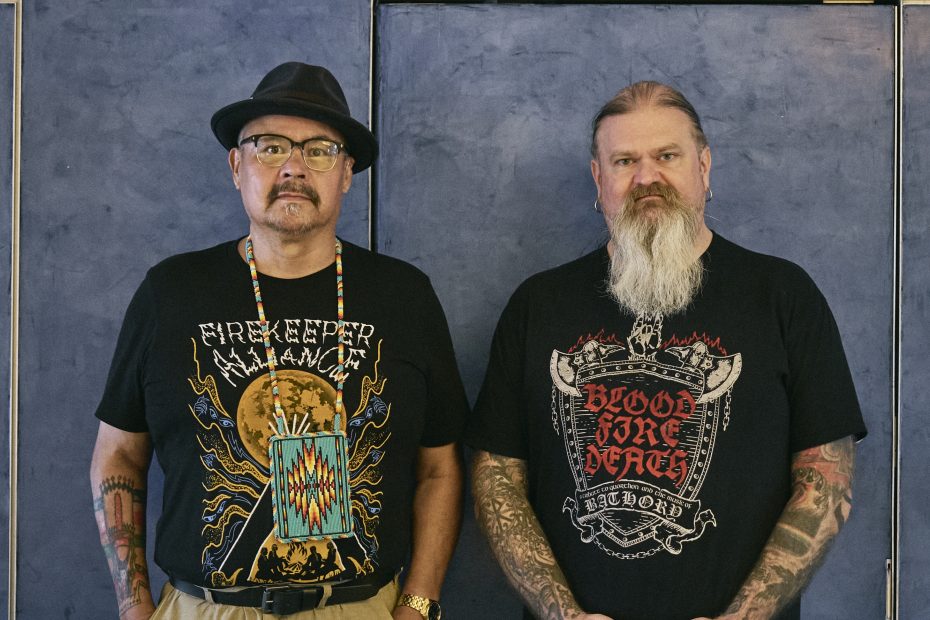
For more than three decades, Enslaved have explored the cross between history, spirituality, and progressive extremity. Their latest release, “Spirit Helper,” pushes that ethos into new territory, pairing the Norwegian legends with Kevin Kicking Woman, an Elder of the Blackfeet Nation, in a collaboration born from friendship and cultural exchange rather than a one-off studio experiment. The song emerged through the band’s ongoing relationship with Montana’s Fire In the Mountains festival, where conversations with Blackfeet community members gradually evolved into a creative partnership built on trust, respect and a shared interest in the ways music can preserve memory and meaning.
At the heart of “Spirit Helper” is a traditional Blackfeet morning prayer song that Kicking Woman entrusted to Enslaved as the foundation for a new composition. Instead of simply sampling the original, the band reshaped its own sound around the prayer’s cadence and spiritual weight. The result is less a cross-cultural collaboration for its own sake than a meditation on connection, and one that Enslaved describes as among the most profound artistic experiences of their career. Decibel caught up with Ivar for an in-depth look into “Spirit Helper” and 35 years of Enslaved:
Decibel: Enslaved marks its 35th anniversary this year. The band has been such a key part of your life since you were a teenager. After all that time, what made “Spirit Helper” feel like uncharted territory instead of just another collaboration?
Ivar: I think what made it different was that it didn’t actually begin as a musical collaboration. Looking back, the song probably started years before there was any thought of writing it. It began with meeting people. First through Fire in the Mountains, then through By Norse and our management, and eventually through getting to know members of the Blackfeet Nation. I met Nick Rink at Fire in the Mountains in 2025, and through Nick I got to know Kevin Kicking Woman. For me, that’s really the key. Usually collaborations begin with music. Somebody says, “Let’s write something together,” and then you see where it goes. Here it was almost the opposite. The relationships came first, and the music emerged naturally from those relationships. That also meant there was a responsibility that felt quite different. We’ve spent thirty-five years using mythology and old traditions as a language in Enslaved—not as something nostalgic, but as a way of exploring what it means to be human. Then suddenly you’re invited into a dialogue with another living tradition that has been carrying those same kinds of questions for generations, albeit in a completely different cultural context.
I never felt we were making a “cross-cultural project.” Honestly, I don’t think any of us were interested in that. It felt much more like meeting fellow human beings who happened to have inherited another way of expressing something we’ve been trying to understand through our music for decades. So yes, after thirty-five years, it genuinely felt like new ground. Not because we were trying to do something different, but because something different happened to us first.
Kevin Kicking Woman and Ivar Bjørnson PHOTO CREDIT: Tomoko Inoue @TheTinfoilBiter
Decibel: Kevin Kicking Woman entrusted you with a traditional morning prayer song as the foundation for the track. How did that shape your writing process, and did it force you to approach composing differently than you normally would for Enslaved?
Ivar: Completely. I don’t think I’ve ever started writing an Enslaved song from that point before. Usually, I begin with a riff, an atmosphere or maybe a rhythmic idea, and then I gradually discover where the music wants to go. Here, there was already something there. Kevin’s morning prayer wasn’t simply a melody or a vocal line—it already had its own identity, its own pulse and its own purpose.
Quite early on, it became clear to me that this couldn’t be one of those collaborations where you write an Enslaved song first and then invite someone to participate. To me, that would have missed the whole point. Instead, I tried to understand what was already happening in Kevin’s singing. I spent a lot of time just listening to it. Not analyzing it in a technical sense, but trying to understand its natural movement—where it breathes, where it settles, where it builds. It gradually became obvious that if this was going to work, our music had to adapt to his song, not the other way around. That actually made the process both more difficult and more liberating. Difficult because I had to let go of quite a few musical ideas that I liked, simply because they belonged to another song. But also liberating because once I stopped trying to control where the music was going, the song began revealing its own identity.
Decibel: You said you wanted the music to adapt to Kevin’s cadence and vocal performance rather than the other way around. What did that mean in practical terms? Were there riffs or arrangements you had to rethink to make the song work?
Ivar: Oh yes. Quite a lot, actually. I am kinda used to building things around fairly defined structures. Even when Enslaved gets quite progressive, there’s usually a rhythmic architecture that everything grows from. Kevin’s singing comes from a completely different place. It’s guided by language, by breath and by intention,
That sounds a bit abstract, but it became a very practical way of working. There were riffs I really liked that simply didn’t belong in this piece. They weren’t wrong; they just belonged somewhere else. Once I accepted that, the arrangement started falling into place much more naturally. I suppose that’s one of the things I enjoyed most about writing “Spirit Helper.” It reminded me that composing isn’t always about adding things. Sometimes it’s about removing your own expectations and letting the music find its own balance.
Decibel: Fire in the Mountains seems to have played a huge role in bringing this together. What is it about FITM that transcends your typical metal festival in 2026?
Ivar: I’ve been fortunate enough to play festivals all over the world, and I love festivals. But Fire in the Mountains has always felt like it was trying to become something more than just another weekend of concerts.
People actually spend time together there. Musicians, artists, organisers, Indigenous community members, audiences… You find yourself talking about things that don’t normally come up backstage at a festival. When the festival moved onto Blackfeet land, that feeling became even stronger. Suddenly, there was another layer of meaning to everything that was happening. It wasn’t simply about bringing a festival to a beautiful place. It became a meeting between communities. And perhaps even building of a new community?
Decibel: Enslaved has always drawn inspiration from Norse history and mythology. Did working so closely with Kevin and the Blackfeet community give you a different perspective on how traditional cultures preserve their stories through music?
Ivar: Very much so. One thing it reinforced for me was that traditions only stay alive if they’re lived. They’re not preserved because somebody writes a book about them or puts them in a museum. They’re preserved because people continue to sing the songs, speak the language, perform the ceremonies and pass them on to the next generation. That’s something I found very moving about spending time with Kevin and the Blackfeet community. At the same time, it also reminded me to be careful about drawing too many comparisons. Every tradition has its own history and its own identity. I’m not interested in saying, “This is just like Norse mythology.” It isn’t, and it shouldn’t be. What I do think they share is something more fundamental. They both remind us that we’re part of a much longer human story than our own individual lives. That’s something Enslaved has been exploring from the very beginning, and this collaboration gave me another perspective on that. It didn’t replace anything we believed before; it expanded the perspective and the conversation.
Decibel: Looking back over Enslaved’s evolution, from the raw early records to where the band is today, where does “Spirit Helper” fit? Does it feel like a one-off collaboration, or could it point toward another direction for the band’s future?
Ivar: I honestly don’t know, and over the years I’ve learned not to make too many predictions about Enslaved. If you’d asked me after almost any album whether it pointed towards the next one, I’d probably have been wrong. The band has always developed in a fairly organic way. We don’t usually decide on a direction first and then write music to fit it. We write, we explore, and eventually we begin to understand where we’ve ended up. I suspect “Spirit Helper” will become part of that process as well. Whether it is likely that we will make another collaboration like this isn’t really the question for me – I think what stays with you are the experiences themselves. Once you’ve worked this closely with people you respect, and once you’ve had the privilege of being invited into a collaboration like this, it inevitably changes you in some way. As a musician, as a composer, probably as a person as well. So I don’t think of “Spirit Helper” as a new chapter or a one-off experiment. I think of it as becoming part of Enslaved’s vocabulary. How that vocabulary will express itself in the future… We’ll discover that when we get there.
The post ENSLAVED’s Ivar Bjørnson Talks New Collaboration “Spirit Helper”: “After 35 Years, it Genuinely Felt like New Ground.” appeared first on Decibel Magazine.