The Tradie Turned Artist Making Glass Candy That Looks Good Enough To Eat
Studio Visit
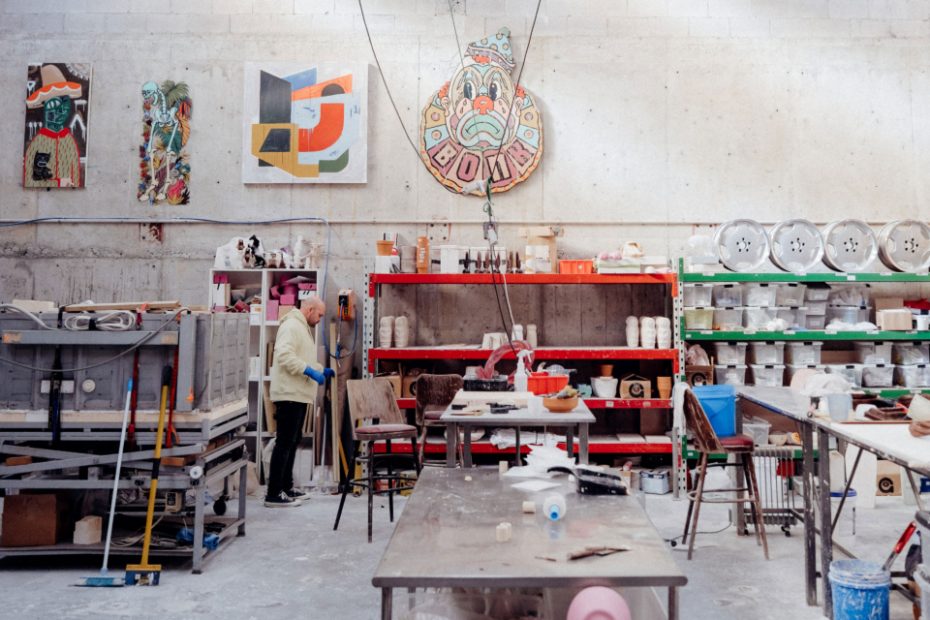
Inside Simon Lewis Wards studio, dubbed the ‘world’s most dangerous candy shop’.
A blue gummy bear in progress.
Artist Simon Lewis Wards.
Simon’s incredible glass cola bottles!
Each sculpture is cast in glass or porcelain moulds.
Coloured glass sheets are cut down to fit the moulds.
A line of candyman creations.
‘Working around hot kilns and glass keeps you pretty alert,’ Simon says.
The Fried Eggs.
The Fizzy lollies are coated in fine glass frit — crushed and rolled glass that creates its sugary sparkle.
The surface isn’t sharp; it’s smooth-edged and bonded permanently during finishing.
The finished product looks good enough to eat!
Some pieces like the Banana are made from slip-cast porcelain.
Aotearoa New Zealand-based artist Simon Lewis Wards’ sculptures tap into something that is arguably universal to childhood: an unbridled love of sweets.
Think back to the kinds of treats you would get in a lolly bag at a friend’s birthday, or the experience of going to the shops and filling up a paper bag with ‘pick and mix’ sweets.
It’s these kinds of memories that come flooding back when you look at his (incredibly realistic) sculptural recreations of gummy bears, fizzy cola bottles, and even red frogs.
‘Funnily enough, I didn’t have the classic corner shop run with pocket money, that’s not really my memory,’ Simon says.
‘But I loved baking with my mum, and one of our favourites was lolly cake made with Candy Men, those little foam pastel characters you chop up and fold through the batter. That’s the memory that links me back to the candy world.’
Simon’s career path is one full of swings and roundabouts. As a kid, he fell in love with lettering and after school, he worked at a sign writing company.
‘That job didn’t last long,’ he adds. ‘But by then I’d discovered graffiti, which became another outlet for painting letters, and the beginning of realising I was essentially unemployable.’
For the next 15 years or so, he dipped in and out of various tradie gigs; drain laying with his uncle Merv; plumbing; working on building sites. He never even considered working with glass until his friends Luke and Kate asked for help getting a glass studio up and running.
‘Kate was casting glass, and I had a go at making a telegraph pole. I instantly fell in love with the freedom of making, and I haven’t looked back,’ he says.
‘The coloured lead crystal I was working with always made people say the same thing — it looked “yummy”. So luscious and vibrant, it was a short leap to lollies. I took a mould off a Jet Plane, New Zealand’s quintessential lolly, and that’s where it all started.’
The rest, as they say, is history. Simon’s now known across Australia, New Zealand, and overseas for his playful, ever-growing collection of Glass Candy, which features classics like Swedish fish, raspberries, and gummy bears in every colour scaled up and cast in glass crystal, while slip-cast porcelain is used to mimic the texture of bananas and milk bottles.
There are even sour versions, coated in fine pieces of crushed glass that replicate the enchanting sparkle of sugar with incredible realism.
‘A technique I love is hot sculpting precast work: I cast a piece, clean it up until it’s exhibition-ready, then put it back in the kiln. Once the glass reaches a toffee-like consistency, around 650–700°C, I suit up with the big gloves and face shield, pull it out, and have about ten to fifteen seconds to manipulate it into a shape that feels spontaneous before it goes straight into the annealing cone,’ Simon says.
Each piece is made by hand in Simon’s studio on the western edge of Tamaki Makaurau Auckland. His candy making has grown into something of a family business, now with his wife Keya leading the marketing, alongside a small team helping in production and dispatch.
You can’t help but smile when you see his pieces hung on a wall, in what he calls a ‘Big Spill’. And perhaps that’s because for Simon, creating something that sparks joy for so many has unlocked a true sense of freedom.
‘Being the master of my own destiny suits me deeply. As for challenges, the hardest thing is that nothing ever feels fully stable. Just when you think you’ve got everything dialled in, a kiln breaks, or a new glass arrives with a different firing behaviour, and you’re problem-solving all over again.
But that’s also what makes the wins so satisfying. You know they won’t last long, so you really enjoy them.’