How Hidden Features Power This Impressive 8.2-Star Home
Sustainable Homes
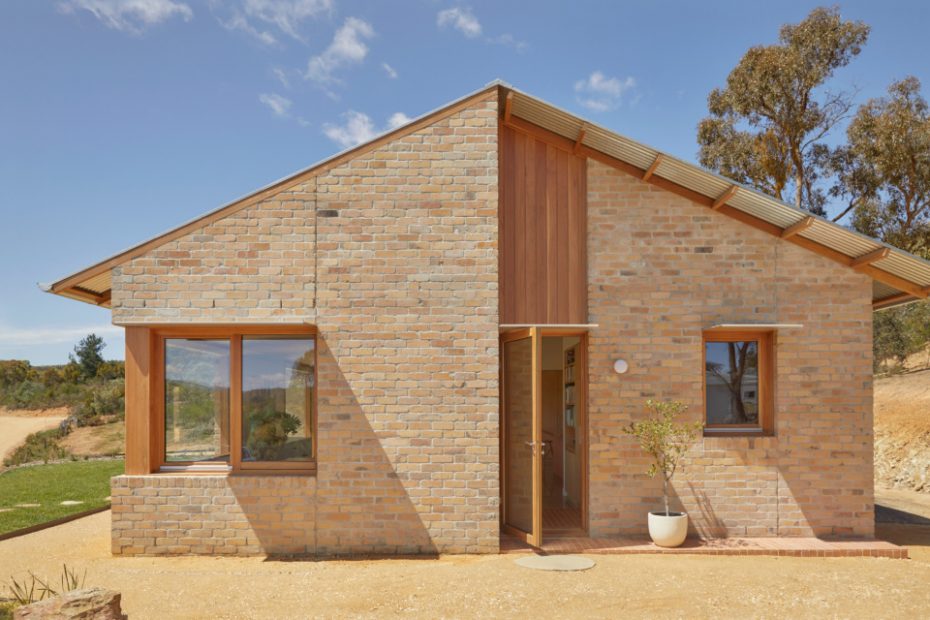
The home’s material palette was carefully considered to complement the surrounding landscape, using locally sourced, recycled cream brick and blackbutt timber cladding.
The view east towards the bushlands.
Cathedral ceilings ensure the compact floor area doesn’t feel too cramped.
Art by Michael Longton. Paper lampshade by Hay.
The front door in reeded glass allows for northern light to enter the open-plan space.
The laundry extends adjacent to the kitchen with a sliding door to separate these two spaces. Cathedral ceilings give the open-plan area an even greater sense of space.
Art by David Frazer.
The kitchen has easy access to the vegetable garden. A continuous bulkhead runs along the length of the space to allow the heat recovery ventilation (HRV) system to reach the required areas — an essential for Passive House design.
Cotto Manetti tiles from Artedomus. Cabinetry in blackbutt timber veneer.
The main bedroom maintains privacy at the end of the house and takes advantage of the views and morning light through tilt and turn windows by Binq Windows.
Lisbon Taupe tiles on the walls by Tiento. Cotto Manetti tiles on the floor and bath from Artedomus.
The exterior of the home is wrapped in locally sourced recycled cream brick and blackbutt timber cladding.
If you’ve ever lived in a house that’s perpetually cold in winter or prone to overheating in summer, you’re not alone.
The majority of Australia’s existing housing stock is extremely energy inefficient, with over 70 per cent of houses having an energy rating of three stars or lower, according to Australian Housing and Urban Research Institute.
It was precisely this problem that inspired one of Folkal Built’s latest projects: a new sustainable home in Chewton, a Victorian town just outside of Castlemaine.
‘The clients were sick of living in cold, draughty and energy hungry homes,’ Folkal Built director Peter Schreiber says. ‘They wanted a house that would address all of these concerns.
‘They had discovered passive and high-performance houses, and after doing a lot of research, they were adamant this is what they needed to have.’
The couple sought out the local builders to bring the house to life on a vacant country block with overgrown vegetation, engaging Bush Studio Architecture directors Naomi Brennan and Marie Le Touze for the all-important design.
It was essential the building could withstand the region’s harsh climate changes, with Chewton’s temperature reaching as high as 45°C in summer and below freezing during winter.
In the 18-month-long design and documentation phase, Bush Studio carefully considered the landscape, siting, and natural sunlight of the 2120-square-metre block before landing on the resulting 148-square metre floorplan.
Naomi says, ‘The main challenge was how to best locate the house within the vacant sloping site.’
‘We wanted the house to feel like it was nestled into the site, respectful of the natural contours, and yet maximise the solar passive design and surrounding views,’ Naomi adds.
At first glance, the building presents a compact profile, characterised by a pitched roof and recycled cream brick. But the full extent of the house reveals itself as you approach to find a second wing containing the bedrooms, cleverly angled out behind the main living spaces at the front entry.
‘The central outdoor dining terrace looking out onto the bushlands acts as a hinge point between the public and private spaces,’ Marie says.
Inside, the pared-back palette of locally sourced blackbutt timber joinery, polished concrete floors and terrazzo benches is complemented by Artedomus Cotto Manetti terracotta tiles — which the savvy owners found secondhand on Facebook Marketplace.
The kitchen maintains easy access to the vegetable garden, while the island sink and dining space face out towards the beautiful bushland and mountain views in the east.
But as with most sustainable homes, the real magic is in the parts that remain unseen.
‘The main sustainable element of this house is how little energy it requires to heat and cool thanks to the Passive House principles that have been applied to the design and construction of the home,’ Peter says.
These range from having thicker walls to house better insulation; an airtight membrane to control air and moisture; all-electric appliances; and high-performance tilt and turn windows from Binq that promote passive and secure ventilation.
There’s also a continuous bulkhead that runs along the back length of the kitchen to allow the heat recovery ventilation (HRV) system to effectively reach the required areas, helping maintain temperature and continuously circulate fresh air throughout the home.
‘These features are not only good for the people living inside the home, but they better protect the building from moisture, mould and rot,’ explains Peter.
By following this rigorous methodology, Peter says the home will last longer than a typical ‘code built’ home, in addition to being more energy efficient — scoring a NatHERS rating of 8.2 stars out of 10, well above the minimum 7-star standard for new homes.
There’s no denying houses like this require a certain level of finesse, dedication, and craftsmanship. But, the extra care invested today, will ensure this high-performing home serves its inhabitants well into the future.
An edited version of this story originally appeared in The Design Files Magazine Issue 04. Subscribe to the biannual print magazine here.