If you’ve been keeping up with Ontario Nature’s social media, you may have seen the buzz over a recent sighting at Sauble Dunes Nature Reserve – a bobcat!
Bobcats range across North America but are highly elusive and rarely seen by humans. Over the years, Ontario Nature staff and property stewards have spent countless hours at Sauble Dunes Nature Reserve, and thanks to our wildlife camera program, we’re still collecting new wildlife observations.
History of the Wildlife Camera Program
In 2023, a simple suggestion from volunteer property steward John Muff ended up making a lasting impact on our nature reserves program. John is a member of Pembroke Area Field Naturalists and longtime steward of Reilly Bird Nature Reserve, a 27-hectare property along the Ottawa River. The previous winter, he had noticed evidence of a moose at the nature reserve, but neither John, the stewardship team, nor trail users ever saw this animal. To confirm its presence, John proposed the purchase of a motion-activated wildlife camera and worked with Nature Reserves Stewardship Coordinator, Tharanya Ravikumaran, to kick off this new program.
With support from the Deep River and District Community Foundation, Ontario Nature was able to purchase and install a wildlife camera at Reilly Bird Nature Reserve.
The results exceeded everyone’s expectations. Not only did the camera confirm the moose’s presence but it also captured a glimpse into the rich diversity of wildlife living on the nature reserve. Since this initial camera was purchased, support from the Grey Bruce Community Foundation and Bruce Power has allowed more cameras to be purchased, and the program to be expanded throughout our nature reserve system.
Expanding to the Saugeen (Bruce) Peninsula
Mentioning the Saugeen (Bruce) Peninsula often evokes thoughts of the towering cliffs of the escarpment and stunning lookouts over crystal clear water. The escarpment is also one of the best examples of a contiguous natural area in South and Central Ontario. With the expansion of our wildlife camera program, Ontario Nature set out to demonstrate that other areas of the Peninsula deserve the same attention.
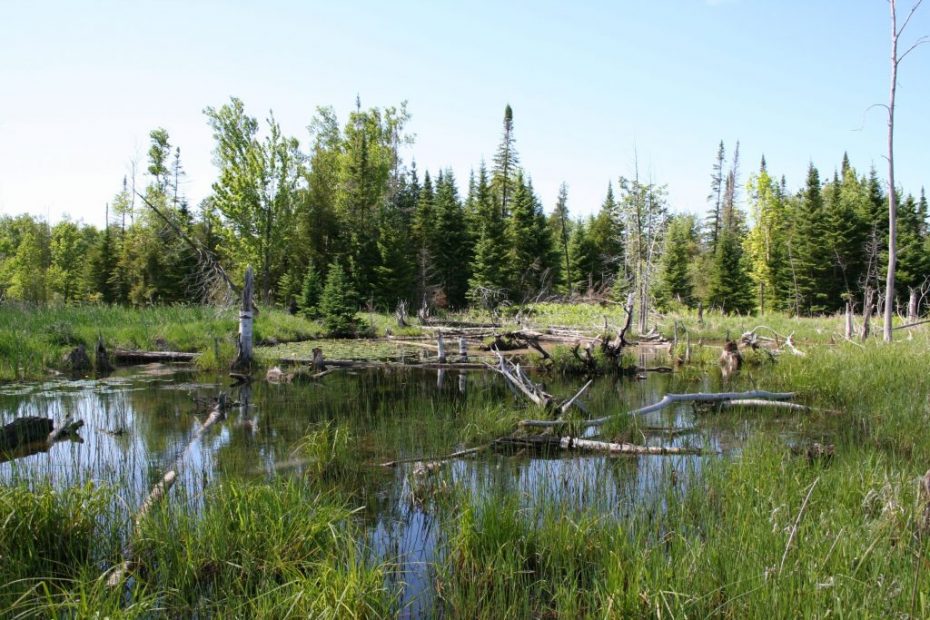
In spring 2025 staff visited the western side of the Peninsula to deploy cameras at Sauble Dunes Nature Reserve, and in spring 2026, additional cameras were added when the community came together to expand the nature reserve by 27 hectares, additional cameras were added. The 78-hectare Sauble Dunes Nature Reserve is a sanctuary of forested sand dunes and interdunal wetland. It borders the 168-hectare Chiefs Point Provincially Significant Wetland complex and contains a portion of the 764-hectare Sauble Falls North Area of Natural and Scientific Interest. Together, these features create a large contiguous natural area that is relatively uninterrupted by roads or other human disturbances.
Open wetland at Sauble Dunes Nature Reserve © Mark Carabetta
Lights, Camera, Action!
Within weeks, the cameras captured footage of otters, turkeys, a black bear, a coyote — and a bobcat! There have been previous sightings of Bobcats on the Saugeen (Bruce) Peninsula, but these were often unsubstantiated, and those that were confirmed were several years old.
Bobcats are medium-sized predators that occur across North America. Commonly confused with the lynx, they can be distinguished from by their distinctive tails which feature a white underside and a black top. Bobcats can travel great distances – up to 20 kilometers per day – but rarely maintain home ranges over 5 square kilometers. From this footage alone we can’t say for certain whether this bobcat is a permanent resident of Sauble Dunes Nature Reserve, or if it was just passing through. What we do know is that this nature reserve offers a linkage between natural areas across the peninsula, making it indispensable for wildlife such as bobcats.
While bobcats can survive in many climates, they require an abundance of habitat to hunt and survive. A well-connected and intact landscape is essential for bobcats and many other species to thrive.
Calero Creek Trail Bobcat © Don DeBold CC BY-SA 2.0.
Combating Habitat Loss and Fragmentation
Habitat loss and fragmentation are among the leading drivers of biodiversity loss in Ontario. Habitat loss is often addressed directly through conservation efforts – for instance, if a property is acquired by a land trust and protected in perpetuity, that habitat is effectively saved. However, preventing further fragmentation by roads, development, and other human factors can be just as important. Due to the fragmented nature of our landscapes, wildlife must often contend with development to access core areas of their home range.
This can lead to changes in home range size, increased mortality on roads, and in a worst-case scenario, local extinction, illustrated in a 2018 study about habitat selection by bobcats. They found strong habitat selection preference for forest habitat, as one might expect. However, they also found that movement speed increased >3x when that forest was adjacent to developed areas or agriculture. This demonstrates one way that human modified landscapes impact wildlife, and these impacts can be more significant on species with smaller home ranges.
Fortunately, the conservation and expansion of Sauble Dunes Nature Reserve and associated bobcat sighting are a conservation success story, and there have been many others in recent years.
For instance, Ontario Nature recently partnered with Garden River First Nation, the City of Sault Ste. Marie, Algoma Highlands Conservancy, and Central Algoma Land Trust to lay the groundwork for future conservation efforts by identifying, mapping, and ground truthing ecological connectivity between Lake Superior and Lake Huron. Another such example is the Algonquin to Adirondack Initiative, or A2A, which aims to protect a 300km ecological corridor from Algonquin Provincial Park to Adirondack State Park. Ontario Nature’s recently expanded Lost Bay and Gananoque Lake Nature Reserves represent a small portion of this corridor, protected in perpetuity.
Fostering connectivity and protecting our natural heritage is crucial to ensure that we safeguard these amazing species, now and in the future. We can certainly think of one animal that will be happy with these efforts!
Resources
Authors
Marcus Maddalena is Ontario Nature’s Nature Reserves Manager. He holds both a Bachelors and Masters of Environmental Studies from the University of Waterloo and a Diploma in Ecological Restoration and Rehabilitation. Marcus has extensive experience in the conservation and rehabilitation of rare species populations and their habitats.
Tharanya Ravikumaran is Ontario Nature’s Nature Reserves Stewardship Coordinator. Previously, she worked at Hamilton Conservation Authority, Toronto Region Conservation Authority and Ontario Streams. She has a B.A. in bio-resource management (majored in Environmental Management) from the University of Guelph and has completed the ecosystem restoration program at Niagara College. Tharanya is proficient at Ecological Land Classification, Ecological Monitoring and Assessment Network, habitat restoration, species at risk monitoring and invasive species management.