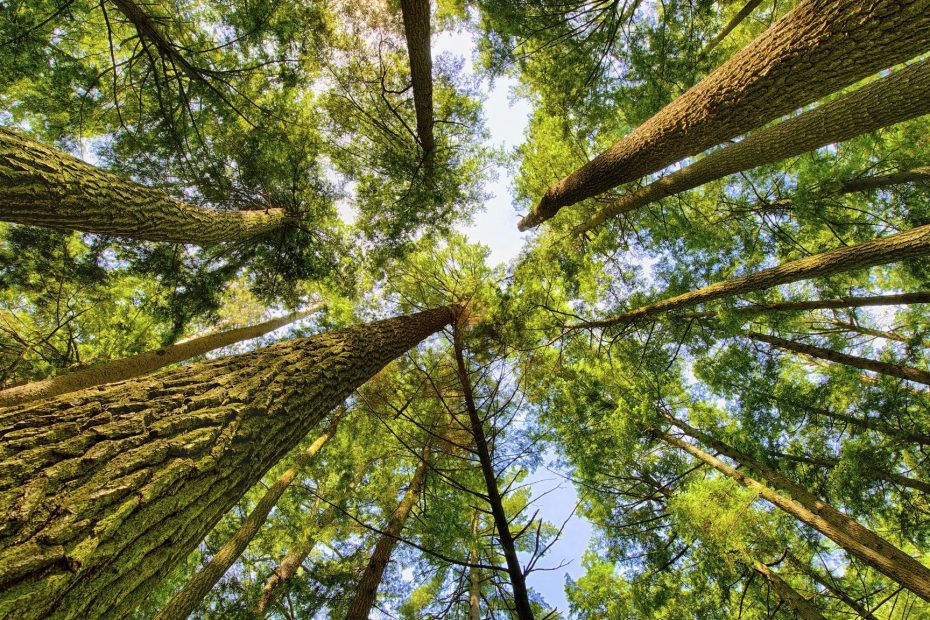
As conservationists, we often mourn the forests we never saw. Much of Ontario was once covered in old growth forest – ancient ecosystems with complex forest structure, large quantities of woody material, and unique types of habitats and nutrient cycling. Many of the trees in these forests would have been hundreds of years old, towering above the landscape.
Due to Ontario’s colonial history, the majority of its old growth was logged. Even today, Ontario’s remnant old growth forests are threatened by development and human activities. The value of these forests, however, is far more than just the size of their trees: The intricate architecture of old growth forests makes them excellent as habitat for wildlife and for carbon sequestration.
While much of Ontario has been logged, old growth areas still exist in isolated pockets, often as individual trees that were spared rather than large tracts of forest. Many of them remain today due to a combination of unsuitability for timber, the tireless work of a few dedicated naturalists, and in some cases, sheer luck. These small patches of old growth are valuable as both habitat and history in Ontario’s changing landscape. Alongside our supporters, Ontario Nature works tirelessly to steward remaining old growth trees across our nature reserve system.
Obabika old growth forest © Elvis Kennedy CC_BY-NC-ND_2.0
Thickson’s Woods Nature Reserve
In Whitby stands the last remnant of old growth pine forest on the north shore of Lake Ontario. These Eastern white pines provide crucial habitat for migratory birds crossing Lake Ontario. The survival of this rare forest – known as Thickson’s Woods Nature Reserve – is a testament to the hard work of the conservationists who fought for its protection.
Thickson’s Woods was slated for logging twice. The forest was originally reserved to make the masts for the sailing ships of the British Royal Navy but managed to escape destruction. In 1983, Thickson’s Woods was set to be logged again. The threat of logging spurred local naturalists into action. They formed Thickson’s Woods Heritage Foundation (later renamed to Thickson’s Woods Land Trust), a non-profit dedicated to preserving the local flora and fauna. In 2026, Thickson’s Woods Land Trust passed the torch to Ontario Nature, ensuring that the old growth forest and the species that depend on it will be stewarded in perpetuity.
Thickson’s Woods is a sanctuary to more than just wildlife. The property has a robust, transit-accessible trail network that has been enjoyed by the community for decades. Taking a walk along the Waterfront trail and exploring its many side paths, you too can enjoy the Eastern white pines that still stand today as a legacy of the region’s environmental protections.
Old growth forest at Thickson’s Woods Nature Reserve.
Kinghurst Forest Nature Reserve
Walking through the scenic Old Growth trail at Kinghurst Forest Nature Reserve, you may see ancient maples and beeches stretching far into the canopy. At over thirty meters in height, these trees are a significant part of the region’s natural heritage. Many of them are over 250 years old, making Kinghurst one of the oldest, least-disturbed deciduous forests in Southern Ontario. Located in Grey County, it stands as a monument to the importance of conservation.
This type of landscape is known as a “climax forest” — a stable community of plants that tends to remain unchanged. In younger forests, certain plant species may be overtaken by others that are more suited to the environment in a process known as “succession”. At Kinghurst Forest, where succession has reached its natural endpoint, we can expect that the canopy will be dominated by maples and beeches far into the future.
In the early twentieth century, the forest was owned by the Krug family, who selectively logged it for use in their sawmill. The Krugs did not log the maple trees and instead tapped them for maple syrup production. This decision resulted in the survival of a significant number of old growth trees, a rarity in Southern Ontario. This highlights the extent to which sustainable forestry practices can help to safeguard the environment.
Today, Kinghurst Forest Nature Reserve is a sanctuary for wildlife that requires extensive, connected forest habitat, such as the scarlet tanager.
Scarlet Tanager © Bill McDonald
Planning for the Future
While we cannot bring back trees that were logged, we can still work towards a future where Ontario is covered by connected, resilient old growth forest. Ontario Nature is committed to safeguarding its properties from logging and development forever. While it can take hundreds or even thousands of years for a forest to develop the canopy layers, understory, and ecological processes that define it as old growth, many of Ontario Nature’s reserves are well on their way to reaching this stage of their life cycle. Protected in perpetuity, all they need is time.