This Melbourne Home Is Cloaked In Greenery, Thanks To A Clever Roof
Architecture
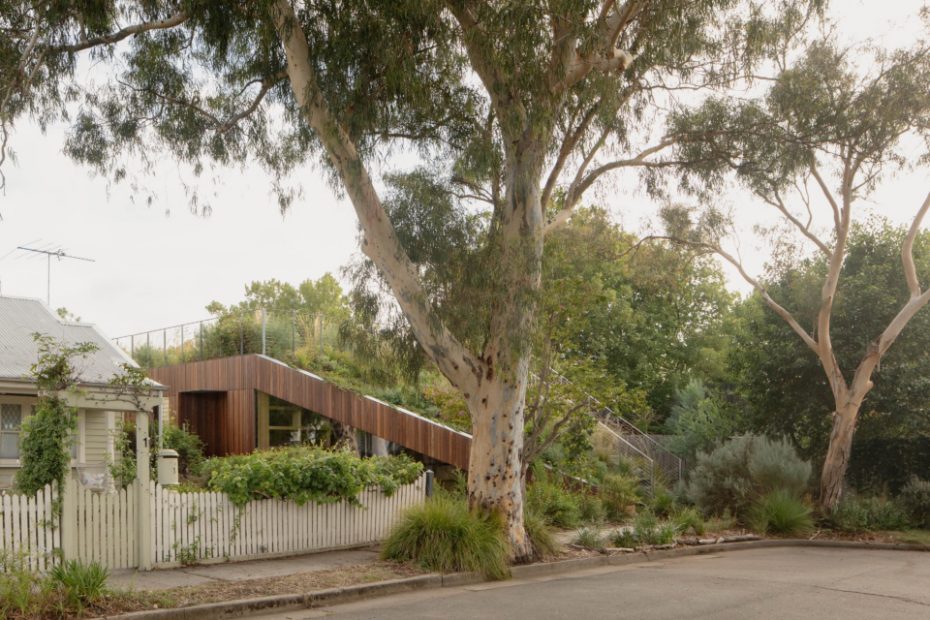
The side view of Bank Street reveals the sloping green roof.
The front of the house is slightly sunken below ground, achieving privacy without sacrificing light or outlook.
Tacchini Sessan sofa from Stylecraft. Plinth from SBW. Light from VBO Australia. Cowrie Chair by Ratio. Genoa rug by Armadillo. Artworks by Ksenia Shinkarenk and Ro Noonan.
A stainless steel island forms the centre of the kitchen. Chairs by Fomu. Large vessel by Fabien Capello, from Pan After. Bowls from Homu and Pan After. Vessel in cupboard by Beverly Berton, from Craft Victoria.
Timber joinery in the living space and bedrooms is profiled with a series of grooves to allow art and photographs arranged in ever-changing compositions.
Sliding timber panels can be moved to maximise daylight, shade, ventilation, and privacy.
The striking entry. Light by Sean Brickhill. Ceramic vessel by Alexandra Howie, Craft Victoria.
The front room is nestled below the sloping green roof. Side table from Great Dane Furniture. Light by Sean Brickhill.
Flos Glow ball by Euroluce. Bedlinen by Sutram.
Towels by Hommey. Candle holder by Nicholas Aylward. Candle by Tsu Lange Yor.
The roof functions as a 190-square-metre platform, elevated above surrounding fences and rooflines, offering uninterrupted views in all directions.
In a time when many suburban houses prioritise amenities like butler’s pantries, double garages, and even cinema rooms, this Northcote family home takes a more grounded approach. Literally and metaphorically.
The house itself is compact, defined by a singular palette of reclaimed timber. But the most spectacular feature is the sloping roof covered by a cascade of beautiful native planting that blurs the lines between nature and built environment.
It all started with the desire for a larger garden. The owners, a couple with three young children who’d lived on the site since 2012, approached architects Prior Barraclough in the hope of reimagining their home to be more environmentally responsive.
Most of all, they were seeking more green spaces, and a stronger connection to their cul-de-sac, which transforms ‘each afternoon and weekend into a lively communal space, animated by neighbourhood children.’
‘A lengthy design process was undertaken to explore retention of the existing house; however, it was ultimately determined that retaining the structure was not feasible,’ Prior Barraclough director Michael Barraclough says.
Instead, they designed a new 190-square-metre dwelling with a habitable green roof, effectively doubling the site’s usable outdoor space.
‘From above, the entire site now reads as a continuous, expansive garden,’ Michael says.
With no front fence, the house deliberately invites interaction with the streetscape, as stairs lead up to the rooftop platform elevated above surrounding fences and rooflines, offering uninterrupted views in all directions without the need for overlooking screens.
There was no formal landscape plan; the garden evolved organically in the care of the clients, who also carefully selected natives and vegetables to enhance biodiversity.
To accommodate the functions of the former two-storey house in just one level, the floorplan is efficiently arranged in a ‘dumbbell configuration’, comprising four modest rooms at the centre flanked by two larger living areas on opposite ends of the block.
The street-facing space is slightly below street level, creating a multi-functional zone with a sunken lounge that can serve as a library, study, entry gallery and occasional sleeping area for children’s sleepovers. Meanwhile, the rear contains an open-plan kitchen, living, and dining room, oriented towards the backyard.
‘The design deliberately resists several suburban conventions typically included in an architectural brief: there is no ensuite for every bedroom, no walk-in pantry, no garage, and no front fence. Instead, the architecture privileges openness, restraint, and community connection over domestic excess’, Michael says.
This ethos also extends to the impeccable interior detailing. From floor to ceiling, the interiors are lined in various timber profiles, forming integrated pulls, hooks, shelving and desks, in addition to large sliding panels — a detail that required extensive testing and development.
‘One of the greatest challenges was developing the operable facade system for the east and west elevations. The system consists of sliding timber-lined panels, seamlessly integrated into the east and west facades, which provide nuanced control of light, ventilation, and privacy,’ Michael says.
These thoughtful elements combine to create something masterful: a home that stays cool in summer, warm in winter, and is inextricably connected to its environment.