How This Family Turned Their Victorian Era Home Into A Sustainable Sanctuary
Interiors
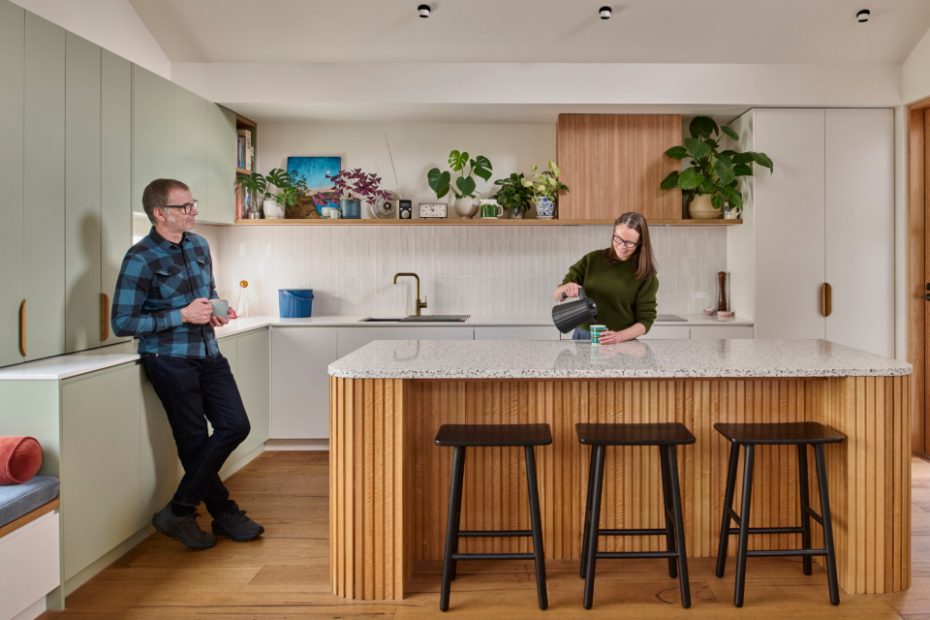
Homeowners Michael Weldon and Michelle Bennett in their Seddon family home of 20 years.
Terrazzo tops the kitchen island bench.
The Victorian house has been transformed with a new extension, all-electric appliances, and even low-VOC interiors.
New double-glazed windows overlook the backyard.
The extension was designed to maximise natural sunlight, minimising the need for artificial heating.
The view into the new open-plan dining and kitchen.
A salon-style gallery wall adds character to the lounge room.
Energy efficient double-glazed windows ensure thermal comfort in the front bedrooms, year round.
New split-system units help efficiently heat and cool the home.
Low-flow shower heads and taps were installed throughout.
The cosy bedroom.
The house is now powered primarily by a 7.055kW solar panel array and an 8.28kWh battery.
‘We’re saving between $2000 and $3000 a year when you take the savings from solar and rainwater into account,’ Michelle says.
The couple say the renovation has been a huge improvement.
It took 20 years for the sustainable transformation of this double-fronted Victorian to come to fruition.
Michelle Bennett and illustrator Michael Weldon bought their house in Seddon back in 2004. The property was in bad shape, but it was in a great location, and there was an overarching ‘good energy’ that compelled them to make it their family home.
‘We renovated it straight after buying, but we didn’t have much of a budget at the time so we couldn’t do all of the things we would have liked to do, like double glazing,’ Michelle says.
For the next two decades, the family grappled with a few flaws, namely due to the home’s comfort and energy performance. Poor insulation meant it often felt cold, forcing them to run up a hefty gas bill in winter. The foundations had also shifted, creating further draughts and dust that filtered through cracks between doors and window frames.
By 2020, Michelle and Michael decided it was time to upgrade their elegant house, approaching designers Altereco and Nido Building Group for the project.
The brief was to add all the things they missed the first time around: double glazing, all-electric appliances, solar panels, and extend the house for a bit more space for entertaining in the kitchen and dining room.
‘We wanted to do our bit for the environment and also reduce our energy bills,’ Michelle explains.
As with many sustainable renovations, the transformation was extensive. Beyond the charming facade, the front two rooms were retained and retrofitted with new insulation and floorboards.
However, the rest of the building had to be rebuilt, embracing passive house principles that helped bring the house’s original 2.3-star NatHERS rating to an impressive 6.8 out of 10 — impressively close to the minimum standard of 7 that’s now expected for brand new builds in Victoria.
This process also inspired the family to go one step further, installing a home battery: ‘We were already having so much work done, we thought we may as well get it all done in one go. Although it was expensive, we’re really glad we got the battery, mainly because it allows us to power our home almost entirely by the sun,’ Michelle says. ‘We’re saving between $2000 and $3000 a year.’
The more surprising bonus is how the home’s atmosphere has changed. Michelle and Michael were surprised at just how quiet and peaceful the interiors have become, thanks to the new double-glazed windows and insulation. Best of all, it’s comfortable now in every season, aided by ceiling fans and efficient split-system air-conditioning units.
‘For much of the year, we don’t even need to turn the heating or cooling on. And when we do, often one unit is enough for the entire house,’ she says.
There can be a sense of trepidation about the varying levels of success when embarking on a sustainable renovation of an older house. But for Michelle, Michael and their daughter Jeannie (16), it was well worth the wait.
‘If you have the time, energy and means, I’d say just go for it,’ she adds.
‘I found the process daunting at times, but I’m so glad we made the change. It’s definitely improved our lives.’
Learn how to electrify your home with AGL’s Electrify Now™ tool. Estimate your potential savings on energy bills or running costs and find out about available rebates, payback period and connect with their trusted installer network.
Disclosure: AGL did not supply the products or services featured in this article. The energy savings and outcomes described reflect this household’s specific renovation, system size tariff and usage, and individual results will vary.