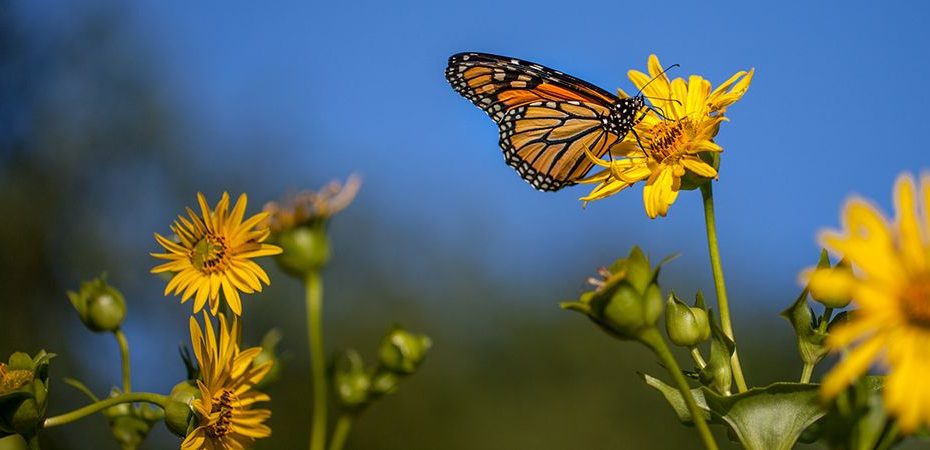
As spring unfolds and summer draws nearer, many migratory species are making their way back to Ontario. One such species is the iconic monarch butterfly. Their long journey is a multi-generational undertaking: while it typically takes only one generation to make the southward journey in fall, it takes several generations for monarchs to make their way back to their breeding sites in the spring. Read on to find out commonly asked questions and answers about this beautiful species.
Where can I see monarchs in Ontario?
Monarch butterflies can be found throughout southern Ontario, typically between late May or early June and mid to late September. The monarch population in Ontario represents one of two subpopulations with different migratory routes. The group present in Ontario travels between overwintering sites in central Mexico and breeding sites across the eastern US and southern Canada. Another group migrates between overwintering sites along the Pacific coast in California and breeding sites in the US and Canada west of the Rocky Mountains.
Monarch on cupplant © Diana Troya
Sadly, fewer and fewer butterflies are making their way back to our gardens each year, as decades of declining numbers reveal a precarious situation for the monarch. The direst threats to monarchs involve habitat destruction in their overwintering sites in the Oyamel Fir forests of central Mexico, but they face a myriad of threats throughout their breeding sites in the United States and Canada as well.
Mating monarch butterflies © Joe Crowley
Are monarchs endangered in Canada?
A 2016 assessment by the Committee on the Status of Endangered Wildlife in Canada listed monarchs as Endangered and in December 2023, they were officially uplisted from Special Concern to Endangered under the federal government’s Species at Risk Act. In Ontario, however, which represents approximately 19% of the Canadian population, monarchs are listed only as Special Concern. This means that while harming or collecting monarchs on federal land is prohibited, the species is offered no provincial protection for the individuals or their habitat.
Monarch caterpillar and common milkweed © Noah Cole
What do monarchs eat?
There are several ways we can all help monarchs. One of the best things you can do is provide them with food by planting native plants. Monarch butterflies lay their eggs on milkweed, which is the sole food source for caterpillars. Adult butterflies depend on native wildflowers for nectar, so adding these to your garden can provide them with a food source too. Gardens full of native plants are not only more ecologically friendly, but also require less water and maintenance than traditional grass lawns.
Are pesticides harmful for monarchs?
You’ve likely heard of the lethal effects neonicotinoids can have on bees, but these pesticides are dangerous to monarchs too. A 2021 study by the University of Guelph found that milkweed planted near neonicotinoid-treated crops were linked to reduced survival rates for butterflies. While Health Canada has some risk mitigation measures in place, continued advocacy for tighter restrictions is crucial for protecting monarchs and other pollinators.
After feeding on milkweed, growing, and molting for about 9-15 days, the monarch caterpillar pupates and becomes a chrysalis. Another 9-14 days later, a fully developed adult butterfly will emerge © Chris Turner
Monarch chrysalis © Chris Turner
Is it illegal to raise monarch butterflies?
Rearing monarch caterpillars may seem like a good way to help protect them, but capturing and rearing is prohibited without a permit from the Ministry of Natural Resources and Forestry. Instead, consider planting milkweed in your garden to attract monarchs, but leave them be and delight in being able to witness their fascinating life cycle. However, if you’re still interested in rearing caterpillars, you can join the Toronto Entomological Association (TEA) and request to be added as an assistant under TEA’s permit.
You can also help monarchs by participating in a community science effort led by the David Suzuki Foundation called Butterflies in My Backyard. To join please fill out the application form by April 12, 2024.
Keep a lookout for monarchs as they make their way back to Ontario this spring, and learn more about our campaign to protect pollinators here: ontarionature.org/campaigns/pollinators
Resources
The post Monarch Butterflies in Ontario and How You Can Help appeared first on Ontario Nature.